





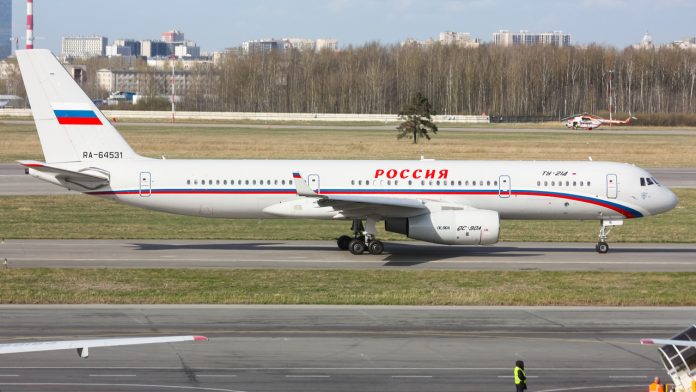
As tensions between the United States and Iran in West Asia continue to cause deep global concern, a strategic decision by Russia has sent shockwaves through international politics. Extending direct support to Iran, Russia has dispatched one of its most advanced and secretive airborne command aircraft, the Tu-214PU, to the Iranian capital, Tehran.
According to live flight-tracking data that surfaced on Monday, July 13, 2026, the Russian “Doomsday” aircraft landed safely at Imam Khomeini International Airport in Tehran. Operated by the Rossiya Special Flight Squadron under the callsign “RSD420,” the aircraft reportedly reached Iran via a route over the Caspian Sea, avoiding other regional airspace.
Although neither Russia nor Iran has officially disclosed the purpose of the aircraft’s arrival, the move carries immense significance given the nearly five months of war-like conditions in West Asia. Moscow’s decision came immediately after Tehran announced that the United States had struck its military bases in Iran the previous Sunday, appearing to signal Russia’s open assurance of protection to Iran.
The Tu-214PU, known as “Punkt Upravleniya,” is one of the most heavily secured airborne command-and-control aircraft used by the Russian government. Unlike ordinary passenger aircraft, it is specifically designed to allow governance to continue from the sky and military forces to be directed even during extreme crises or doomsday-like emergencies, functioning in a manner similar to the US President’s “Air Force One.”
The aircraft is equipped with highly sophisticated encrypted communication systems, anti-jamming technology, secure satellite links, and airspace control systems. Even in the event of a severe nuclear detonation on the ground or the complete destruction of communication networks, the country’s president, defence minister, and top military commanders can continue to travel aboard this aircraft while overseeing strategic missile launches and military operations.
To protect those on board from the dangers of nuclear radiation and electromagnetic pulses (EMP), the aircraft’s structure, apart from the cockpit, has been built without any windows. It also features specialised mid-air refuelling capability, giving this doomsday aircraft the extraordinary ability to remain airborne continuously for several days without needing to land.
Amid intensifying attacks by the US-Israel coalition on Iran’s air defence systems and missile bases, this aircraft is expected to strengthen surveillance over Iranian airspace. It is likely to prove highly useful in providing real-time satellite data and in alerting Iran’s air defence systems in advance whenever enemy aircraft or missiles approach.
The deployment of this aircraft by the Rossiya Special Flight Squadron, which exclusively transports Russia’s top political and military leadership, is seen as part of a larger diplomatic strategy. Defence analysts believe it could serve as a strong platform for high-level military consultations between Russia and Iran and for the implementation of emergency joint defence plans. Although exact numbers of these Tu-214PU aircraft, previously seen repeatedly in Russian airspace during the Ukraine war, remain unknown, its arrival in Tehran amid the current Gulf crisis is being viewed as a firm warning from Russia to the United States and its allies. Despite earlier ceasefire announcements, continued US-Iran strikes and counterstrikes have turned West Asia into a tinderbox, and the entry of a nuclear-resilient Russian “Doomsday” aircraft into this volatile situation has heightened international fears that the crisis could spiral toward a third world war.