





India’s aviation sector is witnessing unprecedented growth, with airports operating at full capacity and the skies more crowded than ever. Increased public awareness and rising preference for air travel have significantly boosted passenger numbers, bringing substantial revenues to airlines. However, despite this expansion, the industry continues to face deep-rooted challenges. The recent disruptions involving IndiGo, which affected lakhs of passengers, have once again highlighted the sector’s vulnerability. Industry experts note that the problem is not limited to one airline, as several carriers have struggled or shut down over the years.
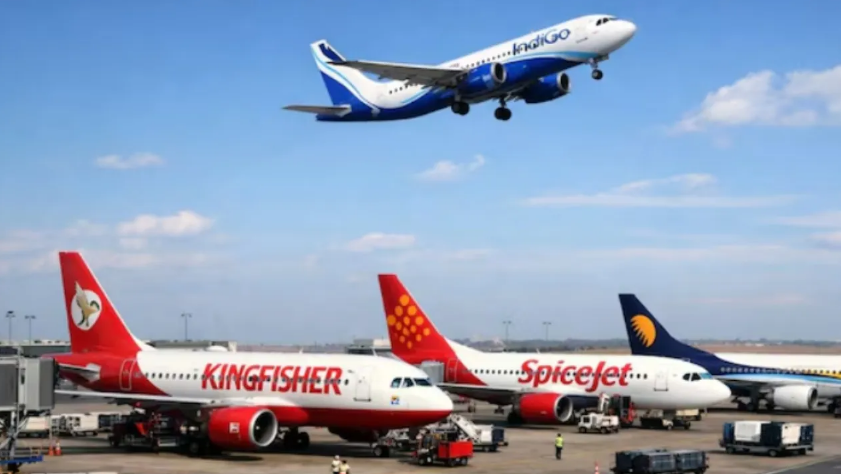
Once-prominent airlines such as Kingfisher Airlines, Jet Airways, Air Deccan, Paramount Airways, and Go First were major players in Indian aviation. While some positioned themselves as luxury carriers and others focused on low-cost travel or regional connectivity, most expanded rapidly in their early years. Full flights and quick growth initially masked underlying issues, but financial stress, regulatory pressures, and management challenges eventually led to their collapse. Analysts point out that these failures were gradual and structural rather than sudden.
Experts argue that operating an airline in India is far more complex than launching one. While market entry may be relatively easy, sustaining operations is extremely difficult due to entrenched systems of control and regulatory hurdles. New entrants often find it hard to scale and survive, and even those that manage to challenge the status quo tend to struggle within a short period. Many of the airlines that failed in the past encountered similar obstacles.
Despite being one of the world’s fastest-growing aviation markets, India remains a tough environment for airline profitability. Annual passenger traffic has crossed 200 million, new airports are under development at Navi Mumbai, Jewar, Goa, and other regional hubs, and airlines have placed orders for more than 1,900 aircraft. While these indicators signal long-term confidence, instability within the sector persists. Over the last three decades, dozens of Indian airlines have shut down, suggesting that market structure, not just management inefficiencies, plays a significant role.
India’s aviation market is also highly price-sensitive. According to industry experts, high demand does not necessarily translate into high profits, as airlines often operate at full capacity with thin margins. A large section of passengers continues to rely on railways, especially on short routes, forcing airlines to keep fares low to remain competitive. However, the high cost of flight operations makes it impossible to match rail fares consistently, creating sustained financial pressure.
Adding to these challenges are high operating costs, particularly the heavy taxation on Aviation Turbine Fuel, one of the highest globally. Fuel costs are beyond the direct control of airlines and cannot always be fully passed on to passengers due to intense competition. Shortages of pilots and engineers, along with supply chain delays from aircraft manufacturers, have further strained operations. Experts conclude that unless structural issues are addressed, Indian airlines will continue to face turbulence despite the sector’s rapid growth.