





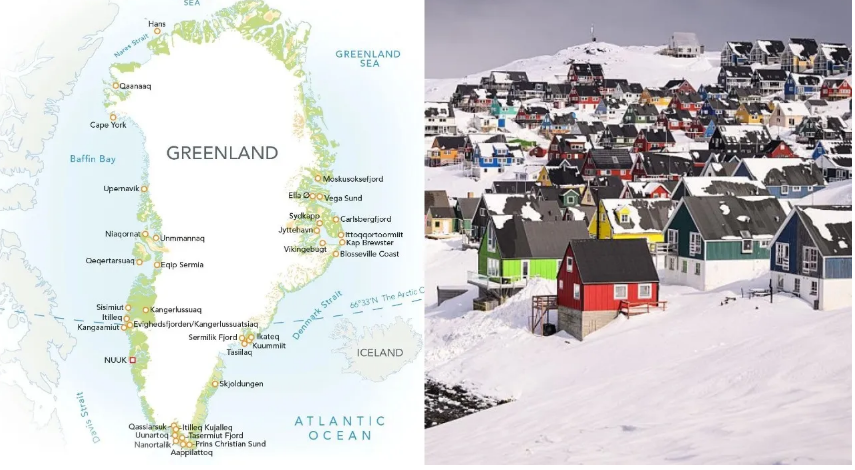
US President Donald Trump has repeatedly raised the issue of Greenland, asserting that the United States would take action, if necessary, to ensure the island’s security. Trump has indicated that Washington is determined to bring Greenland under its control, even suggesting that the US would not hesitate to use economic or coercive measures if negotiations fail. His remarks have sparked global debate over America’s strategic intentions in the Arctic region.
According to Trump, the primary concern driving US interest in Greenland is the growing presence of China and Russia. He has warned that if the US does not act, Beijing or Moscow could establish a strong foothold on the island, posing a direct threat to American national security. Trump has also claimed that Russian warships, Chinese naval vessels, and Russian submarines are already operating around Greenland, underlining the strategic risks involved.
From a military perspective, Greenland holds significant importance for the US and NATO. The Thule Air Base plays a critical role in missile defence and space surveillance, enhancing early warning and defence capabilities. Economically, Greenland is rich in rare earth minerals such as lithium and uranium, which are vital for electric vehicles, renewable energy technologies, and advanced manufacturing. US officials believe China is seeking to dominate these resources, prompting Washington to act pre-emptively.
Greenland is the world’s largest island and an autonomous territory within the Kingdom of Denmark, enjoying self-rule since 2009. Its location between North America and Europe, within the Arctic Circle, has gained renewed importance due to climate change. Melting ice has opened new shipping routes and exposed vast reserves of oil, gas, and rare minerals, intensifying competition among global powers for influence in the Arctic.
The US has maintained a military presence in Greenland since World War II and continues to operate its base there under NATO arrangements. Studies indicate that Arctic sea ice is melting rapidly, raising the prospect of an ice-free Arctic Ocean within this decade. Such a development would significantly boost shipping activity and resource extraction, further increasing geopolitical rivalry in the region.
India, too, is closely watching developments in the Arctic. Anticipating increased commercial and strategic activity, India established its first Arctic research station, Himadri, in Svalbard, Norway, in 2008. With rising competition between major powers in the Arctic, experts believe the region will play an increasingly central role in global geopolitics in the coming years.