





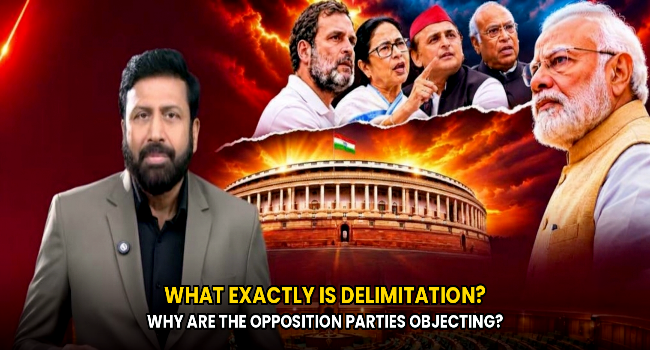
. Ravi Prakash

If everything happens because of Gyanesh Kumar, the country will face even greater hardship. They were not satisfied with stealing votes. This government has now come to steal seats. In the Lok Sabha it is 42, and in Telangana, Assembly constituencies would go from 119 to 179. In Andhra Pradesh, they would go from 175 to 263.
What the Bill Does and Why It Is Contested
Why is there such a big controversy over this delimitation bill? Just imagine: Uttar Pradesh, with 80 seats, gets a huge jump. Telangana goes from 17 to 26, Tamil Nadu from 39 to 59 and Kerala from 20 to 30. The map of Indian politics is being redrawn with heavy, powerful marbles. The Centre has cleared the delimitation bill to be taken through Parliament. The opposition is asking the obvious questions. Is the Centre proposing only a 50 per cent increase, or will the political balance between states in Parliament change? Will the southern states’ representation be protected? Who will decide the new constituencies? Why is women’s reservation being tied to delimitation? The bill is being opposed because of the uncertainty over what happens to all the seats. The real issue is how many Lok Sabha seats each state should have, and that decision directly determines what representation people get in Parliament.
For decades, the number of Lok Sabha seats has not been increased. Why not? Political and population-related reasons lie behind the limit. Some states successfully controlled population growth through education, development and family planning, while in others it remained high. Had seats been increased according to population, the high-growth states would have gained more. That is why the 84th Constitutional Amendment of 2001 froze the allocation until the population figures of the first census after 2026 are published. Now only the constituency boundaries within states are to be redrawn on the basis of the 2011 census.
The Union Cabinet has approved a package of laws, including the Constitution (132nd Amendment) Bill, 2026 and the Delimitation (No. 2) Bill, 2026. Their aim is to increase the Lok Sabha seats allotted to each state by 50 per cent. The Lok Sabha has 543 seats today, and if this is implemented the number moves to about 816. Look at how many seats each state could gain. Uttar Pradesh goes from 80 to 120, West Bengal from 42 to 63, Tamil Nadu from 39 to 59, Karnataka from 28 to 42, Gujarat from 26 to 39 and Rajasthan from 25 to 38. Assam and Jharkhand go from 14 to 21 each, Punjab from 13 to 20 and Haryana from 10 to 15. Madhya Pradesh has 29 at present. These are only proposals.
The government has also built in another key provision. Until the population figures of the census held after 2026 are published, each state keeps its present share of Lok Sabha seats. Put simply, every state’s seats go up, but the ratio of seats between states does not change. Even so, this delimitation bill is the biggest danger hanging over our country.
Gerrymandering and the Women’s Reservation Row
That is gerrymandering. This map is a very clear example, with the red areas visibly increasing. These are the mandatory constituencies of the country. If one seat holds eight people today, the government can give those eight two or three seats. As of November 29, 2026, the last complete nationwide census figures are from 2011. The second question is who will control the Delimitation Commission. The Centre’s design is for the commission to be headed by a former Supreme Court judge, with the Chief Election Commissioner and the concerned state election commissioners also on it.
The Nari Shakti Vandan Act of 2023 promises 33 per cent reservation for women in the Lok Sabha and state assemblies. Its implementation has been twisted into the census and delimitation process, and in the name of women’s reservation, the present 543 seats were taken as the basis for reserving seats for women. People are asking why the entire political system of the country must be changed on such a massive scale for that. The Samajwadi Party demanded reservation for OBC women as representation for castes, and the rights and quota of OBC women were discussed in this exercise.
The South’s Case and What Happens Next
The real question is the second one: the southern states are arguing strongly that they should not lose their political importance for having successfully controlled population growth. Tamil Nadu and Kerala, in particular, have raised their voices strongly. When the Government of India began thinking, around 2020, that a census would be held and delimitation would follow, the first party in the country to raise its voice was the BRS. Our stand was clear: we implemented population control effectively, and now we are being made to suffer for it. Today the seat count would fall. Of the 543 seats, South India holds 129, which is 24 per cent.
South India must not be penalised. If delimitation is done on the basis of census and population, the Government of India would in the end only be following our suggestion. The Centre has now come forward with a proposal to distribute 50 per cent more seats to every state, giving every state priority. Tamil Nadu goes from 39 to 59, Kerala from 20 to 30, Karnataka from 28 to 42 and Andhra Pradesh from 25 to 38. So the proposal for new seats is neither only for the South nor only for the northern states. Seats are being increased in all states, and the ratios between states remain. Is Tamil Nadu’s share of seats falling? No. Andhra Pradesh Chief Minister N. Chandrababu Naidu has also backed the 50 per cent increase. The southern states were part of an earlier bill too, so this is not the first attempt. A special majority is genuinely required, which is why that bill fell through. The representation of states may be affected, and there is no clear guarantee on any state’s share of seats.
Parliament’s session begins on November 30. The Cabinet has given its approval, but this has not yet become law. That is what is about to happen now. In Parliament, there is the Constitution amendment bill, along with another related bill to bring in women’s reservation by the 2029 Lok Sabha elections. What happens to these bills in Parliament, and the implementation process that follows, will decide the final outcome.
Delimitation is not just about the number of MPs. People, from the public up to Parliament, must have representation, and every state must have strength. The results of future elections will affect those in power. The Centre says its aims are the distribution of representation, equality among states and implementing women’s reservation first. The question is whether, to protect democracy and fight these culprits, they will steal and then ask for votes. Mark my words: delimitation will cost them. The longer they delay their defeat, the bigger their problem will be. The anger is growing, a terrible anger.