





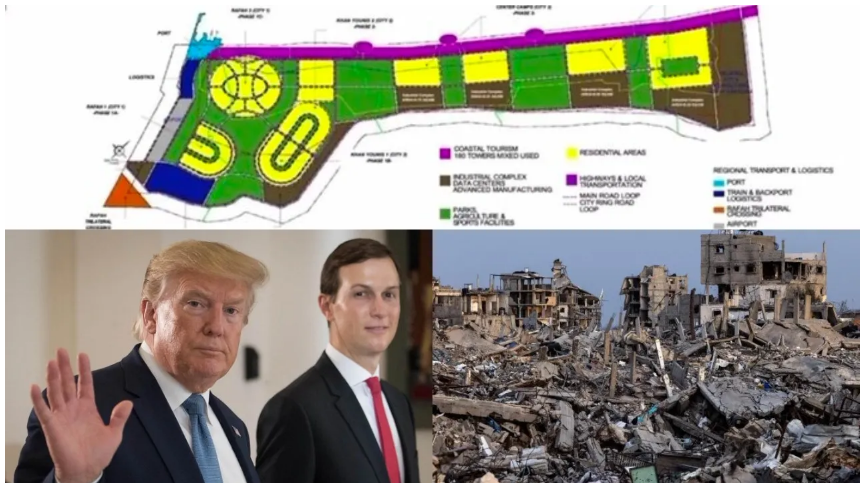
Washington/Davos: US President Donald Trump and his son-in-law, Jared Kushner, have unveiled a controversial master plan for the post-war reconstruction of Gaza, sparking international debate. The plan, presented at the World Economic Forum in Davos, proposes transforming Gaza into a major economic and tourism hub.
According to the proposal, Gaza would be divided into four main zones: Rafah, Khan Yunis, Central Camps, and Gaza City. The new development includes over 100,000 homes in Rafah alone, along with 200 educational institutions, 180 cultural, religious, and professional centers, and 75 hospitals.
The plan aims to create a luxury coastal tourism area with high-rise residential towers, hotels, villas, commercial buildings, smart manufacturing zones, data centers, parks, and sports facilities. Modern infrastructure projects, including a new airport, a major port, and upgraded road networks, are projected to boost Gaza’s GDP by $10 billion.
The reconstruction strategy also emphasizes security and demilitarization. Hamas is expected to relinquish weapons, with security oversight provided by the American-backed National Committee for Gaza Reconstruction (NCAG). A “Board of Peace,” chaired by Trump and including former US Secretary of State Marco Rubio, former UK Prime Minister Tony Blair, and World Bank President Ajay Banga, will oversee the initiative. Representatives from 19 countries endorsed the plan at Davos.
While proponents highlight the plan’s potential to create jobs and revive Gaza’s economy, human rights organizations and Palestinian advocates have raised concerns about population relocation, transparency, and the withdrawal of Israeli forces. Reports also suggest that $1 billion from frozen Russian assets, linked to the Russia-Ukraine conflict, could be redirected to support the reconstruction.
Experts caution that the ambitious plan faces significant logistical, political, and security challenges, and its successful implementation remains uncertain.