





-Ravi Prakash
Rahul Gandhi lacks discipline. Rahul Gandhi lacks dignity. Rahul Gandhi lacks the experience required to lead a country like India. Rahul Gandhi is not an alternative to Narendra Modi. The Gandhi family did not weaken Narendra Modi; rather, the Gandhi family has made Narendra Modi even stronger.
If Rahul Gandhi is truly that incompetent, why does everyone talk about him so much? If leadership experience is the only metric, what was Barack Obama’s experience before he became the President of America? And before becoming the Prime Minister, what was Narendra Modi’s international experience? We cannot say that they are the sole reason for India’s political shifts and right-wing victories. Behind the rise of the BJP, there are Mandal politics, regional parties, economic liberalization, the RSS network, changes in the media sector, as well as shifting social equations. The real question is not about Rahul Gandhi. The real question is about ‘Hindutva’. The real question is: Does the opposition have an alternative vision for India or not?
Why have historians, journalists, political analysts, and senior Congress leaders suddenly engaged in such an intense debate over Rahul Gandhi? Can Rahul Gandhi really not take on Narendra Modi? Has the Gandhi family become the biggest weakness for the Congress? Or are critics like Ramachandra Guha oversimplifying this complex political narrative?
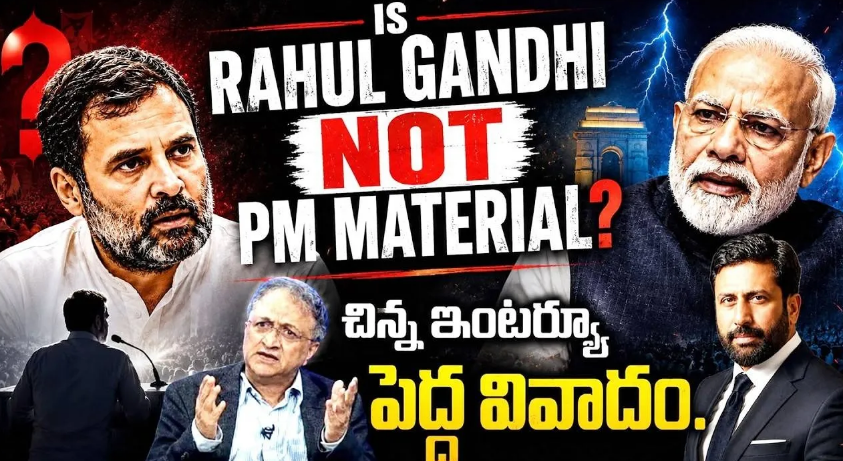
Over the past few days, a single interview has sparked a massive debate that goes far beyond just one politician, one family, or one party. Hidden behind this controversy is the biggest political question India faces today: If not Rahul Gandhi, then who? If not the Congress, then what? This is the story of how a single interview triggered a nationwide debate.
The person responsible for this controversy is not a BJP leader. He is not a Congress leader. He is not a TV anchor, nor is he even a political strategist. The man at the center of this debate is India’s highly respected historian and intellectual, Ramachandra Guha. That is why his comments created such a political earthquake. Guha has never been a supporter of the BJP. In fact, for years, Guha has been one of the sharpest critics of the Narendra Modi government. He has continuously written about the weakening of institutions under the BJP regime, the decline of democratic values, rising majoritarian politics, and the shrinking space for dissent and freedom of expression.
When someone like Ramachandra Guha criticize Rahul Gandhi, people listen intently. When he stated that the Gandhi family has actually helped Narendra Modi consolidate his power, the political world was caught completely off guard.
This controversy began with an interview Guha gave to The Wire. Following that, he articulated those arguments in greater detail in a column for a prominent newspaper. Together, that interview and article kicked off a massive storm. This was because Guha did not just offer standard political criticism; his argument questioned the very foundation of Congress politics. Let us clearly understand what Guha actually said—looking past the headlines and the subsequent social media reactions to examine the core matter. If we do not properly understand Guha’s argument, we will not understand why so many people opposed and attacked him.
An interesting aspect of this critique is that Guha did not completely dismiss Rahul Gandhi’s achievements. In fact, he acknowledged that the Bharat Jodo Yatra helped completely transform Rahul Gandhi’s image. For years, his opponents portrayed Rahul Gandhi as a leader disconnected from the public, a privileged politician, and someone lacking seriousness. However, the Bharat Jodo Yatra changed that image.
The entire country watched Rahul walk across the nation. Everyone observed him meeting ordinary people, listening to their problems, and interacting with laborers, students, social activists, and farmers. Even his critics ultimately conceded that this yatra earned Rahul a brand-new political credibility.
Yet, in Guha’s view, the Congress squandered that momentum. Why? Because immediately after the 2024 elections concluded, the Congress reverted to its old habit of prioritizing reliance on the Gandhi family. Instead of capitalising on that moment to democratize leadership and bring a new generation of leaders to the forefront, the Congress once again began revolving around the Gandhi family. Guha argues that this is proof that no matter how many blows the party takes or how many golden opportunities it receives, it has still learned nothing.
This is the most central point in Guha’s argument. He believes that instead of functioning like a modern political party, the Congress operates today like an enterprise controlled by a single family. What evidence does he offer for this? The prominence given to Rahul Gandhi, the growing role of Priyanka Gandhi, the continuing influence of Sonia Gandhi, and the failure of non-Gandhi leaders within the party to emerge as credible power centers.
Guha asserts that this reliance on the family hurts the Congress in two ways:
First, it damages internal competition within the party.
Second, it hands the BJP a perpetual opportunity to criticize the Congress as a ‘dynastic party’.
Guha opines that every time the Congress prioritizes the Gandhi family, it validates the BJP’s narrative.
However, Guha’s most controversial remarks were yet to come: *Rahul Gandhi is not a credible alternative to Modi!* This is the exact comment that caused an explosion on social media. Guha argued that Rahul Gandhi still does not appear to be a strong alternative to Narendra Modi. According to him, Rahul Gandhi possesses three core weaknesses:
1. Lack of a consistent political vision: Guha acknowledges that Rahul Gandhi frequently raises important issues—whether it is unemployment, the Election Commission, the autonomy of institutions, or economic distress. However, Guha argues that these movements and struggles lack long-term consistency and stability. He states that modern politics requires tireless, daily organizational effort. That is what political parties do every day, but he feels Rahul has often failed to demonstrate that level of consistency and stamina.
2. Lack of gravitas (dignity): Regarding the second criticism, Guha believes that Rahul sometimes relies too heavily on mere symbolism. While public interactions, posing for photos, tours, and affable behavior catch public attention, Guha expresses doubt over whether these translate into long-term political advantages.
3. Lack of administrative experience: Then comes the third and most controversial point—experience. Guha asks a simple question: What significant administrative responsibility has Rahul Gandhi handled so far? He has never served as a Chief Minister. He has never held a cabinet post. He has not run a ministry, nor has he governed a single state. Therefore, Guha argues that when Rahul is presented as a future Prime Minister, a credibility gap emerges. Whether one agrees or disagrees, this was Guha’s argument, and these specific comments provoked severe reactions.
The criticisms and comments by Guha mentioned so far are quite common. The actual controversy is bigger than this. It is not just about Rahul Gandhi; it is about the Gandhi family itself! According to Guha, Narendra Modi and Amit Shah are undoubtedly responsible for the rise of the BJP and its capture of power. However, the Gandhi family and the culture surrounding them played a main role in making that rise much easier. In other words, Guha’s argument is that Rahul Gandhi is only a small part of the problem; the core issue is the continuation of the Gandhi family itself. At that point, this discussion ceased to be just a debate about Rahul Gandhi’s leadership and turned into a national controversy. The question is no longer “Can Rahul Gandhi defeat Narendra Modi?” The question has become: “Has the Gandhi family inadvertently helped Narendra Modi become even stronger?” This allegation met with fierce resistance from journalists, intellectuals, and Congress leaders.
The essence of that counter-argument is: “Forget Rahul Gandhi for a moment. Forget the Gandhi family. Forget the dynasty. Your very question is wrong.” This perspective comes from writer and lawyer Saryu Pani. Unlike other responses, her critique is not just about history; it is about ideology. One of the sharpest observations Saryu Pani made was pointing out a contradiction in Guha’s argument.
Let us understand it simply. According to Guha, the Gandhis are politically incompetent. They are unable to stop Narendra Modi and have repeatedly failed to revive the Congress. Yet, at the same time, Guha argues that they are blocking a strong alternative from rising within the party. This is where Saryu sees a contradiction. If the Gandhis are truly that weak, incompetent, and powerless to defeat Modi, why has a better alternative failed to overthrow them and rise to the top? Why would it be impossible to replace a weak leader? How can a weak family dictate terms to the entire political system?
According to Saryu, Guha never fully answered this question. From there, she moved toward a larger argument. Why are we talking about Rahul Gandhi? According to Saryu, focusing excessively on Rahul Gandhi might be part of the problem. The real political story of the past decade is not about an individual; it is about the rise of an ideology—an ideology that has transformed Indian politics, restructured public consciousness, and changed the way millions of people understand their identity, history, and country. In other words, the real issue is ‘Hindutva’. If that is the real issue, focusing excessively on Rahul Gandhi risks making us blind to the massive shift happening around us.
Saryu argues that the rise of Hindutva cannot be explained merely through leadership failures or the mistakes of the Congress, nor can it be confined to Rahul Gandhi’s strengths and weaknesses. Instead, she contends that a deeper process is at play. Over the years, political, cultural, and historical narratives have shifted. The internet has transformed political communication, and social media has altered political equations. Through all of this, Hindutva has succeeded in creating a powerful emotional bond with a vast number of voters. She argues that this shift is far bigger than any single political family.
This brings Saryu to a stark conclusion. Perhaps the biggest challenge facing the Congress today is not leadership; perhaps it is ideology. Think about it for a moment.
Suppose Rahul Gandhi steps away from politics tomorrow. Suppose Priyanka Gandhi steps down too, and the Gandhi family completely vanishes from active politics. Will all of the opposition’s problems be solved automatically? Will it automatically reduce the BJP’s influence? Will it automatically weaken Hindutva? According to Saryu, the answer is ‘no’.
The challenge runs much deeper. The opposition still needs to answer fundamental questions:
* What is their vision for India?
* What economic model are they offering?
* How will they tackle unemployment?
* How will they address inequalities, confront caste discrimination, and halt environmental degradation?
* How will they counter religious polarization?
Most importantly, how can they generate a new political imagination capable of competing with the political ideology currently dominating the national stage? In Saryu’s view, attention needs to be paid to these questions, not to endless arguments over a surname. This is where the debate suddenly becomes much larger than the Congress, much larger than Rahul Gandhi, and much larger than Ramachandra Guha.
We are now discussing something very foundational: Can traditional Congress politics still provide an effective answer to current politics, or does the opposition require an entirely new language, a new vision, and a completely fresh political imagination? These are tough questions without easy answers, but they are the exact questions confronting modern Indian politics. According to Saryu, these matter far more than the question of who sits in the Congress president’s chair.
This controversy has developed dramatically. The story began with a historian criticizing a politician, but it has now evolved into a debate about history, ideologies, and the future of the opposition. Just as the debate entered the realm of ideology, a senior Congress leader entered the arena—not with an ideological or historical argument, but to directly challenge a specific claim made by Ramachandra Guha.
He challenged the argument that Rahul Gandhi lacks the experience necessary to run India. To prove his point, he cited two names: Barack Obama and Narendra Modi. At this stage, the debate became even more intellectual. Historians are arguing with historians, writers are talking about ideologies, and journalists are debating history. But now, a senior Congress leader has entered the conversation.
Unlike others, he did not challenge Ramachandra Guha’s entire argument. He focused on only one specific point—perhaps the most controversial one: the point that Rahul Gandhi lacks the experience to run the country. That leader is Shashi Tharoor. His answer was simple: If experience is the ultimate test, history becomes very complex.
The first example Tharoor cited was Barack Obama. Before becoming the US President, Obama had never been a state governor, nor had he ever served in a president’s cabinet. He possessed only limited foreign policy experience. Yet, he became the president of the most powerful country in the world—and not during a period of peace, but at a time of a massive financial crisis, with America waging wars abroad amidst major geopolitical challenges.
Tharoor’s question is clear: If Obama could become president without decades of administrative experience, why should Rahul Gandhi be declared unqualified on similar grounds? Whether one agrees or disagrees with this comparison, the point is unmistakable: political leadership is not a corporate job interview. History is filled with leaders who rose through their intrinsic capabilities rather than arriving with flawless resumes.
However, Tharoor raised another, even more thought-provoking example: Narendra Modi. Before becoming the Prime Minister in 2014, Modi had governed Gujarat. But how much international exposure did he have? How much direct experience did he possess in handling global diplomacy or managing India’s international relations? Yet, once he became the Prime Minister, he inherited an entire institutional ecosystem: diplomats, military advisors, cabinet ministers, civil servants, and foreign policy establishments.
This led Tharoor to another argument: Prime Ministers do not rule alone. No leader faces a national crisis in isolation. Modern governments are complex systems backed by institutions and advisors. Therefore, limiting the entire debate to an individual’s past experience can be misleading.
Tharoor also challenged the notion that Rahul Gandhi lacks a political resume. Above all, Rahul Gandhi has spent more than two decades in electoral politics. He has led a national political party, campaigned across India, represented his party in Parliament, and held discussions with political leaders from around the world. Critics may argue this experience is insufficient, while others may argue it is enough. Tharoor’s point, however, is that portraying Rahul Gandhi as a political novice is an exaggeration.
Interestingly, Tharoor did not engage heavily with the dynastic argument, nor did he spend much time defending the Congress’s organizational record. He did not attempt to counter every single criticism made by Guha. Instead, he focused tightly on a single question: Is Rahul Gandhi truly unqualified to run the country? His answer was a resounding ‘No!’.
This is precisely what makes this controversy so fascinating. Behind all these headlines, three distinct debates are occurring simultaneously:
The first debate is about Rahul Gandhi: Does he possess the leadership qualities necessary to challenge Narendra Modi?
The second debate is about the Congress party: Has its reliance on the Gandhi family weakened it, or is the dynastic argument being overstated?
The third debate is much larger than both: What is driving the rise of the BJP? Is it the failure of the Congress, the organizational and ideological success of the BJP, or is it the result of deep-seated social, economic, and political shifts that have transformed India over the past three decades?
Ramachandra Guha provided one answer. His critics offered others. This is likely why the debate has resonated so deeply with the public. It is not just about an interview, nor is it merely about a single politician. It is about the future of the opposition, the future of the Congress party, and ultimately, the future direction of Indian politics. The real controversy is not just about what Ramachandra Guha said; the real controversy is whether India’s opposition has answers to the questions he raised, and whether those questions are the right ones to be asking in the first place.