





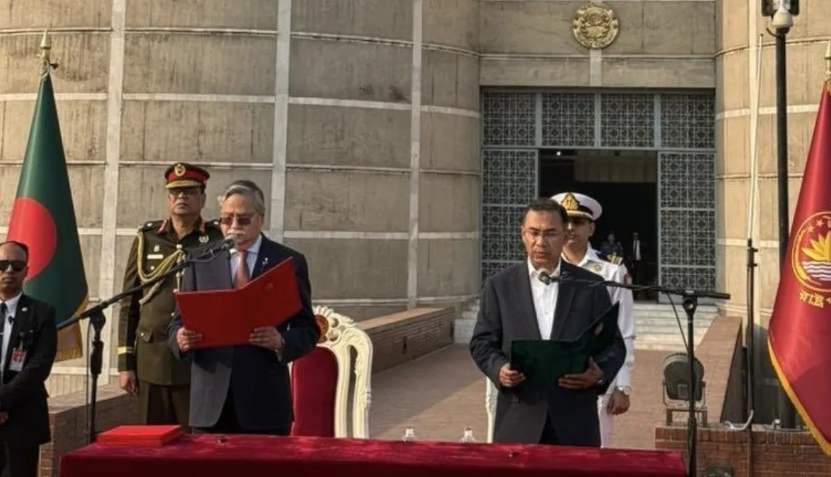
Bangladesh has inaugurated a new government as BNP (Bangladesh Nationalist Party) chief Tarique Rahman took oath as the country’s Prime Minister. The ceremony was administered by President Mohammad Shahabuddin. In the recent parliamentary elections, the BNP, in alliance with friendly parties, won 212 of the 299 seats, securing a decisive mandate. Tarique Rahman assumed office after 17 years, marking a significant political return, and India’s Lok Sabha Speaker Om Birla attended the event.
Outgoing Prime Minister Mohammad Yunus stepped down on Monday and addressed the nation for the last time. In his speech, Yunus made remarks perceived as critical of India, referring to the northeastern states collectively as the “Seven Sisters” and highlighting their strategic and economic significance for the region.
Yunus emphasized that Bangladesh’s access to the Bay of Bengal is not only a geographic advantage but also a vital link to the global economy. He said that together with Nepal, Bhutan, and the Seven Sisters, the region possesses considerable economic potential, underscoring Bangladesh’s interest in strengthening regional connectivity and maritime trade routes.
Previously, during a visit to China, Yunus had made similar comments on the northeastern states, noting that these territories serve as the only access points for landlocked regions to reach the sea and suggesting that they act as maritime guardians. He also described the area as an opportunity for China to expand its economic footprint, remarks that drew strong condemnation from India. Arunachal Pradesh, Assam, Manipur, Tripura, Mizoram, Nagaland, and Meghalaya are traditionally referred to as the Seven Sisters.