





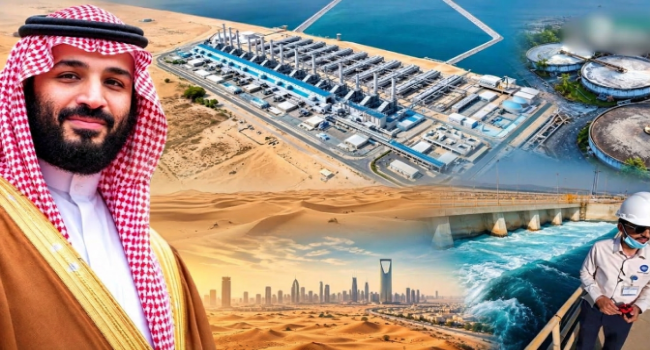
Despite having no natural rivers, annual rainfall of under 100 millimeters, and summer temperatures that regularly exceed 45°C, Saudi Arabia has built one of the world’s most extensive water supply systems — delivering purified drinking water around the clock to roughly 40 million people. The achievement is being described by engineers worldwide as a landmark example of infrastructure innovation in one of the planet’s most arid environments.
A Land Without Water
Saudi Arabia spans approximately 2.15 million square kilometers, of which nearly 95 percent is desert. Groundwater exploration in much of the country yields oil rather than water, and rainfall is negligible. Rather than depend on scarce natural resources, Saudi authorities turned to large-scale engineering to secure a sustainable water supply for the population.
Global Leadership in Desalination
The centerpiece of this effort is seawater desalination. Saudi Arabia now operates some of the largest desalination plants in the world, converting seawater from the Red Sea and the Persian Gulf into potable water. The country has positioned itself as a global leader in this field, supported by an extensive distribution network often described as an “artificial river system.”
The infrastructure includes corrosion-resistant, ultrasonically tested carbon steel pipelines — the same grade of material typically used in oil and gas transport — laid across roughly 14,000 kilometers of desert terrain. Construction required advanced GPS-guided surveying, and in mountainous or rocky areas, tunnels were blasted to route the pipeline network.
How the System Works
At coastal desalination facilities, large intake pipes positioned several hundred meters offshore draw in seawater; a single 63-centimeter pipe can pump about 15 million liters per day. Protective intake screens prevent marine life such as fish, crabs, and jellyfish from entering the system. Once filtered, the water — naturally low in minerals and flat in taste — is re-mineralized with calcium and magnesium and adjusted to an appropriate pH level before distribution. Artificial intelligence–based sensors monitor the pipeline network continuously, allowing faults to be detected and addressed rapidly.
Officials note that laying pipeline infrastructure of this scale costs millions of dollars per kilometer, placing the overall investment in the hundreds of billions of dollars.
A Shift Toward Sustainability
Historically, much of Saudi Arabia’s desalination process relied on burning oil to power purification plants. Under Saudi Vision 2030, the kingdom is transitioning toward solar-powered desalination facilities, aiming to reduce the sector’s environmental footprint while maintaining supply to its predominantly coastal population.
A Model of Engineering Resilience
Analysts and engineers point to the project as evidence that infrastructure planning can overcome severe natural constraints. With the water network now considered a core part of national infrastructure, Saudi Arabia’s achievement is being cited internationally as a benchmark in water management — alongside its long-standing prominence in the global energy sector.