





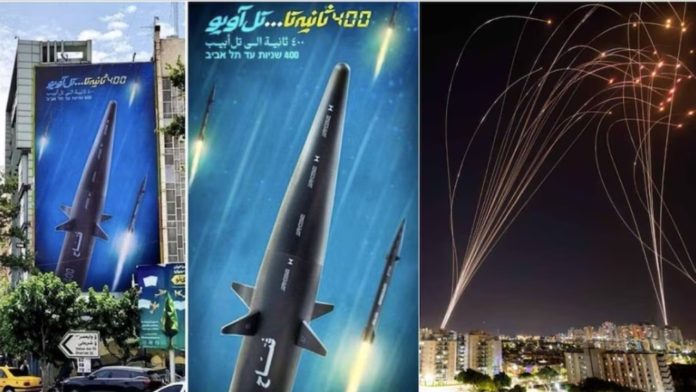
Iran has begun overwhelming US-Israeli defense systems with its hypersonic missiles. Reports suggest that Russian satellites and Chinese targeting technology are enabling these missiles’ speed, maneuverability, and precision targeting capabilities.
Iran has developed missile technology so advanced that even the most sophisticated defense systems of the US and Israel are struggling to intercept it. American officials say Iranian missiles are now not only traveling at extremely high speeds but are also changing direction mid-flight to strike precise targets. They express concern that while these missiles could once be easily intercepted, the situation has now completely changed.
Several experts suspect that China or Russia are providing Iran with targeting technology and other technical assistance, making Iranian missiles far more dangerous. This development is heightening tensions across the Middle East and posing new challenges to US-Israeli defense systems.
Iran has already developed hypersonic missiles such as the “Fattah-1” and “Fattah-2,” capable of traveling at five times the speed of sound. Because these missiles can change direction mid-flight, tracking and intercepting them has become extremely difficult. Compared to conventional ballistic missiles, they can maneuver far more easily.
Iran claims these missiles can even overwhelm the most advanced US and Israeli defense systems — Iron Dome, Arrow, and THAAD. In recent attacks, these missiles reportedly evaded multiple interceptors and successfully struck their targets. While Israeli and American defense systems had previously proven effective, Iran’s new technology has now shifted the balance of power.
These missiles run on solid fuel. Their warheads are separately propelled, allowing them to change direction during the terminal phase, which makes the job of radars and interceptors far more difficult. Iran has used these missiles in attacks on Israel and claims that many of them succeeded. American and Israeli officials are concerned that the capability of their defense systems is becoming increasingly limited, as the speed and maneuverability of hypersonic weapons are rendering current technology outdated.
Russia is providing Iran with satellite imagery and improved drone technology, helping Iran target American forces with greater precision. According to a Wall Street Journal report, Moscow has increased intelligence sharing to help Tehran continue its fight against the US and Israel.
This war is benefiting Russia, since Iran is supplying drones to Russia for use in the Ukraine war. In return, Russia is providing Iran with technology and imagery. This cooperation is enhancing the accuracy of Iran’s missiles. Satellite imagery provides real-time location data, making targeting more precise, while drone technology is helping Iran better plan its attacks. Russia and Iran are cooperating with each other to counter Western nations.
American officials also suspect that China is helping Iran with targeting technology. Although there is limited evidence for this, China’s hypersonic technology is among the most advanced in the world. Some reports state that Chinese studies suggest American defense systems are ineffective at intercepting hypersonic missiles.
Technical cooperation between Iran and China goes back a long way. China may have provided Iran with engineering support and components, which could explain why Iranian missiles have become more precise and faster. This coordination triangle — Russia, China, and Iran — has become a major source of concern for the United States. If Iranian missiles continue to succeed, regional security equations could shift. The recent attack on the Jordan air base, in which Iranian missiles killed American soldiers, is cited as evidence of this new capability.
Iran has been running missile programs for decades. While it started with older missiles like the Scud, it is now domestically producing hypersonic, maneuverable missiles. The IRGC (Islamic Revolutionary Guard Corps) is leading this project. Iran states that these weapons are purely for self-defense, developed to counter threats from Israel and the US. However, Western nations view them as aggressive actions.
In recent years, Iran has conducted several tests to increase its missile range. The Fattah missile reportedly has a range of up to 1,400 kilometers, covering Israeli and American bases. Improved guidance systems and satellite support have made it easier to hit targets. While missiles often missed in the past, precision strikes are now achievable.
The US and Israel are attempting to upgrade their defense systems, but countering the hypersonic threat requires entirely new technology. Systems like THAAD and Patriot were designed for conventional missiles. The low-altitude flight paths and random maneuvers of hypersonic missiles make them difficult to intercept.
While Iron Dome has intercepted many rockets in Israel, long-range hypersonic missiles pose an entirely new challenge. The US fears that if Russian-Chinese assistance to Iran increases further, the regional conflict could escalate into a larger war. The increasing intelligence sharing among these nations is affecting global security.
This situation is deepening instability across the Middle East. Iran’s growing capabilities could also strengthen proxy groups such as Hezbollah and the Houthis. Cooperation between Russia and China is forming a new bloc against Western nations. The international community now urgently needs new diplomacy and new defense solutions.