





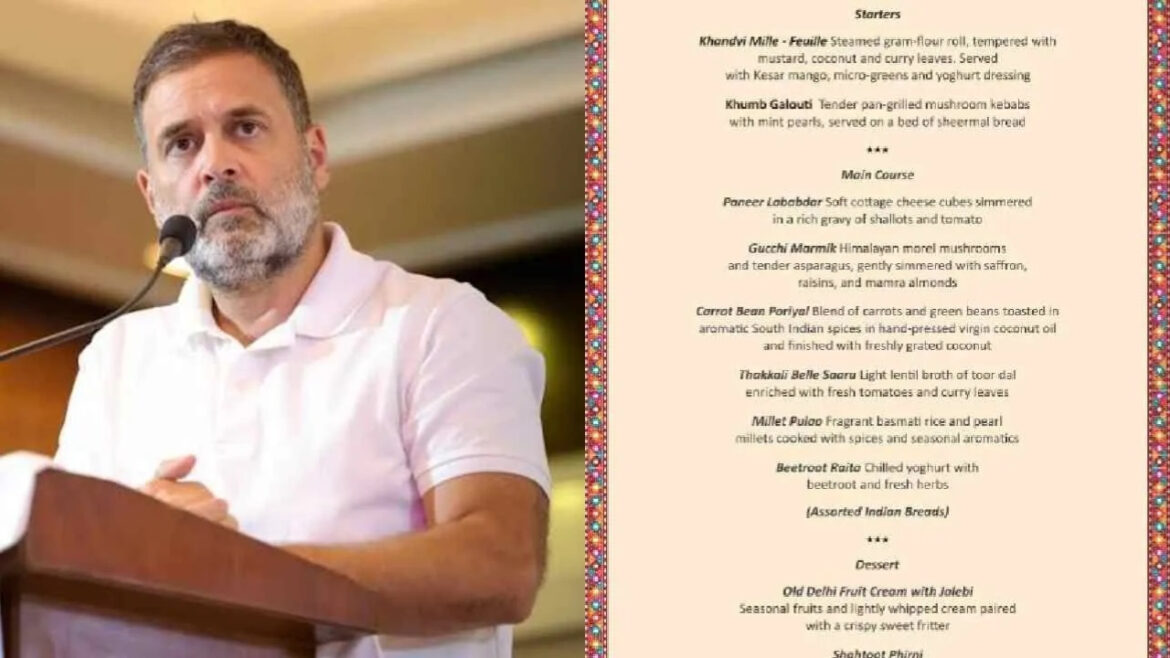
The dinner arranged during the 18th BRICS summit, held in Delhi over the past two days, has sparked a political row. Congress leader Rahul Gandhi hit out at Prime Minister Narendra Modi over the dinner hosted for guests from various countries attending the summit being entirely vegetarian. Noting that a large number of people in the country consume non-vegetarian food, he objected to Indian non-vegetarian cuisine not finding a place on the international platform. He raised several points on the social media platform X, saying, “80 percent of Indians are non-vegetarian. Indian non-veg dishes are delicious. So is my sister’s chole bhature,” adding a lighthearted touch to his comment by referencing chole bhature. The post has since gone viral on social media, sparking a political war of words over the dinner menu, with Gandhi also sharing a photo of chole bhature.
Congress leader Pawan Khera also backed Rahul Gandhi’s remarks, saying that India’s culinary diversity includes world-class non-vegetarian dishes, and questioned why such dishes were not introduced to foreign leaders. He alleged that the BJP was imposing its own food preferences on Indians, and criticised sharply that the same was now being done with foreign leaders and guests.
Union Minister Kiren Rijiju responded sharply to Rahul Gandhi’s comments, stating that BRICS leaders had enjoyed Indian vegetarian cuisine. Posting on X, he said he found it hard to believe that Congress was politicising the food menu served to BRICS leaders. He revealed that the vegetarian menu had been designed to reflect various regions of the country, explaining that both taste and nutritional value were given importance.
What Was On The Dinner Menu?
The dinner hosted by Prime Minister Modi for guests during the BRICS summit served entirely vegetarian dishes, including khandvi, paneer lababdar, gucchi marmik, millet pulao, mushroom galouti, and jalebi, with millets given significant prominence on the menu, designed to reflect both India’s “Shri Anna” initiative and its sustainable food policy.
The main dishes included paneer lababdar, gucchi marmik, carrot bean poriyal, and thakkali bele saaru, among others, along with millet pulao, beetroot raita, and various Indian breads. The menu placed particular emphasis on millets, reportedly using bajra in the pulao, jowar in the breads, and korra (foxtail millet) in the dessert, designed to highlight the role of millets in nutrition, sustainable agriculture, and addressing climate change. At the end of the meal, in a nod to Indian tradition, sweets such as Old Delhi-style jalebi with fruit cream and shahtoot phirni were served, with the mulberry-based phirni given a modern presentation.
Rahul Gandhi’s remarks that non-vegetarian dishes, an important part of Indian food culture, should also have been included at the dinner attended by international leaders have gained significant attention, with the debate over food habits notably taking on a political colour. Responding to Rahul’s post, Union Minister Kiren Rijiju criticised the opposition for turning the dinner menu into a political issue. Notably, on the final day of the BRICS summit — a key platform for discussions on the global economy, trade, investment, energy security, technology, health, and the Global South — the “veg versus non-veg” menu unexpectedly became the hot topic of conversation.