





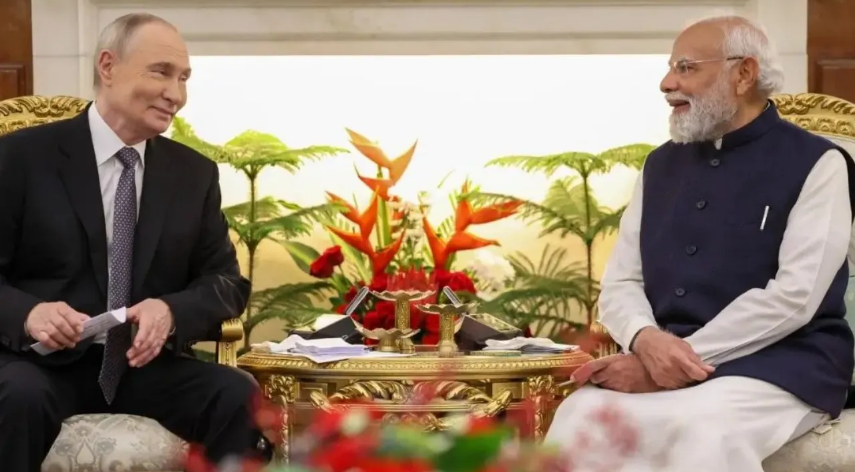
Russian President Vladimir Putin concluded his two-day visit to India on December 4 and 5, during which he met Prime Minister Narendra Modi as part of the 23rd India–Russia Annual Summit in New Delhi. The high-level discussions focused on deepening strategic cooperation, resulting in a series of agreements across defence, trade, energy, and technology.
RELOS Defence Pact Finalised
A major highlight of the visit was the signing of the Reciprocal Exchange of Logistic Support (RELOS) agreement. The pact enables military forces, naval vessels, and aircraft of both countries to access each other’s bases for logistical support. The agreement is expected to streamline joint military exercises, training operations, humanitarian missions, and disaster-relief efforts, including quicker access to fuel, spare parts, and repair facilities.
New Defence Procurements and Joint Manufacturing
Talks progressed on advanced defence acquisitions, including additional S-400 air defence systems, SU-57 stealth fighter jets, and the futuristic S-500 air defence shield. Sources indicate that India has agreed to procure five more S-400 squadrons. Both sides reaffirmed their commitment to the Make in India initiative through joint production of AK-203 rifles, BrahMos missiles, and spare parts for Russian-origin defence equipment.
Trade to Touch 100 Billion Dollars by 2030
Bilateral trade reached 68.7 billion dollars in 2024–25, and New Delhi and Moscow set a new target of 100 billion dollars by 2030. The summit also emphasised the need to fast-track negotiations for a Free Trade Agreement (FTA) with the Eurasian Economic Union. Agreements were signed to boost logistic cooperation in customs, postal services and fertilizer supply.
Russia Assures Continued Supply of Discounted Crude Oil
Despite external pressure from the United States, President Putin reiterated Russia’s commitment to supplying crude oil to India at affordable prices. Discussions also included the progress of the Kudankulam Nuclear Power Plant (KKNPP) and collaboration on the development of small nuclear reactors. New cooperation agreements were signed to expand civilian nuclear partnership.
Visa Reforms and New Sectoral Partnerships
Prime Minister Modi announced that Russian citizens will be offered a free 30-day e-tourist visa. Russia also confirmed its decision to join the International Big Cat Alliance. Multiple memoranda of understanding were finalised in sectors such as maritime cooperation, food security, medical education, and broadcast media. An additional agreement permits citizens of both countries to take up temporary employment opportunities.
President Putin’s visit has given renewed momentum to the long-standing India–Russia strategic partnership, delivering significant progress not only in defence cooperation but also in economic and socio-cultural ties.