





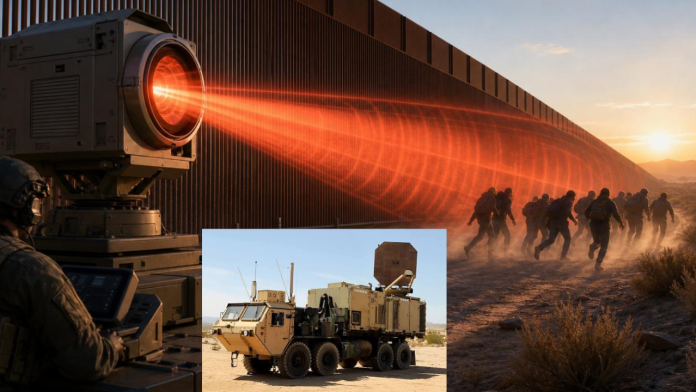
The Pentagon has authorized the Department of Homeland Security (DHS) to test a military-grade heat ray and develop tactics for its potential use at the southern U.S. border, according to a memo signed by Defense Secretary Pete Hegseth and obtained by CNN. The decision has drawn criticism from rights advocates and medical experts.
What the weapon is
The device is officially known as the Active Denial System (ADS), a directed-energy weapon. It projects an invisible beam of millimeter waves that can reach a little more than half a mile, according to the military. It is classified as nonlethal and produces a burning sensation.
Reports describing the system say it operates at about 95 GHz and works on a principle similar to a microwave oven. The waves are said to penetrate only a fraction of an inch into the skin and rapidly heat moisture there. People caught in the beam are reported to feel an intense burning, like opening a furnace door, which triggers an urge to flee. The Pentagon has said the effect fades within 10 to 15 minutes without lasting damage.
Terms of the loan
The memo authorizes a temporary loan of one ADS system for seven months, starting in September. It bars Department of War personnel from operating the system and makes DHS solely responsible for its use and for developing tactics and procedures. After the loan period, DHS can request further use of the system for border operations, a defense official told CNN.
How it might be used
The DHS request did not specify where or how the system would be tested or eventually used. The system has never been deployed at the border, though current and former Customs and Border Protection officials told CNN they have discussed using it to disperse crowds in areas with high numbers of crossings. Officials also previously considered whether it could help agents deter people from crossing near a river.
Safety and legal concerns
Human rights groups and doctors have warned of serious risks, according to reports. They say people who cannot leave the beam quickly could suffer severe blistering, and that a beam striking the eyes could cause permanent vision loss. They also warn that using the weapon on crowds of migrants could set off a stampede in which children and the elderly might be killed.
Critics also allege that placing the system under CBP control allows the Pentagon to avoid legal exposure for its use. The memo itself assigns responsibility for the system’s use to DHS.
The U.S. military briefly deployed the system to Afghanistan nearly two decades ago but ultimately declined to use it in active combat operations. The border test is likely to renew debate in international human rights forums over the use of directed-energy weapons on civilians.