





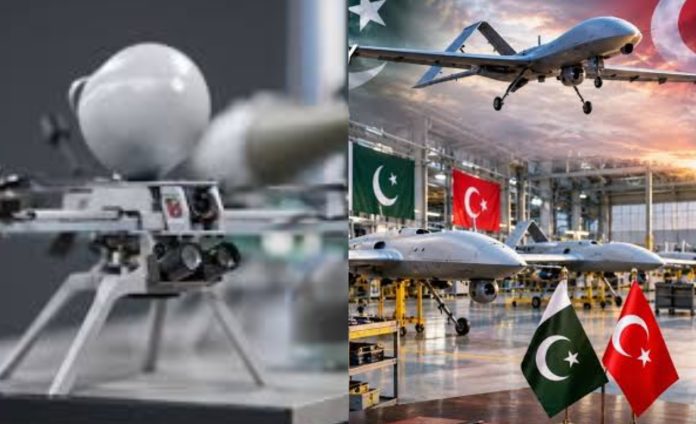
Pakistan, which suffered heavy damage from India’s missile and air defence systems during Operation Sindoor, is now working to strengthen its military capabilities. As part of this effort, it has signed a major three-year deal with its ally Türkiye to purchase one lakh “Merkut” FPV (first-person view) drones. Under the agreement, Pakistan will also receive 10 Alpine unmanned helicopters, 25 Dumrul mini helicopters, 500 loitering munitions and 250 Korgan ground systems. Manufacturing plants for these systems will also be set up in Pakistan itself.
The Merkut FPV drones have a range of 8 kilometres and can remain airborne for 20 to 30 minutes. Their warheads carry up to 1,000 steel balls of 3 mm each, which cause heavy destruction within a 20-metre radius when they explode. The Alpine helicopters can carry out autonomous attacks with 200 kg of explosives and are equipped with thermal and night vision technology, while the Dumrul mini helicopters can stay in the air for 120 minutes to carry out surveillance and strikes.
In modern warfare, such small FPV drones are playing a more significant role than Reapers and Bayraktars. Operators watch the live camera feed from the front of the drone through special goggles (VRX monitors) and use a remote to destroy targets with precision. Pilots can operate the drones from safe bunkers located 2 to 8 kilometres away. Costing less than 500 dollars, or about Rs 47,000, each to make, the drones need no runway and can be launched from just 150 feet of space.
Their capability is evident from the Ukraine-Russia war, where around 60 percent of daily attacks are carried out with these drones and Ukraine has deployed as many as 30 lakh of them. Pakistan and Türkiye, which have already joined hands to build fifth-generation fighter jets, are now posing a new challenge along the borders with this drone deal.