





- Ravi Prakash
They confronted officials. They challenged the judiciary and the police. They exposed nearly every arm of government. But in recent times, the situation has changed dramatically — the very media that once questioned those in power is now itself facing the fury of the public.
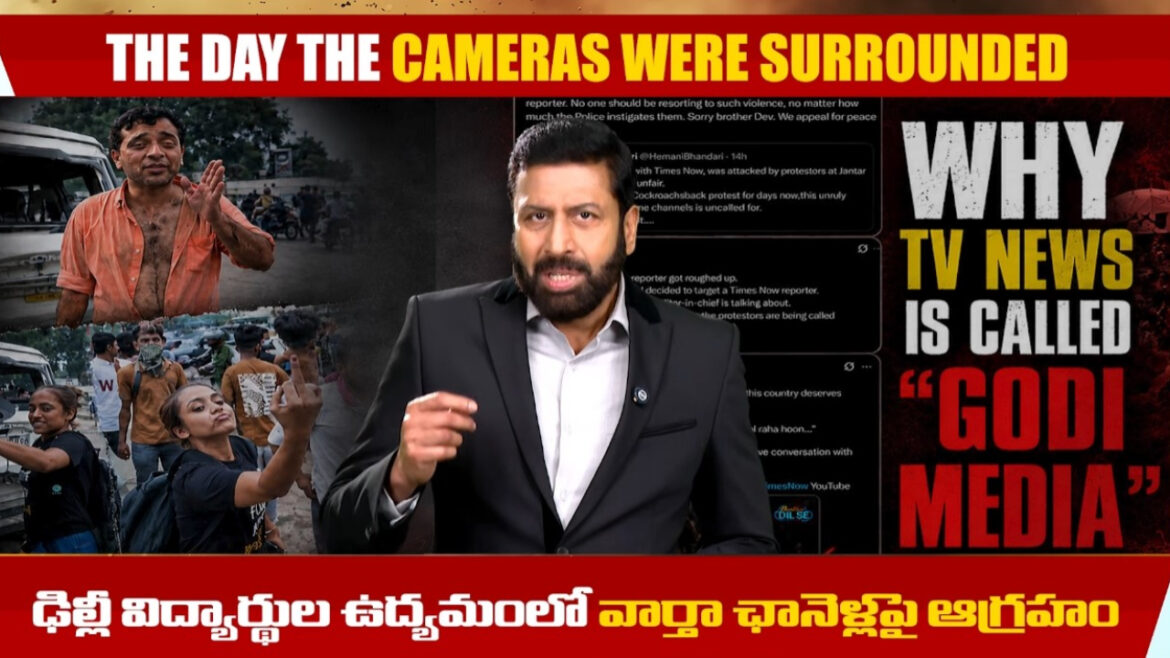
During the student protests in Delhi, that anger was not directed at the government alone — it turned squarely on mainstream news channels. Several videos capturing these confrontations have since gone viral on social media. In some clips, protesters are seen erupting the moment they spot reporters approaching. In others, journalists are confronted and directly berated. These are not the kind of scenes typically witnessed at protest sites, and they point to an uncomfortable truth: the reporters whose job it is to bring the news to the world have themselves become the story. The central question this raises is whether the public has lost faith in the media, and if so, why. This analysis is not intended to defend the media, nor to put it on trial — rather, it seeks to understand why reporters on the ground are bearing the brunt of public anger over coverage decisions made far away in studios.
In one widely circulated clip, an ABP News reporter providing live coverage was met with protesters chanting “Godi media, hai hai” in unison. In a second video, also from Jantar Mantar, a television reporter questioned a protester about whether anti-national slogans were being raised at the demonstration. The protester pushed back sharply, asking what exactly qualified as anti-national about the protest. When the reporter cited slogans such as “Inquilab Zindabad” as an example, a heated exchange followed between the two.
A further video shows a woman reporter giving live coverage near Jantar Mantar being interrupted mid-report as protesters surged forward, chanting “Godi media, murdabad,” forcing her to retreat from the location. In a separate incident, another woman reporter who questioned the protesters’ conduct received no response to her questions and instead found herself the target of the crowd’s anger, reflecting the high tension prevailing at the scene.
Perhaps the most serious of these incidents involved Times Now reporter Dev Kotak. Footage shows him being pulled out from the middle of the protest by bystanders, visibly shaken, while a separate video captures Kotak himself describing what took place. Cockroach Janata Party leader Sarvadas subsequently condemned the incident and issued an apology on X, stating unequivocally that such intimidation would not be endorsed by the movement. That statement underscores an important point: attacking, threatening, or obstructing any reporter carrying out their duties can never be justified, and violence is never an acceptable response.
At the same time, the underlying question remains: how did matters reach this point? Why does the sight of certain television reporters on the streets today provoke anger rather than trust? Over the past several years — through the farmers’ protests, the agitation against the CAA-NRC, and numerous other public movements — persistent criticism has been directed at sections of the television media for allegedly abandoning their role of questioning those in power in favor of amplifying the government’s position. Whether or not one agrees with that criticism, the fact that such a perception exists among the public is undeniable, and perceptions of this kind carry serious consequences.
Notably, at around the same time the attack on Dev Kotak occurred, an interview aired on Times Now in which film lyricist Manoj Muntashir referred to the protesters outright as “anti-nationals.” Reactions to those remarks may vary, but the broader issue at stake extends well beyond a single interview or a single channel: it is a question of public trust. Journalism is meant to hold power accountable — but when journalism instead appears to defer to power, it risks losing the very trust that sustains it, with the public turning against the institution itself.
That risk extends beyond the media alone — it strikes at the foundations of democracy. The media is often described as democracy’s fourth pillar, and its real strength lies neither in studios nor in ratings, but in the trust of the people. Should that trust erode, it is not the media alone that stands to lose — democracy itself suffers the greater loss. Perhaps that, more than any single viral clip, is the real story behind today’s unsettling scenes.