





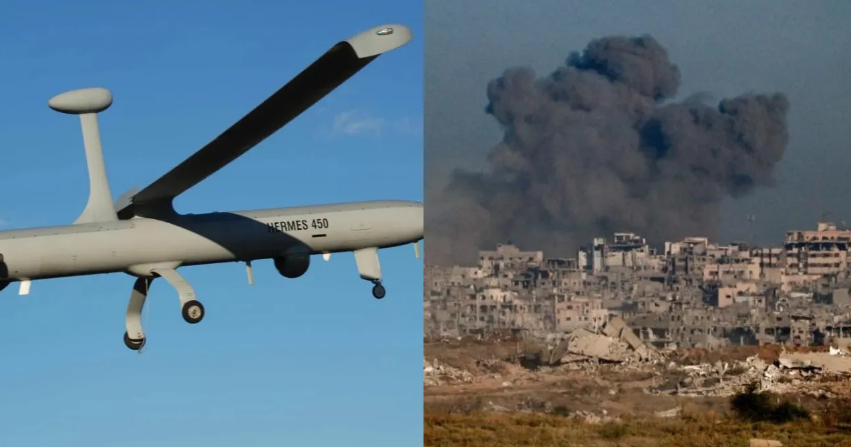
Israel is shifting its military strategy in the Middle East, relying more on advanced technology to strike enemy targets from command centers rather than deploying troops directly. In its ongoing operations against Iran and Lebanon, the Israeli defense forces are extensively using two key unmanned aerial vehicles (UAVs), the Hermes 450 and Hermes 900, which have conducted operations from Gaza to Iran’s borders.
The Hermes 450 drone has become a central component of Israel’s aerial strategy. Capable of remaining airborne for up to 20 hours, it continuously monitors enemy movements and can deliver precision strikes using spike munitions. Its dual role in surveillance and targeted attacks makes it a highly effective tool for modern warfare.
The Hermes 900 drone offers even greater capabilities. It can fly at altitudes of up to 30,000 feet for approximately 30 hours, carrying bombs weighing up to 300 kilograms. Equipped with advanced radar and sensor systems, it can detect and destroy concealed targets, including those hidden behind walls. Both drones operate silently, making it nearly impossible for adversaries to detect attacks until impact.
Israel is currently deploying these “silent hunter” drones to monitor Iran’s nuclear program and track missile activity. The Hermes series provides Israel with an invisible yet powerful shield, allowing precision strikes while minimizing risks to personnel. Their operational effectiveness has become a cornerstone of Israel’s evolving military strategy in the region.