





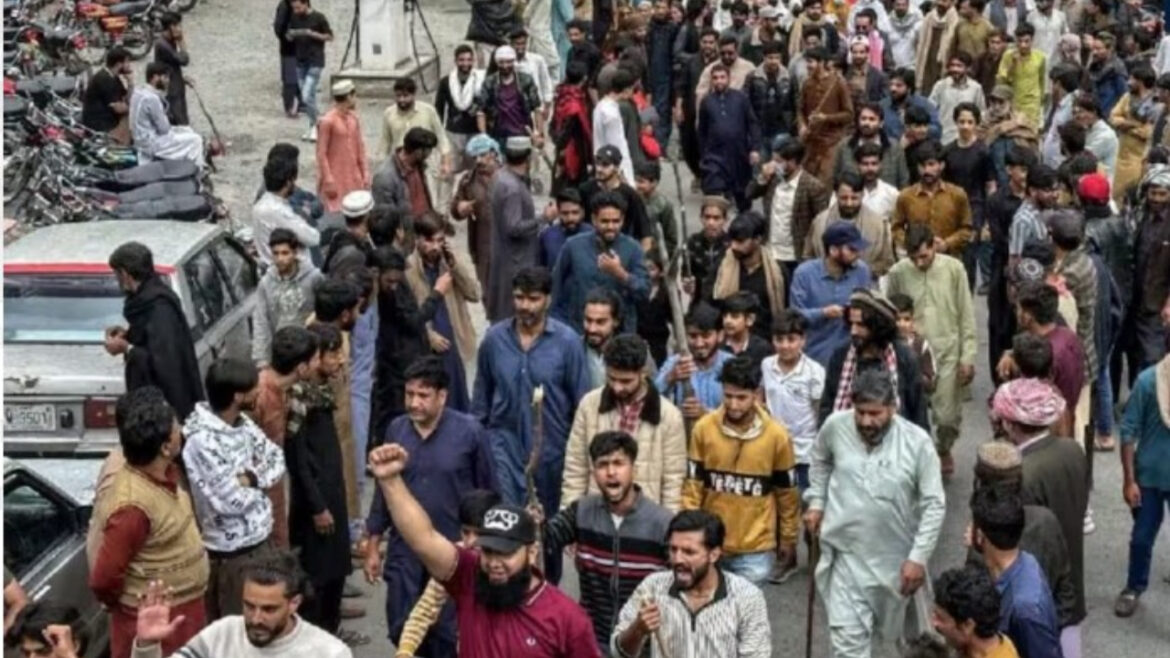
Rebellion is intensifying in Pakistan-occupied Kashmir (PoK), as local residents themselves are tearing down the decades-old “Azad Kashmir” narrative that Shehbaz Sharif’s government and the Pakistani army have projected before the international community. At a massive public gathering in Rawalkot, Joint Awami Action Committee (JAAC) leader Sardar Aman Khan declared, “This is not an independent or disputed territory—it is occupied land that Pakistan has forcibly seized and enslaved.” His remarks, delivered before thousands, have sharpened the region’s long-simmering demand for freedom.
The rally, held at Rawalkot’s Eidgah Ground, drew an estimated 80,000 participants, where Khan directly challenged Pakistani authorities, asserting that residents would no longer accept Islamabad’s rule. His statement was met with sustained applause from the crowd, reflecting the depth of public resentment despite continued efforts by Pakistan’s army chief, General Asim Munir, to suppress the movement through force.
Tensions in the region escalated sharply after Pakistani security forces opened fire on peaceful demonstrators near Rawalkot’s New Bus Terminal, killing six civilians. The dead were identified as Zahid Mughal, Zafar Mughal, Arsalan Akbar, and Wajid Hayat, among others. Wajid Hayat, notably, was a well-known local cricketer, and news of his death triggered widespread outrage across the region.
In a strategic escalation, JAAC has called on women and children to join street protests alongside men, arguing that mass participation across all sections of society is necessary to make the government in Islamabad take notice. Movement leaders say the involvement of women and children signals that the struggle is no longer confined to a small group of activists but has become a survival fight for every Kashmiri family.
The killings have hardened public sentiment against Pakistani rule, with residents asserting that peaceful demands for rights have repeatedly been met with bullets rather than dialogue. As anger spreads through the mountainous region, the aspiration among PoK’s population to separate from Pakistan appears to be growing stronger.