





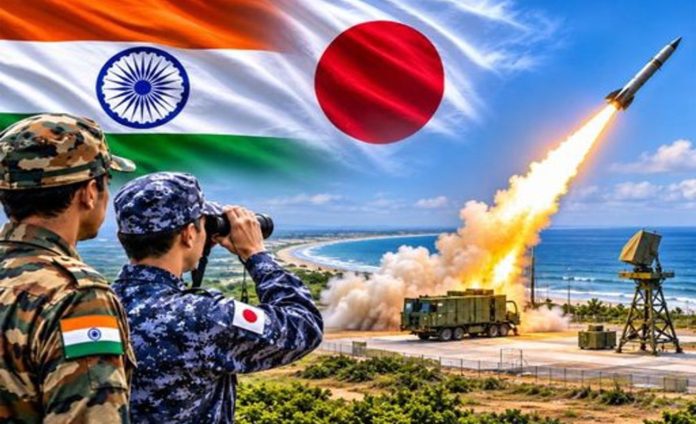
New Delhi/Tokyo: India and Japan have taken their defence partnership to a new level, agreeing that Japan’s Self-Defence Forces will, for the first time, carry out live-fire training with surface-to-ship missiles on Indian firing ranges. The decision was announced at the India-Japan 2+2 meeting of defence and foreign ministers in Japan, where a Letter of Intent on the arrangement was signed. Defence Minister Rajnath Singh and External Affairs Minister S. Jaishankar represented India.
Officials said the choice of India reflects Japan’s geographic constraints. As an island nation with high population density and heavily trafficked shipping lanes, Japan lacks adequate space to test long-range missiles. India, by contrast, offers expansive military ranges and secure maritime areas, giving Japanese forces an opportunity to assess their weapons under realistic conditions.
The growing convergence between the two countries is driven largely by China’s expanding military footprint in the Indo-Pacific. India faces pressure along its land borders, while Japan confronts Chinese assertiveness in the East China Sea. Against this backdrop, deepening defence cooperation is being seen as a strong strategic signal to Beijing.
Beyond missile training, the two sides agreed to jointly develop the “Unicorn” stealth naval mast system for warships under the “Design with Japan, Make in India” initiative, which will give India access to advanced Japanese technology. They also decided to expand the use of drones in naval and air force exercises and to work together on disaster relief operations.
The ministers also called for firm action against Pakistan-based terrorist groups such as Lashkar-e-Taiba and Jaish-e-Mohammed, and pledged mutual support on United Nations Security Council reform, including permanent membership. Analysts say the agreements could significantly reshape the security balance in the Indo-Pacific.