





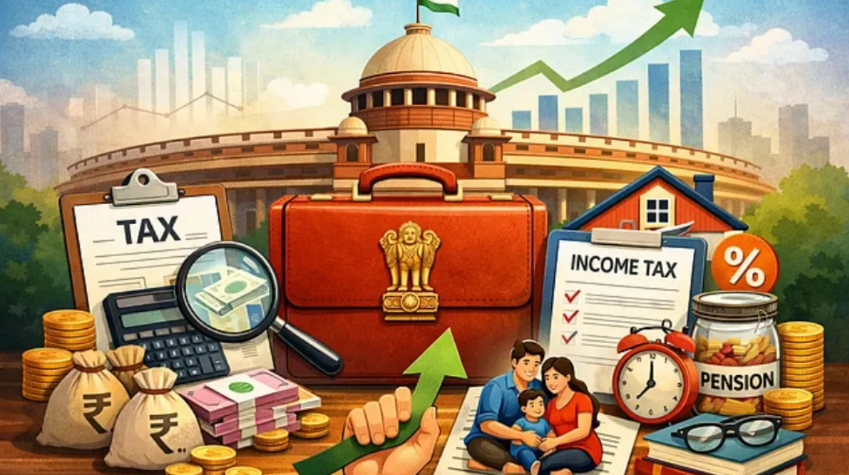
The dates for the Union Budget session have been finalised, with proceedings scheduled from January 28 to April 2. Union Parliamentary Affairs Minister Kiren Rijiju announced that the first phase of the session will be held from January 28 to February 13, followed by the second phase from March 9 to April 2.
Public expectations from the 2026 Union Budget are high, particularly among the middle class, as discussions and projections gain momentum. There is widespread speculation that the government may revise income tax slabs, with demands to raise the threshold for the 30 per cent tax bracket to ₹35–50 lakh. Experts believe such a move could offer substantial relief to middle- and higher-income groups. In the previous Budget, incomes up to ₹12.75 lakh were exempted from tax, and amid rising inflation, medical expenses and living costs, taxpayers are seeking an increase of at least ₹3 lakh in the exemption limit in Budget 2026.
The upcoming Budget is expected to focus on sustaining economic growth, with emphasis on sectors such as climate action, green energy, MSMEs, artificial intelligence and robotics. Proposed measures may include incentives, improvements in public infrastructure, tax rationalisation and reduction of compliance burdens. In direct taxation, expectations include relaxation of the interest deduction limit under Section 24(b) for self-occupied houses, possible introduction of a joint taxation system for married couples, and provisions to claim foreign tax credit at the TDS stage. Tax concessions for manufacturing and emerging technologies such as AI are also anticipated.
On the indirect tax front, further simplification of the GST regime is expected, along with measures to digitise foreign trade and customs processes and rationalise tariffs and export regulations. The real estate sector may receive a boost through reduced stamp duty, faster project approvals, single-window clearances and potential grant of infrastructure status to facilitate long-term financing. The Budget is also likely to encourage foreign investment and global collaborations, possibly through an optional presumptive tax regime for foreign firms in technology, digital services, e-commerce and software.
Emerging technologies such as AI, robotics and advanced automation are expected to receive greater support through enhanced infrastructure, digital capacity building and wider adoption across healthcare, logistics, education and public services. Manufacturing and MSME development is likely to be a key focus, with measures aimed at improving credit access, stabilising working capital and strengthening resilience against global uncertainties. Climate change and green energy initiatives, particularly in solar power, green hydrogen and clean industrial energy, are expected to be prioritised, alongside strong support for clean mobility, electric vehicles, charging infrastructure and battery ecosystems.
Higher defence expenditure is anticipated in view of global security challenges, with a focus on indigenous manufacturing, increased capital outlay and reduced import dependence. Research and development is also expected to receive enhanced allocations to strengthen innovation ecosystems and collaboration between industry, academia and startups. In the healthcare sector, the Budget may include measures such as reduced customs duties on essential medicines and advanced equipment, expanded PLI-linked infrastructure support, increased hospital capacity, strengthened rural healthcare and additional funding for telemedicine, along with incentives to boost domestic pharmaceutical and medical device manufacturing.