





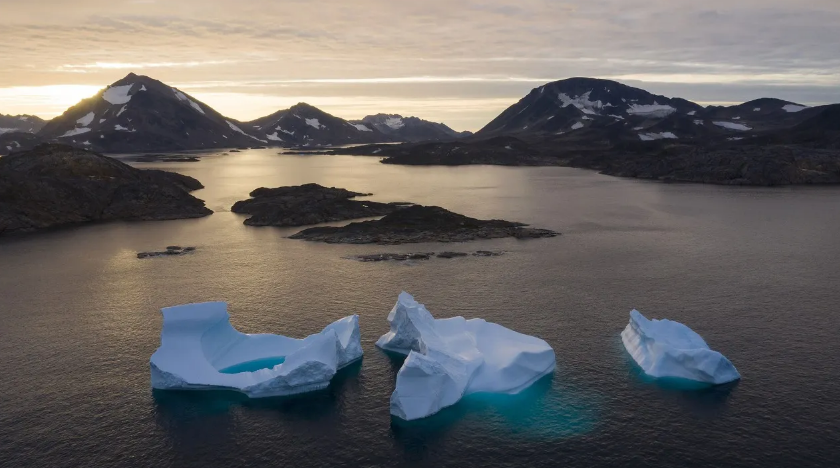
Greenland is confronting two major challenges — renewed geopolitical attention following US President Donald Trump’s past remarks about acquiring the island, and an escalating environmental crisis driven by rapidly melting glaciers. Scientists warn that ice loss across the world’s largest island is occurring at unprecedented rates, raising concerns over its long-term stability and the broader impact on global sea levels.
Researchers stress that the accelerated melting has no connection to political developments or Trump’s interest in Greenland. Instead, recent studies attribute the phenomenon entirely to climate change and rare natural processes. Rising temperatures, combined with environmental feedback mechanisms, are significantly weakening Greenland’s ice sheets.
Experts explain that factors beyond warming are contributing to the rapid melt, including the albedo effect and microbial activity. Wind-blown mineral dust settling on the ice darkens its surface, reducing its ability to reflect sunlight and increasing heat absorption. Nutrients such as phosphorus in the dust also promote the growth of glacier algae, further darkening the ice and accelerating surface melting.
Scientists from the University of Waterloo report that Greenland’s ice is now melting nearly three times faster than during the 20th century. This accelerated loss is a major contributor to rising global sea levels, creating a dangerous feedback loop as darker ice surfaces absorb more heat and speed up glacial retreat.
While Trump previously cited Greenland’s strategic location and rare mineral resources as reasons for US interest, scientists emphasize that political factors play no role in the environmental crisis. Experts warn that continued ice loss could threaten coastal cities such as Mumbai and Chennai, and caution that a complete melt of Greenland’s ice sheet could raise global sea levels by up to seven metres, underscoring the urgent need to prioritize environmental protection over geopolitical ambitions.