





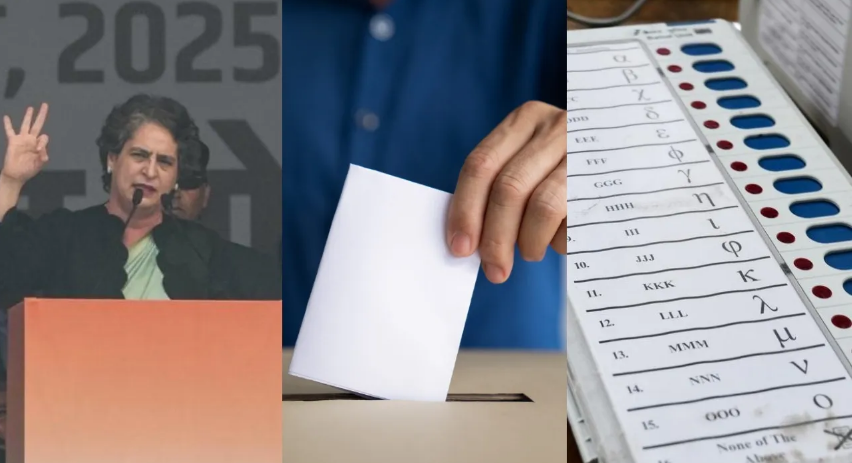
New Delhi: Allegations of Electronic Voting Machine (EVM) tampering routinely surface after Assembly elections, with losing parties questioning the process and winning parties dismissing the claims. The debate has persisted for years, extending beyond political circles to voters as well, with repeated demands to scrap EVMs and return to ballot paper voting for Assembly and Parliamentary elections. The issue regained prominence after senior Congress leader Rahul Gandhi alleged “vote theft” by the Centre in collusion with the Election Commission. Adding to the controversy, Congress general secretary Priyanka Gandhi on Sunday launched a sharp attack on the NDA government while addressing the “Vote Chori, Gaddi Chhodo” rally at Ramlila Maidan in Delhi.
Priyanka Gandhi accused the Modi government of weakening democratic institutions and claimed elections in the country were not being conducted fairly. She alleged that despite vote theft and the open distribution of money during polls, the Election Commission was turning a blind eye. Challenging the BJP, she said the party should contest elections using ballot papers if it had the courage, asserting that it would never win under such a system. She also alleged that the BJP had won elections in Bihar through vote theft. Her remarks have triggered renewed political debate nationwide, once again bringing the EVM versus ballot paper issue to the forefront.
Evolution of EVMs in India: EVMs were first used on a trial basis in 1982 during a by-election in Kerala’s North Paravur constituency. However, in the absence of a legal framework, the Supreme Court later invalidated the election. This led to amendments to the Representation of the People Act, 1951, in 1988, inserting Section 61A and empowering the Election Commission to use EVMs. Experimental use followed in 16 Assembly constituencies across Madhya Pradesh, Rajasthan, and Delhi in 1998. Full-scale deployment came with the 2004 Lok Sabha elections, when EVMs were used successfully across all 543 Parliamentary constituencies.
VVPAT and Transparency: To enhance transparency and voter confidence, the Voter Verified Paper Audit Trail (VVPAT) system was introduced in phases from 2013, following Supreme Court directions. By the 2019 Lok Sabha elections, EVMs with VVPATs were deployed nationwide. The system reduced voting time, accelerated counting, and significantly lowered the number of invalid votes, while allowing voters to verify that their vote was recorded correctly.
Ballot Paper System: India used ballot paper voting during its first general elections in 1951–52. Initially, separate ballot boxes were assigned to candidates, later replaced by a single ballot paper listing all candidates and symbols from 1962 onwards. While the system aided voter understanding, especially among the illiterate, counting often took weeks, invalid votes were common, and risks of tampering existed. To address these challenges, EVMs were introduced. Currently, Parliamentary and Assembly elections are conducted using EVMs, while Panchayat elections continue to follow the ballot paper system.