





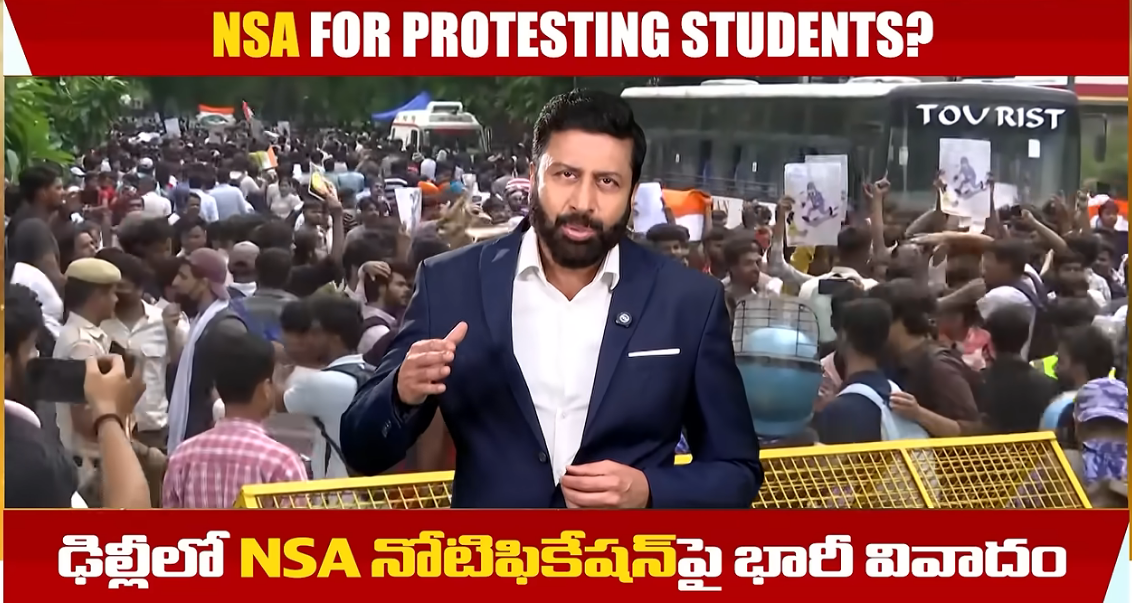
- Ravi Prakash

Namaste… The nation’s capital, Delhi, has for several days now become the stage for a massive student movement. Thousands of students have poured into the streets, police have deployed in huge numbers, hundreds have been arrested, and the entire city stands barricaded, with patrolling in every corner. It was exactly at this moment that a notification was released by the government — and within seconds, tremors began on social media. Questions are now being raised over the police order the government has just released: Is the government preparing to invoke the National Security Act (NSA) on students? Have the Delhi Police been handed powers unlike anywhere else? Is this yet another attempt to choke the students’ voice? The fear this official GO has created is no small thing, and it is to find out the truth behind it that we bring you this report today.
With the controversy the notification has stirred, the Delhi Police have gone on alert. Police officials have offered an explanation, saying there is nothing new in it, that this is not a decision taken just now, and dismissing it as a process that happens routinely. To put it more clearly, the police have flatly stated that the current student movements and this recently issued order have absolutely no connection whatsoever. If what the police are saying is true, the controversy should end right there. But this is exactly where journalism begins — because journalism does not mean blindly believing what officials say, but tracing the roots to dig out the truth.
As the Delhi Police claim, if this is a routine notification issued once every three months, there ought to be records of it. This is where doubts arise. Will the Delhi Police release the notification issued in April 2026? What about January 2026? Before that, October 2025? July 2025? Where are the records of the notifications released before that? If such orders are being issued strictly as per the rules, what is the fear in disclosing their records? If the records genuinely exist, this controversy would end within a minute — so why the delay?
Before going further, a clarification: we are not saying the government is going to invoke NSA on the students, nor are we saying the notification came because of the student protests. The point being raised is simple — what the Delhi Police are saying about the notification is only one side of the argument. Determining how much truth lies in that argument, and placing it before the people, is the responsibility of a media outlet committed to accountability. A close study of the matter and an examination of available records has raised several questions that remain unanswered — because a review of past notifications shows that such orders from the government have tended to appear precisely when public unrest and protests were at their peak. Is this merely a coincidence, or is there a definite plan behind it? That is the focus of today’s analysis.
A Look at the Past Pattern
What do the special orders issued to the police over the years actually show, and what does history say? On January 10, 2020, Delhi’s Lieutenant Governor released a notification granting the Delhi Police Commissioner powers of arrest under the NSA, effective from January 19 to April 18 that year. Notably, this came before the Delhi riots of February 2020 — but at the time, large-scale movements against the CAA-NRC were already underway across the country, with Shaheen Bagh as the epicentre and protests spreading through Delhi. Even then, the government’s response was the same: that this was simply a routine process. That may well be true under the law, but the real question is why this order emerged precisely when the protests in Delhi were at their peak.
Come July 2021, another notification surfaced, again granting the same NSA powers — this time as the farmers’ movement was underway in Delhi, with farmers protesting for months at the capital’s borders and a Kisan Sansad being held near Parliament amid tight security. Once again, officials called it a routine procedure. And once again, the question resurfaces: what lies behind releasing such a notification exactly when protests are at their peak?
Now, in July 2026, Delhi’s streets are reverberating with student slogans, thousands have been arrested, and what is unfolding is being called the biggest student protest in a decade. At precisely this time, NSA orders have been released once more, with the Delhi Police again describing it as a common, quarterly occurrence. Assuming that is true, where is the evidence to support it? If this is genuinely a routine process, where are the notifications in between — April 2026, January 2026, October 2025, July 2025? If they exist, why haven’t they been disclosed? To reiterate, this is not an accusation against anyone — the ask is simply for transparency. If the police who claim these orders come every three months were to disclose those records, the controversy would be settled in moments. The central question of this discussion remains: why are these notifications released precisely when protests and unrest are at their peak — coincidence, or does the government reach for the NSA instrument specifically when situations escalate? The answer, ultimately, lies in the government making those records public. What powers does this notification actually confer on the Delhi Police? Is there a real chance NSA could be invoked against students once the order takes effect, or is the social media reaction merely fear-mongering? That remains the million-dollar question, to be addressed further in the next segment.
Understanding the National Security Act
So what exactly is the National Security Act, and why does the very name NSA provoke such fear? The NSA is one of the harshest preventive detention laws in the country. Unlike ordinary criminal law, which punishes after a crime has occurred, this law is designed to pre-empt a future threat before it materialises. Once an NSA case is filed, the person loses the standard right to a court trial — under the law’s special provisions, they can be detained for up to 12 months without any trial. Invoked in the name of national security, the NSA has become one of India’s most controversial laws. While the government maintains it is a shield for national defence, the very scale of the powers it grants has fuelled widespread demands for greater transparency.
Has NSA actually been invoked in Delhi before? Yes — and it has sparked significant debate. In April 2022, following the Jahangirpuri violence, the Delhi Police invoked the NSA against five individuals identified as key accused — Mohammad Ansar, Saleem Chikna, Sonu Chikna, Dilshad, and Aheer — applying the law’s harshest provisions. But what followed? Court records show that while the criminal investigation proceeded, nearly all the accused eventually secured bail, and years later the trial still has not reached a conclusion. This highlights an important distinction: registering a case under the NSA is one thing; proving the crime in court is an entirely different matter — the gap between the two is vast.
There is a further twist. During both the anti-CAA protests of 2020 and the farmers’ agitation of 2021, the government granted the Delhi Police Commissioner the power to invoke NSA — yet there is no evidence that even a single case was registered under the Act against those protesters. Holding the power is one thing; exercising it is another, and it is this thin line that now sits at the centre of the current debate. Regarding the ongoing student protests, there has so far been no official statement that NSA has actually been invoked — a crucial point in this story. Yet the underlying questions remain: if the release of NSA notifications is genuinely a quarterly exercise, what is the difficulty in disclosing the records — the April 2026 notification, the January 2026 notification, October 2025, July 2025, and all prior quarterly notifications? If this is a normal procedure, why the reluctance to produce evidence? Those records alone would settle every question — so what is there to hide? Transparency, it bears remembering, never weakens institutions; it strengthens them, particularly where extraordinary laws confer such far-reaching powers, and every citizen has the right to demand clarity on their use. Is this debate solely about the National Security Act, or is there a larger strategy at play? Where exactly is trust breaking down between government, policing, and citizens — and are these developments unfolding under the guise of power? A deeper analysis follows in the next segment.
The Core Questions
Setting out the facts plainly: First, the Delhi Police maintain this is merely a routine administrative exercise, and under the law, they do hold such powers — that much is true. Second, based on information available so far, there has been no official statement that the National Security Act has been invoked against anyone in the Delhi student protests; placing facts squarely before the public is a foundational responsibility of journalism, and that fact is being stated clearly. Third, and worth noting carefully: why do these notifications keep emerging exactly when nationwide movements are underway — the CAA protests, the farmers’ movement, and now the student protests? Is this coincidence, or a deliberate pattern? Answering that requires all the records to come to light.
This is where the real question rests: if the notification is genuinely a quarterly renewal, what is the fear in disclosing the records? A single PDF compiling the past five years of notifications would settle the matter within a minute — so what is there to hide? The questions being put to the Delhi Police are simple: where is the April 2026 notification, the January 2026 notification, and those from October 2025 and July 2025? Disclose every notification issued in the past. If this is a normal procedure, why the secrecy? Rather than relying on press statements, the records should be made public — documents reveal the truth far more convincingly than words. Transparency is not a favour extended to the people; it is the lifeblood of democracy, and the responsibility to be forthcoming rests especially heavily on institutions wielding such stringent laws. This report does not seek to support any side — it is an attempt to establish the truth. In a democracy, questions are the oxygen, and it is only when those questions are answered with facts that public trust in institutions is reinforced. The question today remains singular: if this is truly a routine process, why are the records being withheld? Release the documents, and let them settle what the truth actually is. Until then, these questions remain very much alive.