





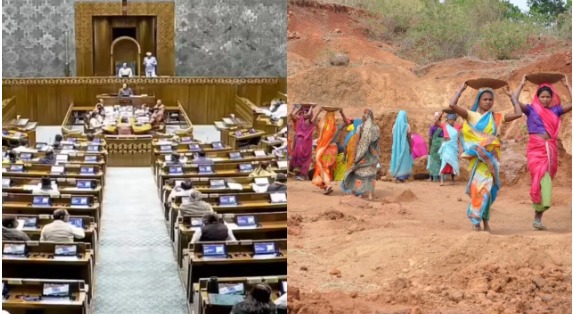
In a significant move, the Indian government has replaced the Mahatma Gandhi National Rural Employment Guarantee Act (MGNREGA) with the Viksit Bharat Guarantee for Rozgar & Ajeevika Mission – Rural (VBGRR & A Mission – Rural) Bill in the Lok Sabha on Thursday. The Bill was passed after a contentious debate, during which opposition parties staged protests, leading to disruptions in the House. Despite the uproar, the Speaker proceeded with the voting process, and the Bill was approved. The Lok Sabha was later adjourned till Friday.
Union Minister Shivraj Singh Chouhan responded to the opposition’s criticism, defending the new legislation by stating that the NDA government’s welfare initiatives are rooted in the principles of Mahatma Gandhi. He accused the Congress of diluting Gandhian ideals and asserted that schemes such as PMAY, Ujjwala Yojana, Swachh Bharat Mission and Ayushman Bharat reflect Gandhi’s vision of inclusive development. Chouhan also claimed that the Congress renamed the scheme as MGNREGA in 2009 for electoral gains and alleged that the programme focused excessively on wage payments rather than material creation.
MGNREGA, introduced by the UPA government in 2005 to provide employment to rural households, was officially renamed in 2009. With the introduction of the VBGRR & A Mission – Rural Bill, the government has proposed major structural changes to address long-standing implementation issues. The new legislation includes five key reforms aimed at making the rural employment programme more effective, transparent and sustainable.
Under the revised framework, the number of guaranteed workdays has been increased from 100 to 125 per year. A 60-day break has been introduced during peak agricultural sowing and harvesting seasons to avoid labour shortages. The financial burden will now be shared, with the Centre bearing 60 per cent of the cost and states covering 40 per cent, while Northeastern states will receive 90 per cent central funding. The scheme also mandates biometric attendance and the use of geo-tagging and artificial intelligence to curb fraud. Projects have been categorised into four areas: water security, rural infrastructure, livelihood resources and disaster mitigation, aimed at creating durable assets and sustainable livelihoods for rural families.