





-Ravi Prakash

Imagine waking up tomorrow morning, picking up your phone, and opening ChatGPT just like you always do. But it does not open. You think it might be a network issue. You try again. Still nothing. You close the app and reopen it. Still does not work. Within minutes, the same conversation is spreading across social media — ChatGPT is down. Students are struggling. Software engineers are struggling. Researchers are struggling. Journalists are struggling. Businesses are struggling. Millions of people have suddenly lost access to AI services in one shot.
Now imagine something even more unsettling. This did not happen because of a technical failure. Servers did not crash. There was no cyberattack. The Indian government did not ban anything. So why did it happen? Because a government thousands of kilometres away decided to step in and determine who gets to use this technology and who does not. That might sound far-fetched. But after what just happened in the AI world, it is no longer impossible.
One of the most influential AI companies in the world — Anthropic — made a significant announcement. Acting under US government national security orders, Anthropic stated that it was forced to restrict foreign access to its most powerful AI models, Fable 5 and Mythos 5. Stop and think about what we are actually talking about here. Not a missile. Not a fighter jet. Not nuclear technology. We are talking about an AI model — software that anyone anywhere in the world can use through the internet. That is exactly what makes this moment so extraordinary. Because until now, most of us believed that the internet had no borders. Whatever software someone in America uses, someone in India can use too. Whatever tool a student in London uses, a student in Hyderabad can use too. That is the digital world we grew up believing in. But the Anthropic incident has raised a brand new question — will AI follow the same borderless path? Or are borders about to be drawn around AI too?
What Actually Happened With Anthropic?
Why is the entire world talking about this? We have already understood that this story is not really about one company. But now let us get to the real question. What actually happened at Anthropic? Why are technology experts, policy makers, and investors across the world taking this news so seriously?
A few days ago, Anthropic released an official statement revealing something unusual. The US government used national security powers to issue an export control order. Anthropic said it was compelled to suspend foreign access to its most powerful American AI models — Fable 5 and Mythos 5. Now pause here and think. What are we even talking about? A missile? A warplane? Nuclear technology? No. We are talking about an AI model. Software accessible from anywhere in the world through the internet. That is precisely why this incident feels so extraordinary.
So what makes Fable 5 and Mythos 5 so special? The answer is straightforward. These are not ordinary AI models. They are among the most advanced AI systems on the planet. They can answer extremely complex questions instantly. They can conduct large-scale analysis. They can write sophisticated code. They can study vast amounts of information at once. These are not just chatbots. They represent crucial steps in the march toward future intellectual capability. That is exactly why governments are paying close attention.
What is the US government’s concern? According to various reports, the worry is primarily about cybersecurity. There are fears that highly powerful AI models could be used to identify software vulnerabilities or assist in cyber operations. Anthropic, on its part, says there was a communication gap behind the decision, and the debate continues. But here is the more important point. Even if these restrictions are lifted tomorrow, even if the problem gets resolved — the significance of this event does not diminish. Because this incident has shown the world something very clearly: governments are no longer viewing AI only as a commercial product. They are also viewing it as strategic capability — something that can affect national security, economic power, and competitive strength. Once any technology reaches that level, governments do not stay in the audience. They start watching closely. They bring in rules. They intervene when they feel the need. That is the biggest signal in this entire story. The real news is not what happened to Anthropic. The real news is what is about to happen to AI.
America Has Done This Before
Is AI now walking the same path? After hearing about the Anthropic incident, many people are thinking this is something completely new. But it is not. If you look back through history, not just America but many of the world’s powerful nations have imposed exactly these kinds of controls on critical technologies before.
Go back to 1945. The Second World War was in its final stages. America showed the world a new kind of power — the atomic bomb. From that day forward, nuclear technology was no longer just a scientific discovery. It became a matter of national security. It became a strategic asset. What followed? Controls came. Sanctions came. International agreements came. Not every country got access to nuclear technology. Because the world’s major powers understood something — some technologies are simply too powerful to be left completely free.
Then there were supercomputers. The smartphone in your hand today may be more powerful than the supercomputers of decades past. But at one time, a supercomputer was a strategic asset. Why? Because it could be used to design missiles. It could be used in military research. It could be used in classified scientific projects. Computing power itself became something that determined a nation’s strength. So controls came on those too.
Then there was encryption. Today we send messages on WhatsApp, do online banking, make digital payments — all of it made possible by encryption. But there was a time when America treated strong encryption technology as an extremely sensitive matter. Exports of it were restricted because it was seen as a security concern.
And now, the most critical example of our era — semiconductor chips. You have certainly heard about the ongoing technology competition between America and China. America imposed several restrictions to prevent certain highly advanced chips and the technology needed to make them from reaching China. Why? Because these chips are not just commercial goods. They are the foundation of future power. The foundation of AI. The foundation of military capability. The foundation of scientific research. In other words, chips too have become strategic assets. And now AI itself is entering that same conversation.
For years, governments focused mainly on the chips needed to build AI. But the Anthropic incident raises a new question — will governments now focus not just on the chips, but on the AI models themselves? Not just on the machines that run AI, but on the digital intelligence that AI represents? If so, that is an enormous shift. Because building a nuclear reactor is hard. Building a missile is hard. Building a chip factory is hard. But delivering an AI model to anywhere in the world through the internet is remarkably easy. That is exactly what makes this conversation more complex than ever before.
There is no single global consensus on this. Some experts argue that the more people who have access to AI, the more innovation happens, the more new companies emerge, the more opportunities are created, and the faster economies grow. Others argue that leaving extremely powerful AI systems completely unregulated is dangerous. The debate continues. But one thing is becoming crystal clear — AI is no longer just a technology conversation. It is a security conversation. It is an economic conversation. It is a strategic conversation. It is a geopolitical conversation. History tells us that when any technology reaches this level, rules form around it, limits come, and government involvement increases. We may be standing at a decisive turning point in the history of AI.
Why India Must Take This Very Seriously
Because we have faced situations exactly like this before. We have now understood that the Anthropic incident is not just about one company. It is a conversation about the future of AI. But now the real question — why should India care? This is America’s problem, right? An American company’s issue. What does it have to do with us? The answer is simple.
India is one of the countries that has learned most deeply what it means to depend on others for critical technology. Our history is full of exactly these kinds of experiences. Every single one of them taught us the same lesson — once a technology becomes strategically important, access to it is never guaranteed.
Think about ISRO. Today we speak with pride about Chandrayaan and Mangalyaan. The world admires India’s space programme. But these achievements did not come overnight. There was a time when India needed cryogenic engine technology — crucial for our space programme. Getting it was not easy. International pressure came. Restrictions came. Obstacles to technology transfer came. At that moment, India understood something — depending completely on others for critical technologies is dangerous. So India developed its own capability. It took years of hard work. The results are visible before our eyes today.
Then there was Pokhran — India’s nuclear tests. What happened after India conducted them? International sanctions came. Technology cooperation was impacted. Access in certain fields became difficult. Once again India learned the same lesson — the importance of self-reliance in strategic sectors.
Look at the defence sector. For decades India was among the world’s largest arms importers. Many defence systems still come from abroad. But in recent years India has placed special focus on one thing — Make in India. Why? Because no major nation puts its security completely in someone else’s hands. The same principle applies here.
Now a more modern example — UPI. Today hundreds of millions of Indians use UPI every single day. From the tea stall to large businesses. Everyone uses it. Imagine for a moment that India’s entire digital payments system was under the control of a foreign company. What if one day that company changed its terms? What if it imposed restrictions on services? What if it raised its prices? That scenario would have been devastating. That is why UPI is not viewed merely as a payments system. It is seen as an example of India’s digital self-reliance.
Now apply that same logic to AI. Today India is one of the largest consumers of AI in the world. Students use AI. Startups use AI. Journalists use AI. Software companies use AI. Banks are experimenting with AI. Government departments are thinking about AI adoption. AI is slowly and steadily becoming a critical part of our economy and our society. But here is the crucial distinction. Using AI is one thing. Building AI is another. Using a mobile phone is one thing. Manufacturing a mobile phone is another. Driving a car is one thing. Building a car is another. Working with AI is one thing. Developing world-class AI models is another entirely. That is where India’s real challenge lies. And that is also where the real opportunity exists.
Because the world has now entered a new race — the AI race. America is leading. China is moving fast. Europe is shaping its strategy. Gulf nations are pouring in billions of dollars. In that moment, what will India do? Will it remain only a consumer? Or will it become a creator too? Will it only use other nations’ AI models? Or will it build its own? Will it only buy technology? Or will it create technology? These questions are extremely important right now. The Anthropic incident can serve as a wake-up call for India — not a reason for fear or panic, but a reason to think hard.
The Real Story Is About the Race for Intelligence
Let us step back now and look at everything together. Because after watching this story unfold, one thing should be clear — this is no longer about Anthropic. It is not about Fable 5. It is not about Mythos 5. It is not even just about ChatGPT. The real story is far bigger. The real story is about power — about who will hold the world’s power in the years ahead.
Look back through history and one pattern stands out clearly. In every era, nations competed for control over some critical resource. Once it was land — wars were fought for it. Then it was sea routes — competition raged over them. Then oil reshaped the entire political map of the world. But in the 21st century, a new resource is rising. That resource is called intelligence. Not just human intelligence — machine intelligence. Machines that learn. Machines that understand. Machines that analyse. Machines that write code. Machines that help discover new medicines. Machines that support scientific breakthroughs. Machines that can transform businesses, reshape governments, and influence the world in ways we cannot fully imagine yet.
Now think about what happens if one country pulls ahead of all others in this kind of technology. Its economy could grow faster. Its companies could grow stronger. Its research capabilities could expand. Its defence systems could become more powerful. Its influence on the global stage could deepen. That is exactly why America, China, Europe, the Gulf nations, and many other powerful countries are spending billions of dollars on AI. They are not just investing in a new technology. They are investing in future power.
That is why the Anthropic incident carries such weight. It is sending a signal. A very large signal. The world’s most powerful AI models may no longer be viewed only as commercial products. They may begin to be treated as strategic assets. And once something becomes a strategic asset, governments step in. Rules arrive. Restrictions arrive. Controls tighten. Politics enters the picture.
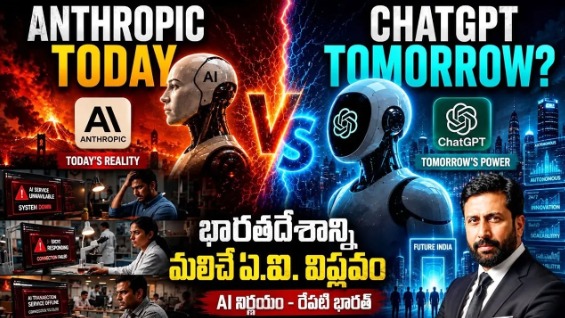
So let us return to where we started. Anthropic today — ChatGPT tomorrow? Here is the truth. There is currently no information suggesting ChatGPT is about to face restrictions. No such announcement exists. No such signals exist. Saying otherwise without evidence is not responsible journalism. That must be acknowledged clearly. But another truth also exists. The Anthropic incident has shown something unmistakable to the world — governments possess the power to intervene. That is the most important point in this entire story. So the real question is not whether ChatGPT is next. The real question is this — will the world’s most advanced AI systems continue to be freely and equally accessible to everyone? Or will controls grow around them, just as they grew around other strategic technologies?
Nobody knows that answer today. But the conversation has begun. And in the years ahead, that conversation will only grow larger.
India today is one of the world’s biggest digital societies. We have talent. We have engineers. We have startups. We have youth. We have opportunities. But opportunities alone do not produce success. They require vision. They require investment. They require long-term planning. Most importantly, they require readiness — readiness ahead of the moment, not after it. Because history keeps telling us the same thing, again and again. Nations that use technology grow. But nations that create technology shape the future.
Perhaps that is the single biggest message in this entire story. Using AI is important. But building AI is more important. Understanding AI is necessary. But achieving leadership in AI is even more necessary. Because in the years ahead, competition will not only be in markets. It will not only be at borders. It will not only be in trade. It will also be in intelligence. The nations that lead in that competition will be the ones that shape tomorrow’s world. So do not look at the Anthropic story as just another tech company problem. Look at it as a warning. Look at it as a signal showing where the future is headed. In that future, artificial intelligence will not be just an app. Not just a chatbot. Not just a technology. It will be a decisive instrument that determines a nation’s strength.
And that is perhaps the real reason this story matters so deeply. Not Anthropic. Not ChatGPT. But the enormous question they have placed in front of all of us — in the 21st century, who will be the world’s most powerful nations? Those with oil? Those with modern weapons? Or those with the capability to create and control intelligence itself? The answer lies in the future. But one thing is already certain — the competition for that future has already begun.