





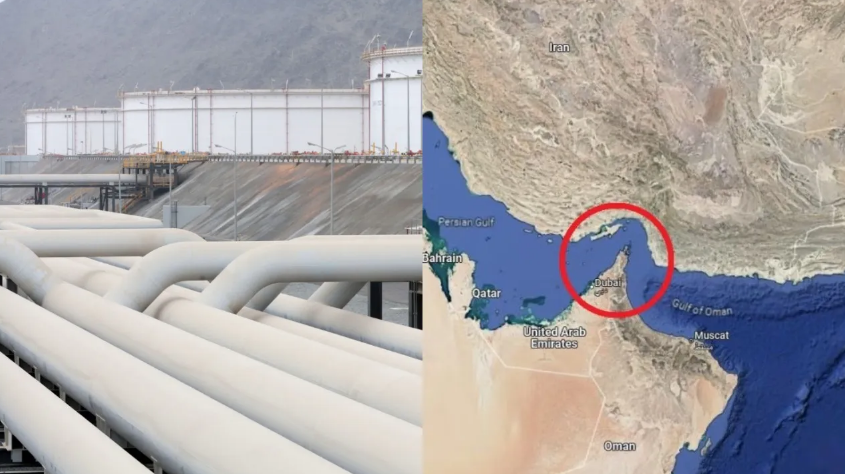
The Persian Gulf plays a vital role in global oil supply, with most crude shipments passing through the strategic Strait of Hormuz. Nearly 20 percent of the world’s oil trade moves through this route, making it one of the most critical energy corridors globally. Located between Iran and Oman, the strait is only about 30 kilometers wide at its narrowest point. Amid rising tensions in West Asia, Iran has reportedly tightened control over the route and has been targeting vessels passing through it, raising concerns about oil and gas shortages in several countries.
As a result, attention has turned to alternative routes that could bypass the Strait of Hormuz. Gulf nations have already developed some pipeline networks to transport oil without relying on the narrow maritime corridor. One of the major projects is the Habshan–Fujairah Pipeline built by the United Arab Emirates. The pipeline runs from the Habshan oil fields in Abu Dhabi to the port of Fujairah on the Gulf of Oman coast, with the capacity to transport around 1.5 to 1.8 million barrels of oil per day.
Another major alternative is the East–West Petroline developed by Saudi Arabia. The pipeline connects oil fields along the Persian Gulf coast to the port of Yanbu on the Red Sea coast. It has a capacity of about 5 million barrels per day and serves as a crucial backup route for Saudi oil exports in case maritime routes are disrupted.
However, these alternatives face significant limitations. Although the East–West pipeline can carry about 5 million barrels per day, the Yanbu port can load only around 2.5 million barrels daily. Meanwhile, the Fujairah pipeline handles roughly 1.5 million barrels per day. Together, these pipelines can move only about 4 million barrels daily, far less than the nearly 20 million barrels that typically pass through the Strait of Hormuz each day.
Experts also warn that pipeline routes come with logistical and security challenges. Supporting infrastructure such as tanker terminals, shipping facilities and transportation systems is still limited. Moreover, pipelines run across thousands of kilometers on land and often pass through multiple regions, making them vulnerable to political disputes, sabotage or attacks during conflicts. For these reasons, analysts believe that while pipelines provide partial alternatives, they cannot fully replace the Strait of Hormuz as the world’s primary oil transit route.