





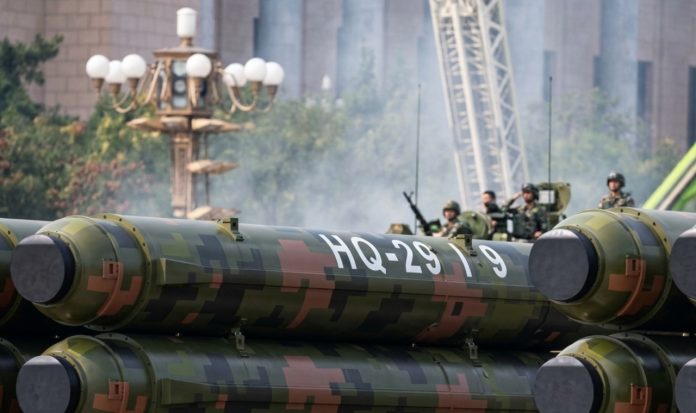
Beijing: China has developed a new ballistic missile defence system to counter potential missile attacks from India and the United States, and claims it is more capable than Russia’s S-400. The move comes as India’s Agni-5 and the submarine-launched K-4 missiles heighten Beijing’s strategic concerns.
The People’s Liberation Army (PLA) said that in recent live-fire exercises it destroyed two new types of missiles simultaneously in mid-air, including one that changes direction in flight. According to the PLA, the Shenwei Missile Battalion of the Central Theatre Command Air Force carried out the test in northwestern China. Units were transported thousands of kilometres by road, rail, Y-20 transport aircraft and ships for the drills.
During the exercise, the HQ-9B missile system was linked with the advanced HQ-19 and HQ-29 interceptors. The PLA said troops have only about two minutes between receiving a warning of an incoming missile and intercepting it, and just a few seconds to react if the missile alters course. It said the system performed effectively even in conditions where a delay of a second or two could mean losing the target.
China’s efforts go beyond routine air defence. Beijing is integrating mobile HQ-29 midcourse interceptors, HQ-19 terminal defence systems, early-warning satellites and advanced phased-array radars. Having once viewed missile defence as a threat to strategic stability, China has now reversed its position. It is building a multi-layered shield intended to protect its political leadership, nuclear bases and deep-sea naval assets in the event of a nuclear conflict.
The main driver of Beijing’s concern appears to be India’s rapid expansion of its sea-based nuclear forces. A September 2026 report by the Bulletin of the Atomic Scientists said India is strengthening its nuclear-powered submarine fleet to ensure it can mount a strong retaliatory strike from the sea even after an enemy first strike.
INS Arihant currently carries K-15 missiles with a range of about 700 km, meaning it would have to venture as far as the South China Sea to reach Chinese targets. The induction of INS Arighaat and the arrival of the larger INS Aridhaman, which has eight missile tubes, have significantly boosted India’s capability.
More boats, including INS Arisudan and S-5 class submarines, are expected to join the Navy. With the K-4 missile, which has a range of about 3,500 km, Indian submarines could target most major Chinese cities from the northern Bay of Bengal. The planned K-5, with a range of about 5,000 km, would further extend India’s strategic reach across Asia.
How China’s new shield would fare in actual combat against proven systems such as the S-400 remains to be seen.