





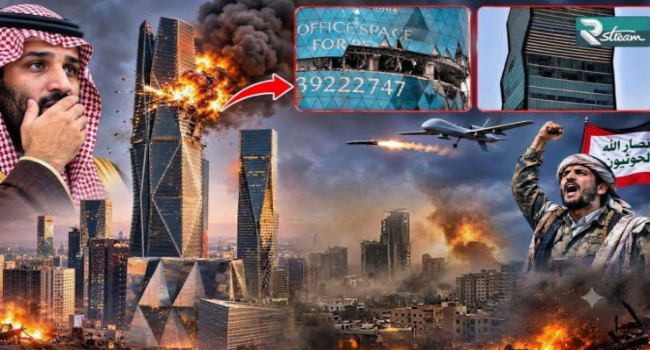
A sudden shockwave has hit Riyadh, the capital of Saudi Arabia, one of the richest countries in the world. A missile attack struck a sky-high, 80-story tower in the city. A loud blast was heard, the building’s glass panels shattered, and metal structures on its exterior were damaged. Police and firefighters rushed to the site and evacuated people from the surrounding area. The attack has raised several questions around the world. How did a missile reach the Saudi capital? Why could such a strong air defense system not fully stop the attack? Why are the Houthis targeting Saudi Arabia? And how much of a role does Iran play behind the attack?
The incident took place in Riyadh on November 19. The building that came under attack is the PIF Tower. It is no ordinary office block. It is the tallest building in Riyadh, with 80 floors, and it houses the headquarters of the Public Investment Fund, the Saudi government body that invests in major companies around the world. The building has now been damaged in a missile attack. According to a Reuters report, glass was shattered on seven to eight floors, metal parts on the building’s exterior were bent, and some neighboring buildings were also damaged. Saudi officials said no one was injured in the incident.
The attack took place in the King Abdullah Financial District, one of the most important business areas in Saudi Arabia. Offices of major corporations, banks and investment firms are located there, and the Saudi government has spent heavily to develop the district in order to attract business leaders from around the world. A missile attack in such a place is no small matter. It is not merely damage to a single building; it raises questions about the security of the country’s most important commercial zones. If such attacks continue, it is natural to wonder how safe the employees who work there, and the companies that invest there, will remain.
An important question remains open: did the missile hit the building directly, or did debris from a missile intercepted by Saudi air defenses damage it? Two versions of events have emerged. Three people familiar with the attack told Reuters that a Houthi missile struck the building. The Saudi-led military coalition, however, said it had countered a missile threat heading toward Riyadh and that the damage was caused by falling debris. The building was damaged in either case, but clarity is still needed on whether the missile responsible hit it directly.
Who are the Houthis, and what is their dispute with Saudi Arabia? To understand the story, one must first understand Yemen. Yemen is Saudi Arabia’s neighbor, and a civil war has been under way there for many years. The Houthis, also known as Ansar Allah, are an armed group in Yemen. They control the Yemeni capital, Sanaa, as well as some other important parts of the country. Saudi Arabia, meanwhile, backs Yemen’s internationally recognized government, and the Houthis and the Saudis have been fighting for years. In 2015, countries led by Saudi Arabia intervened directly in the Yemen war, and the conflict has taken many turns since. Attacks have subsided at times, but the problem has never been fully resolved.
Whenever the Houthis are discussed, Iran’s name comes up, because the Houthis have long been said to have Iran’s backing. Saudi Arabia and Iran are also rivals for dominance in West Asia. However, claiming that Iran directly orders every Houthi attack requires evidence, and it has not been confirmed that Iran ordered the latest one. Still, with an Iran-backed group targeting key buildings in the Saudi capital, there is a risk that tensions between the two countries will rise further.
Another point is worth noting: this is not the first attack of this kind in the Saudi capital this month. On November 8, a building belonging to Saudi Aramco in Riyadh was also damaged. Aramco is the largest oil company in Saudi Arabia and carries great weight in the global oil market. Eleven days after that incident, the PIF Tower was damaged. In other words, buildings housing two of Saudi Arabia’s most important institutions were attacked within two weeks, which poses a major challenge for the Saudi government.
Why are the Houthis targeting such buildings? One possible reason is that oil companies and investment institutions are vital to the Saudi economy. Attacks on them may not cause huge financial losses, but they can raise doubts about the country’s security, and they can draw the attention of foreign companies and businesspeople. The Saudi government is now trying to move beyond dependence on oil sales and push ahead in other sectors, investing heavily in tourism, technology, sports and the construction of giant cities. The Public Investment Fund plays a key role in that plan, which is why damage to its headquarters became major international news.
Crown Prince Mohammed bin Salman is trying to turn the country into a global business hub, and has launched numerous large projects under the banner of Vision 2030. For foreign investment to arrive, confidence that a country is secure is essential. Companies do not look only at profits when they invest. They also weigh conditions on the ground: whether employees will be safe, and whether war will disrupt business. The string of attacks now taking place in Riyadh risks damaging that confidence. At the same time, it would not be right to say that the Saudi economy will collapse because of this one incident.
Saudi Arabia possesses advanced weaponry, including systems designed to intercept missiles. Even so, damage to a key building in the capital has become a talking point. What must be understood is that even if a missile is stopped in mid-air, its debris can fall to the ground, and if it lands on populated areas or buildings it can cause damage. Intercepting a missile and ensuring that it causes no damage at all are not the same thing. In this incident, Saudi officials say debris caused the damage, while other sources say a missile struck directly. Only when the full details emerge will it be clear what actually happened.
Meanwhile, the situation in Yemen is heating up again. Fighting between Saudi-led forces and the Houthis is intensifying. A news agency under Houthi control said Saudi warplanes carried out strikes on the Yemeni capital, Sanaa, on November 19. Saudi Arabia has also declared that it has the right to take whatever steps are necessary to protect its country, its people and its important assets. This has fueled concern that attacks on both sides could increase further.
Will this fighting remain confined to Saudi Arabia and Yemen, or will it create problems for other countries in West Asia? That is now a major question, because the region is critically important to global oil supply. Goods bound for many countries are shipped through the Red Sea and the Bab al-Mandeb Strait. If war conditions there worsen, ship movements could be disrupted, freight costs could rise, and any interruption to oil supply could affect international markets. Oil-importing countries such as India will have to watch these developments carefully. However, it cannot be said at this stage that this single attack in Riyadh will push up petrol prices in India.
All eyes are now on the decision Saudi Arabia will take. Will it respond more forcefully to the Houthi attacks? Will it step up military action in Yemen? Or will it try to ease the problem through talks? A Reuters report says Saudi military operations may continue for several more months, which means the fighting is unlikely to end any time soon.
The attack on the 80-story PIF Tower in Riyadh has handed Saudi Arabia a new challenge. On one hand, the Saudi government is trying to make the country a global business hub; on the other, important buildings in its capital are coming under attack. Fortunately, no one was hurt this time, but there is no guarantee the same will hold in future attacks. Saudi Arabia therefore has two major tasks ahead: protecting the country from missile attacks, and finding a resolution to the ongoing conflict with Yemen. How far it succeeds in both will determine the course of events in West Asia in the coming days. Will Saudi Arabia answer the Houthi attacks, and will this fighting stop here, or lead to another major war? That remains to be seen.