





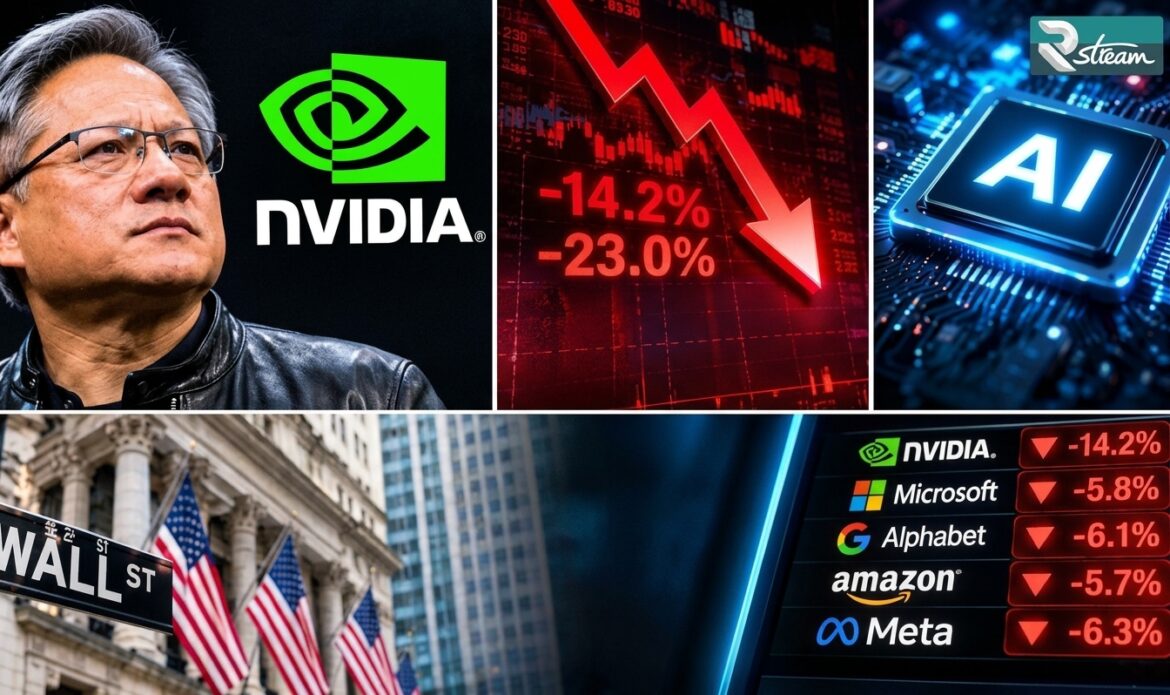
Artificial intelligence, widely expected to transform the world, is now unsettling global stock markets. Investors who were competing to put money into AI companies until recently are now selling those shares. Nvidia, the dominant force in AI, has taken the heaviest blow. Its stock fell nearly 14 percent on Friday alone and lost 23 percent over the week. Shares of other US technology companies also dropped sharply.
The sell-off has raised pressing questions. Why has Nvidia run into trouble so suddenly? Will the trillions of dollars invested in AI be recovered? Is the AI boom the world has banked on coming to an end? These questions are driving a major debate from the United States to Asia.
Why Nvidia matters
AI tools such as ChatGPT answer questions within seconds, photos and videos are being generated by AI, and large companies are using it to carry out a wide range of tasks. But the technology depends on extremely powerful chips, and Nvidia is the top maker of them. Microsoft, Amazon, Google and other firms are building huge data centers for AI, and Nvidia grew rapidly by supplying the chips those facilities need. Investors bought its shares heavily, believing that the faster the AI sector grows, the more business Nvidia will win.
$2.7 trillion wiped off market value
That picture has now changed. Nvidia’s market capitalization, which reached about $5.8 trillion in early October, had fallen to roughly $3 trillion by November 20. In a matter of weeks, nearly $2.7 trillion in value disappeared.
The figure does not mean that money left the company’s bank accounts. It reflects the drop in the total value the stock market assigns to Nvidia’s shares. Even so, the scale of the decline is significant. For one of the world’s most valuable companies to fall this quickly has given investors pause.
Leadership change
The first factor is the change at the top. Jensen Huang, who led Nvidia to its global standing, stepped down as chief executive in the second week of November. The move followed media reports about his personal affairs and subsequent developments within the company. Colette Kress, who oversaw the company’s finances, is serving as interim CEO. Who will be the permanent successor remains unclear.
Investors’ central concern is whether Nvidia can maintain its pace without the person who built it into a giant. They are also asking how new leadership will manage relationships with major customers, development of new chips, and business with China.
SEC scrutiny
A second problem followed. On November 20, Reuters reported that officials at the US Securities and Exchange Commission are examining how Nvidia has presented its business figures. According to the report, regulators are looking at certain aspects of the company’s revenue, expenses and business transactions.
A report of an inquiry does not establish that Nvidia has done anything wrong. But for investors already anxious about the company’s future, the news deepened concerns and led to further selling.
Business remains strong
Notably, Nvidia’s business itself has not been hit. In its latest quarterly results, revenue more than doubled from a year earlier, reaching about $115.8 billion. Of that, more than $107 billion came from the data center business alone. The figures indicate that demand for AI chips remains strong.
Why, then, are the shares falling while the company earns so much? Stock market investors place more weight on what a company can earn tomorrow than on what it earned today, and even a small doubt about the future can trigger selling.
Will AI spending pay off?
A broader question now hangs over the AI sector. Google, Microsoft, Amazon, Meta and other companies are spending hundreds of billions of dollars on data centers and buying very expensive chips. Operating them requires enormous amounts of electricity, and buildings, servers and cooling systems demand still more investment. Whether revenue from AI services will match that spending is the question now troubling investors.
AI usage is indeed growing, but rising usage is not the same as earning a return on every dollar invested. If companies begin to cut costs, the pace of purchases of Nvidia chips could also slow.
US-China tensions
The technology rivalry between the United States and China is another source of pressure. The US government is restricting the flow of advanced AI chips to China, making it harder for companies like Nvidia to do business in one of the world’s largest markets. China, meanwhile, is concentrating on building its own chips.
If competition for Nvidia intensifies, it is unclear whether the company will be able to keep selling chips at today’s high prices. The company therefore faces government restrictions on one side and pressure from new rivals on the other.
Wider market sell-off
The fears have spread beyond Nvidia. On Friday, the Nasdaq fell more than 5 percent, with heavy selling in AI and chip stocks. Concerns about US interest rates added to the pressure. Higher rates make borrowing more expensive for companies and could lead them to cut spending on large projects. They also put pressure on shares bought at high prices in anticipation of big future profits.
Nvidia’s troubles, the expensive valuations of AI companies and the state of the US economy are together pulling the market lower.
Is the AI boom over?
It would be premature to say so. AI use has not stopped, companies continue to launch new AI services, and chip orders are still coming in. What has changed is investor sentiment. Until now, the belief was that any company with an AI label would see its shares rise. Investors are now asking for numbers: how much has been spent, how much revenue has come in, and when profits will arrive.
That shift is not necessarily bad for the AI sector. Companies with genuinely strong businesses are likely to endure, while those that earned high valuations on the AI label alone may face difficulties.
Attention is now focused on three things: the selection of Nvidia’s new CEO, what emerges from the US inquiry, and the AI spending plans of the big technology companies. If any of these turns negative, the shares could face further pressure. If confidence in the company’s leadership returns and chip sales stay strong, the market could recover.
Nvidia’s slide points to a distinction investors are now drawing: believing AI is a great technology is one thing, and buying shares in it at any price is another. The central question is no longer whether AI has a future, but how much the trillions of dollars being invested in that future will ultimately earn back.