





- Ravi Prakash

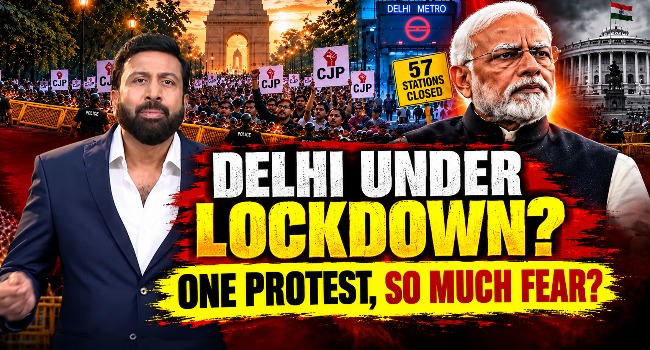
Imagine being a young Indian citizen with questions about how elections are being conducted in the country. What is happening with the voter lists? Are the decisions taken by the Election Commission right? You want answers, and so you decide to take part in a protest in Delhi. But as you prepare to travel, you are hit by one shock after another. The train you were to board has been cancelled. Restrictions are being imposed on the entry and exit points of 57 metro stations in Delhi. Thousands of security personnel are being moved into the capital before the protest even begins. Barricades are going up on the roads, and checks are being increased on routes leading into the city. Activists allege that police are stopping supporters who are travelling to take part in the protest, and that some are being taken into custody.
What is really happening in Delhi? Why are such massive security arrangements being made ahead of the protest scheduled for October 10, which demands the resignation of Chief Election Commissioner Gyanesh Kumar? Is this a precautionary measure to protect law and order, or do the restrictions endanger the very right to protest peacefully? If the government and the Election Commission believe the allegations against them are false, should they answer the questions with facts and transparency, or only by denying permission for protests? This report examines each development in turn, from the Delhi Police decision to the metro restrictions, from the cancellation of Rajdhani Express trains to the deployment of security forces, and from the protesters’ allegations to the proceedings in the Supreme Court. The story is no longer just about a protest. It is also about the relationship between citizens who want to question the government, and the government itself.
Why police denied permission
The Cockroach Janta Party (CJP) had planned to hold a protest at Jantar Mantar in Delhi on October 10. The main demand of those taking part was that Chief Election Commissioner Gyanesh Kumar should resign. Delhi Police, however, denied permission, citing three reasons.
First, police said the application for the protest was received on October 7, only three days before the event, whereas guidelines normally require an application to be made ten days in advance. Second, police alleged that certain conditions imposed during a previous protest had not been followed. Third, they said the protest could cause problems for law and order and traffic. Police also pointed out that Section 163 of the Bharatiya Nagarik Suraksha Sanhita (BNSS) is in force in the New Delhi district.
This is where the real question begins. Protecting law and order is the responsibility of the police, and there is no doubt about that. But denying permission for a protest is one thing. How necessary, and how reasonable, are the measures being taken to ensure that the protest does not take place? That is now the subject of debate. The CJP, for its part, views the protest as a democratic right and has objected to the denial of permission. There are thus two aspects: the police argument about law and order on one side, and the citizens’ right to protest on the other. How the balance between the two should be struck is the real question.
Why 57 metro stations
The actions of Delhi Police were not confined to the protest site. According to reports, police asked the Delhi Metro Rail Corporation to close the entry and exit gates at 57 metro stations from 9 pm on October 9 until the situation is brought under control. It must be made clear that this does not mean the entire Delhi Metro system was shut down. Reports say the request was to close the gates of 57 stations. Even so, the question is a big one: why was it necessary to impose restrictions on so many metro stations in connection with a single protest?
In the eyes of the authorities, this may be a precautionary measure, aimed at preventing large numbers of people from gathering, avoiding traffic problems and protecting law and order. But what of the ordinary commuter? A person who has to go to the office, a person who has to go to the hospital, a passenger who has to reach the railway station: how much will these restrictions affect them? That too needs to be discussed. In a democracy, just as the right to protest is important, ensuring that the movement of ordinary people is not disrupted is equally important. Whether measures taken in the name of security remain within necessary limits should be examined on the basis of facts.
Why Rajdhani Express trains were cancelled
The story that began at the Delhi Metro gates has now reached the railway stations. Even before the protest, the movement of some major trains has been affected. According to reports, the Howrah–New Delhi Rajdhani Express and the Sealdah–New Delhi Rajdhani Express, which were to depart on October 9, have been cancelled. Reports also say that some other trains arriving at and departing from New Delhi and Hazrat Nizamuddin stations between 4 am and 2 pm on October 10 face cancellations and disruptions. Railway officials are reported to have cited traffic problems and the difficulties passengers would face in reaching the stations.
One important point must be remembered: there is no evidence to confirm that all these trains were cancelled with the intention of stopping the protest, so it would not be right to reach such a conclusion. However, when restrictions on metro stations, train cancellations and massive security arrangements appear together before a protest, it is natural for questions to arise among the public. How big a security threat did the authorities actually assess? What steps have been taken to reduce inconvenience to passengers? Clear answers are needed.
There are also reports of further restrictions on businesses and the movement of people in parts of Delhi. Reports said liquor retail shops would be shut and that restrictions would be imposed on hotel bookings in central Delhi. With railway services affected on one side, metro movement disrupted on another, and restrictions on hotels, local transport and public gatherings on yet another, the combined impact, if all take effect at once, is likely to be significant for ordinary life in the city. Taking security measures is the government’s responsibility, but the impact of those measures on the lives of ordinary citizens must also be taken into account.
Why 23,000 security personnel
News reports have stated that 23,000 personnel of the Central Armed Police Forces (CAPF) have been made available for security in Delhi. It is reported that 221 companies of CAPF have been made available to Delhi Police from October 8 to 12. Taken together with the restrictions on metro stations, the train cancellations and the denial of permission for the protest, the figure shows how seriously the authorities have viewed the situation.
Here too, one thing must be made clear. The deployment of security personnel does not mean the protesters will resort to violence. Nor can it be concluded, merely because such massive arrangements have been made, that the government is suppressing democratic rights. What threat did the authorities assess? What is the basis for that assessment? Are the measures taken beyond what was necessary? These questions need to be examined. On one side lies law and order, on the other democratic rights, and maintaining the balance between the two is of the utmost importance for any democratic government.
The controversy behind the demand for Gyanesh Kumar’s resignation
The CJP has called for the protest demanding that the country’s Chief Election Commissioner resign. The central point of the controversy is the process of revising electoral rolls, particularly the Special Intensive Revision (SIR), a process of specially and comprehensively examining and revising voter lists.
The Election Commission says the aim of the process is to remove errors in voter lists, identify cases where one person’s name appears in more than one place, examine ineligible names and correct the details of eligible voters. The process has also drawn criticism. Critics are concerned that people unable to submit proper documents, including the poor, migrant workers and eligible citizens who cannot provide the required details for other reasons, may also have their names removed from the voter list. This concern, however, should not be treated as an established fact that voters’ names have been unlawfully removed everywhere. Allegations, evidence and official figures must be examined separately.
This is where the real democratic question lies. Is it necessary to cleanse the voter list? It is. But whose responsibility is it to ensure that not a single eligible voter loses the right to vote in the process? That is the Election Commission’s responsibility, because a vote is not just a mark. It is one of the most vital rights a citizen has in a democracy. The debate over SIR has therefore gone beyond a political controversy and become a question about the security of the right to vote.
Who has the right to protest
Article 19(1)(a) of the Constitution guarantees citizens freedom of speech and expression, and Article 19(1)(b) guarantees the right to assemble peaceably and without arms. The right to question the government, to oppose a policy and to protest peacefully is vital in a democracy. These rights, however, carry certain legal limits: public order, the rights of others and lawful restrictions must also be taken into account.
Both considerations are therefore important. The government must protect law and order. At the same time, when restrictions are imposed on the right to protest, there must be answers to whether they are lawful, necessary and reasonable. Saying that a protest will cause traffic problems is one angle. Examining how necessary it is to deny permission on that ground is another. This is not only a discussion about a police decision. It is also about the balance between citizens’ rights, the government’s responsibilities and constitutional values.
Were activists stopped across the country?
The CJP has alleged that some activists who wanted to travel to Delhi and take part in the protest were stopped in various places and that some were taken into custody. Videos and posts also circulated on social media. Each of these allegations needs to be independently verified, and news reports have stated that some videos could not be independently verified.
Two things must therefore be looked at separately: the allegations made by the activists, and the evidence that can be independently confirmed in relation to them. Without evidence, it cannot be said that every allegation is true. At the same time, when serious allegations are made, setting them aside without examination is also not right. If anyone has been detained, under which law were they held? What were the reasons? Was legal procedure followed? There must be clear answers. In a democracy, the law applies to protesters, and it applies equally to the officials who enforce it. No one is above the law.
What the Supreme Court has said
Another important development is the hearing in the Supreme Court. On October 9, the court heard matters related to the issue. In view of the protests planned for October 10, it told the Centre not to completely suspend train services to Delhi. It also directed that Delhi Metro stations should not be closed, and advised that train services be regulated so that ordinary people face no inconvenience.
A hearing taking place in court is one thing, and a final decision that the restrictions are unconstitutional is another. The specific orders given by the court, their scope and subsequent developments should therefore be reported only on the basis of official orders. Why do such disputes reach the courts in a democracy? Because the government has the responsibility to protect law and order, while citizens have the right to express their opinions, and when the two collide, the judiciary plays a key role in examining legality. In this matter, rather than the angle of who won and who lost, what matters is what the Constitution says, what the law says and what the court has ordered.
Putting it all together
On one side stands the call for a protest demanding the resignation of CEC Gyanesh Kumar. On the other are the denial of permission by Delhi Police, the order to close the entry and exit gates at 57 metro stations, the cancellation of some trains including the Rajdhani Express and disruptions in movement, reports that around 23,000 CAPF personnel have been made available, and the Supreme Court’s direction to the Centre not to close metro stations. Together, these show how seriously the Delhi authorities have taken the protest.
On the basis of these developments alone, however, it cannot be said that every allegation behind the protest is true. Likewise, merely because security measures were taken, it cannot be concluded that citizens’ rights have been violated. Facts must be examined with evidence. The question the matter raises, though, is an important one. How far does the right to protest endure in a democracy? How necessary are restrictions imposed in the name of law and order? What steps are being taken to ensure that eligible voters do not lose their right to vote? These questions do not concern just one institution. They concern the democratic system.
In a democracy, just as holding elections is important, it is equally important that people have faith in those elections. Criticism of the Election Commission must be answered with evidence. Doubts about voter lists must be examined transparently. If people want to protest, their rights must be respected within lawful limits. At the same time, it is the responsibility of organisers to ensure that protests are held peacefully.
Democracy is not just about casting a vote. It is about questioning, about demanding answers, and about making those in power accountable. The final question is therefore a simple one. By controlling a protest, are we protecting law and order, or can we protect people’s trust by answering the questions behind that protest? The difference between the two is very big. In a democracy, just as the right to vote is important, the right to question is equally important. Democracy is not just about casting a vote. It is also the right to question the government.