





- Ravi Prakash

Imagine being fully eligible to vote. You have every document in order. The Electoral Registration Officer who reviewed your case has confirmed you qualify to be on the voter list. And yet, your name never makes it onto that list — not because you were rejected, but because the software had no way to record the officer’s approval. This, according to a sensational investigation by Indian Express journalist Ritika Chopra, is precisely what happened to numerous voters in Goa. And the story does not end there.
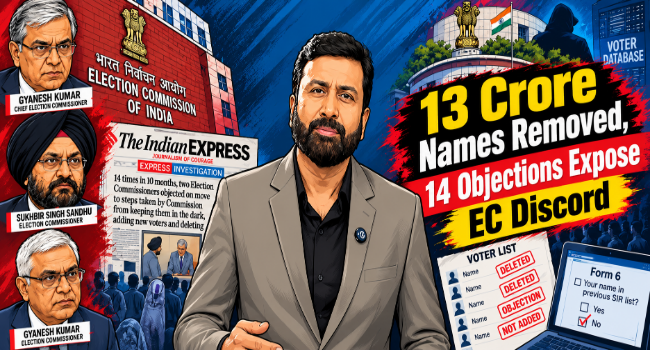
The investigation reveals something far more serious: a rebellion brewing inside the Election Commission itself, over the very document that forms the heart of India’s electoral system — the voter list. And crucially, this was not raised by junior officials. It was raised by two of the Election Commission’s own three members. Election Commissioners Sukhbir Singh Sandhu and Vivek Joshi formally recorded objections at least 14 times over 10 months, the investigation finds — on one occasion raising four separate objections in a single day. This is where the real question begins: who actually controls the voter list in this country? Is it the officials legally empowered to make these calls? The three-member Election Commission? Or the software that runs the entire system?
To understand this, it helps to first understand what the Election Commission actually is. It is not one person — it comprises three members of equal standing: Chief Election Commissioner Gyanesh Kumar, and Election Commissioners Sukhbir Singh Sandhu and Vivek Joshi. Decisions are meant to be taken unanimously wherever possible; where opinions differ, the majority prevails. That means if two of the three agree, their view becomes the Commission’s official position. According to the investigation, Sandhu and Joshi together raised at least 14 formal objections over the past 10 months, questioning decisions taken without their knowledge or consent — and pointing to orders that were issued without their approval.
These objections were not minor. They covered the addition of voters’ names, the deletion of names, the restoration of names, appeals related to the voter list, and — critically — the IT system that runs the entire voter database. All of this unfolded even as the country was undergoing a massive Special Intensive Revision, or SIR, of its electoral rolls. According to Indian Express, more than 13 crore names disappeared from draft voter lists across 30 states and union territories during this exercise — a scale that has itself become a flashpoint, with critics arguing the entire SIR process lacked formal Election Commission approval and should be scrapped altogether.
The First Fault Line: Software
In January, the Election Commission rolled out a new digital platform, ECINET, intended to bring various election-related applications and portals under one system. According to the investigation, both Sandhu and Joshi objected to the way this system functioned. Their concern was pointed: Electoral Registration Officers are legally empowered to add, remove, and correct voter names — but has that authority been quietly eroded by software design? Has control over the voter database effectively migrated from local officials to an IT division based in Delhi? These are the very questions the two commissioners are reported to have raised.
The case of 97 voters in Goa illustrates exactly this tension. According to the investigation, these voters submitted every required document. Election officials reviewed their cases and determined they were eligible. The official said yes — but the software offered no option to register that decision. As a result, all 97 were left off the final voter list. Is this simply an isolated glitch affecting 97 people? Or is it evidence of a far larger problem — a system capable of overriding a legally eligible citizen’s right to appear on the voter list?
The Second Fault Line: Form 6
Form 6, the form used to register new voters, became the site of a second dispute. In July, a new question appeared on the ECINET version of the form, asking applicants whether their name — or their parents’ or grandparents’ names — had appeared on the previous SIR voter list. According to the Indian Express report, applicants who could not answer this question were unable to proceed with their registration at all.
The report states that Vivek Joshi had flagged, as early as May, that any such change required a corresponding amendment to the law — a position Sandhu is said to have shared. Nevertheless, the change went into effect. On August 13, Sandhu is reported to have described the addition as “unauthorized and illegal” and demanded its immediate removal. It should be noted these are characterizations attributed to Sandhu, not a judicial ruling — but the underlying question lingers: who holds the authority to alter voter registration procedure? And if two of the Commission’s own members objected to the change, how did it come into force regardless?
The Third Fault Line: West Bengal
In West Bengal, the story escalates further. During the SIR, nearly 60 lakh voters were flagged under the category of “logical discrepancies.” The Supreme Court intervened, assigning judicial officers to oversee decisions on additions and removals. Roughly 27 lakh names were ultimately removed, while around 33 lakh voters retained their place on the rolls — but then came another twist: a wave of appeals. According to Indian Express, 38 lakh appeals were filed in total — 22 lakh from voters seeking to have removed names restored, and another 16 lakh seeking removal of names that judicial officers had chosen to retain.
This is where Sandhu raised some of his sharpest questions: who authorized these appeals on the Election Commission’s behalf? Who approved them? Who actually filed them? According to the report, Sandhu noted that neither he, nor Joshi, nor even West Bengal’s Chief Electoral Officer had knowledge of the process behind these appeals. In effect, a judicial officer would place a voter on the list, only for an appeal to surface seeking that same voter’s removal — begging the obvious question of who initiated it and on what authority.
Escalation: The July Showdown
By late July, the friction moved beyond the voter list itself and into the Commission’s administrative machinery. A new official was appointed to head the Election Commission’s Administration Division in Delhi, followed by a “Work Allocation Order” that the two commissioners believed could shift control over certain IT-related files. Neither Sandhu nor Joshi was informed in advance, and when one commissioner requested the relevant file, it was reportedly withheld.
What followed was unusual by any standard: the two commissioners separately wrote to Cabinet Secretary T.V. Somanathan, describing the order as a clear violation. The very next day, Sandhu and Joshi jointly moved to set the order aside — meaning two of the Commission’s three members had effectively blocked a decision on their own. This is no longer a routine administrative dispute; it strikes at a much bigger question — who really controls the IT division within the Election Commission of India?
Such friction is not entirely without precedent. In 2009, a Chief Election Commissioner recommended the removal of a fellow commissioner. In 2019, another commissioner boycotted meetings to have his dissent officially recorded. But the investigation stresses that the current situation is fundamentally different: those earlier episodes involved a single commissioner objecting to a single issue. This time, two of three commissioners — a clear majority — say they were repeatedly kept in the dark on key decisions and processes. Compounding this, the report notes that the full three-member Commission did not meet even once between May and August, before finally convening on September 9.
Why Should an Ordinary Voter Care?
On the surface, this may look like officials trading accusations behind closed doors. But the stakes run deeper, because elections do not begin on polling day — they begin with the electoral roll. To vote, your name must first appear on the list. Even a fully eligible citizen cannot cast a ballot if their name is missing. That is why the machinery that maintains the voter list matters so much. Thousands of officials nationwide add, remove, and correct names, review objections, and process appeals — but if real control over the system they operate lies elsewhere, a critical question emerges: when an official says a person is eligible but the software won’t record it, who has the final say — the official, or the system?
Opposition voices have seized on the findings. Congress leader Rahul Gandhi has repeatedly alleged that voter lists have been manipulated, pointing to the deletion of lakhs of names in states such as Maharashtra and Haryana, and demanding accountability from those responsible. Some critics have gone further still, describing the allegations — if true — as nothing short of an assault on democracy and calling for independent investigation, including potential Supreme Court scrutiny, given the Election Commission’s status as a constitutional body.
The Election Commission, for its part, firmly rejects the characterization that SIR-related decisions were taken without any commissioner’s knowledge. Its position is that raising questions and debating them internally is simply part of normal institutional process, and that every major decision — including those tied to the SIR — carried the unanimous approval of all three commissioners.
So the story has two competing accounts. On one side: 14 documented objections, questions over the software, disputes over Form 6, and unanswered questions over the West Bengal appeals. On the other: the Commission’s insistence that every decision was unanimous. Where does the truth lie between these two versions?
Ultimately, this story is not just about 97 voters in Goa, or West Bengal, or the SIR, or ECINET. The real question is far bigger: who controls India’s voter list? Who adds a name, and who removes one? Who restores a name once deleted, and who can challenge a decision to keep a name on the rolls? Who controls the software, and who holds access to the underlying database? And if a decision is disputed, who checks whom? The entire rationale for a three-member Election Commission is that decisions are made together, with the majority prevailing when opinions differ. Yet according to this investigation, two of those three members say they were repeatedly left out of decisions that were theirs to make. That, more than any single incident, is the crux of the entire story — and it raises a serious question about public confidence in how India’s Election Commission is functioning, one that observers say may ultimately warrant scrutiny from the Supreme Court itself.
Whichever party stands to gain or lose politically is beside the point. The real question is whether the very systems built to safeguard India’s voter list are functioning as intended — because before any citizen decides who to vote for, one question must be answered first: is their name on the list at all? And who, in truth, holds the power to make sure it stays there?