





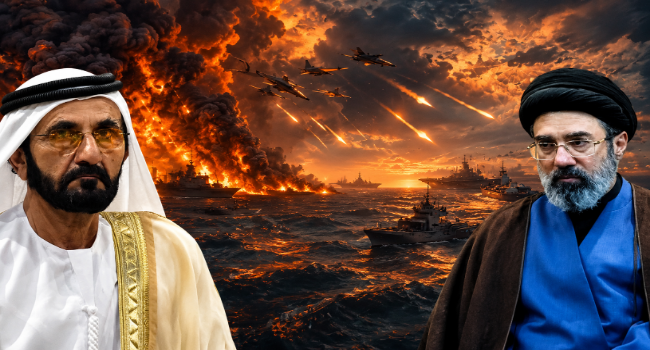
Dubai has dealt Iran a significant setback, announcing the suspension of all trade, commercial activities, and financial transactions with the country. The decision by the UAE has now triggered intense debate. Why would the UAE — which has long maintained strong economic ties with Iran — suddenly take such a drastic step? What threat does the UAE face from Iran? What impact will this business cutoff have on Iran? And what is the current situation in the Gulf? Here’s a detailed look.
Since the war broke out in the Middle East, Iran has been lashing out at Gulf nations. In retaliation for joint Israeli-American strikes, it has been attacking US military installations and air bases located in Gulf countries — and the fallout has reached the UAE as well. Most recently, UAE air defense systems detected two ballistic missiles heading toward the country from Iran. In response, UAE authorities sent emergency alerts to residents’ phones, warning them to move to safe locations immediately. Shortly after this incident, the UAE announced it was suspending all trade, commercial activities, and financial transactions with Iran until further notice.
For several weeks now, the UAE has accused Iran of targeting its oil tankers and commercial vessels. In particular, it says a series of attacks have taken place in the Strait of Hormuz on vessels belonging to ADNOC, the UAE’s prominent state-owned oil company. The UAE has revealed that ADNOC vessels have come under attack multiple times since the war began. As a result, the threat Iran poses to the UAE is no longer limited to missile strikes alone — it has also become a maritime security issue. With attacks on oil tankers continuing, concerns have grown over energy supplies, shipping routes, and trade. Against this backdrop, the UAE and Iran had reached an agreement back in June. UAE sources say that during the roughly two months the agreement was in effect, they faced no major attacks. However, the situation changed again once the agreement’s term ended. Tensions between the two countries flared up once more when a missile threat targeted the UAE the very day after the agreement expired. Taking the threat from Iran seriously, the UAE has now taken a firm decision affecting trade and economic relations as well.
The latest incident has made the situation even more serious. According to the UAE Ministry of Defence, one missile fell outside the UAE’s territorial waters, while another crashed within them. It was after this incident that the UAE took its key decision regarding relations with Iran, announcing that all trade activities, commercial exchanges, and financial transactions with Iran would be suspended until further orders. The UAE Ministry of Foreign Affairs made clear that the decision was taken against the backdrop of escalating regional tensions.
Iran and the UAE have long shared strong business ties, with Dubai serving as a key trading hub for Iran. Business between the two countries spans several sectors, including imports, exports, re-exports, shipping, and financial services. That is why the UAE’s move to halt these trade and financial transactions amounts to a decision that directly ratchets up economic pressure on Iran. For a country already struggling under the weight of war, sanctions, and trade restrictions, the closure of business channels with the UAE could deal it yet another economic blow.
The impact is likely to be felt particularly in import-export and re-export business, shipping, and payments. Since the UAE’s commercial and financial network is critical to Iranian businesses, the halt in these transactions could create difficulties for Iranian companies and traders in payments, shipping, and supply chains. In other words, the UAE’s decision is not merely about halting trade between the two countries — it also strikes at routes that are vital to Iran’s broader business ecosystem.
Another major challenge facing the UAE is the Strait of Hormuz, one of the world’s most critical routes for oil and maritime shipping. With Iran currently refusing to fully reopen this route, shipping traffic through Hormuz has been severely disrupted. If this situation persists, it could affect oil supply, transport, and trade across the entire Gulf region, not just the UAE. The UAE is therefore calling on Iran to ease tensions and restore normal shipping traffic through the Strait of Hormuz.
Amid these developments, tensions across the Gulf region have risen further. On one hand, the missile and drone threat from Iran continues; on the other, Gulf nations have placed their air defense systems on high alert. Compounding this, Iran’s continued warnings over Hormuz have heightened concerns over the safety of oil tankers, shipping routes, ports, and energy infrastructure. As a result, the war’s impact is no longer confined to the battlefield — it now appears to be spilling over into global trade, oil supply, and energy markets.
In sum, with a missile threat on one side and tensions over Hormuz on the other, trade relations between the UAE and Iran have now also been severed. The key question now is which direction the situation in the Gulf will take. How will Iran respond to this counter-shock from the UAE — will it halt its attacks and move toward talks, or will it escalate the war further? That remains to be seen.