





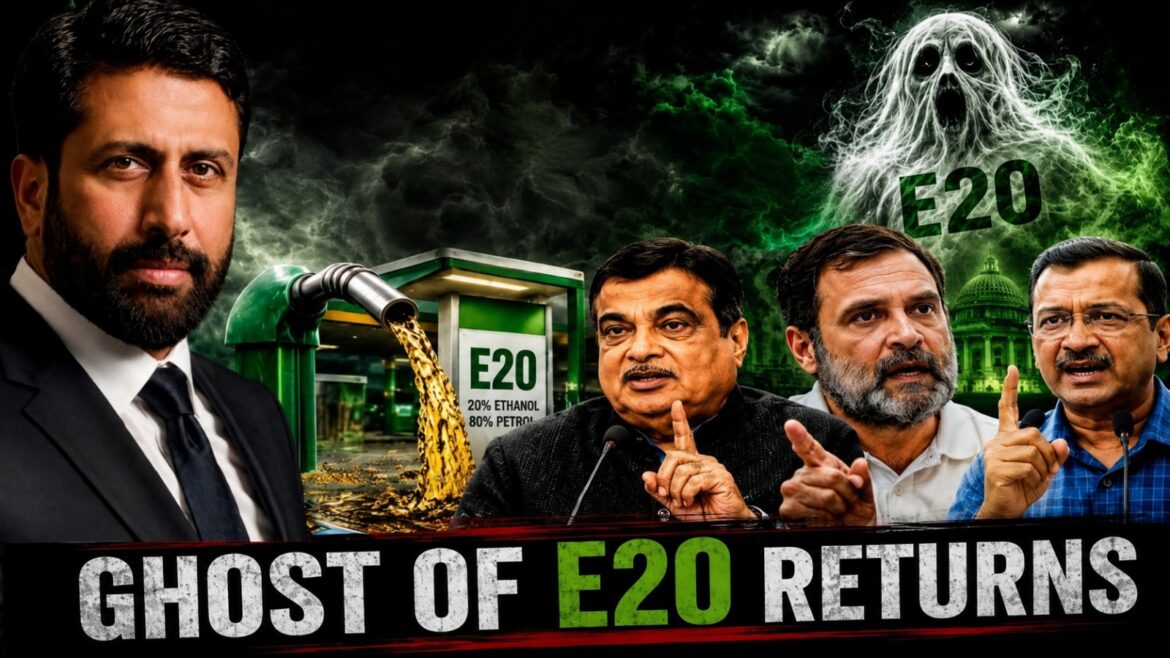
-Ravi Prakash

Congress leader Rahul Gandhi has launched one of his sharpest attacks yet on the Narendra Modi government, describing the E20 petrol policy as one of the biggest scams in recent memory. Using a pointed Hindi phrase to suggest that the flaw runs through the entire policy rather than being an isolated lapse, Gandhi alleged that the damage caused to vehicles and the financial burden placed on citizens is not coincidental but reflects a systemic failure. He argued that this is not merely a wrong decision, but a flaw embedded in the policy itself. E20 has been one of the most significant energy policy decisions taken by the Indian government in recent years, and the Congress party has now announced a nationwide protest against it. Notably, Gandhi was not the first to raise this issue — Delhi leader Arvind Kejriwal has been criticizing the policy for several weeks, demanding that regular petrol remain available alongside E20 so that consumers retain the right to choose, and questioning whether an unwanted fuel is being imposed on the public.
E20 refers to petrol blended with 20 percent ethanol and 80 percent regular petrol, following a phased increase from earlier blends such as E5 and E10. Ethanol, a fuel-grade alcohol produced primarily from sugarcane, corn, and other agricultural products, is blended with petrol and distributed through fuel stations. The government has cited four key justifications for the policy: reducing the country’s oil import burden and foreign exchange outflow, given that a large share of India’s crude oil is imported; lowering vehicle emissions compared to regular petrol; benefiting sugarcane farmers and sugar mills through increased ethanol demand, thereby strengthening the rural economy; and positioning the policy as a broader national energy reform that reduces pollution, supports farmers, and cuts import dependence. Vehicle manufacturers have also begun introducing E20-compatible models to the market in line with the policy.
Despite these stated objectives, the controversy has centered on specific allegations raised by Kejriwal and Gandhi. Kejriwal has campaigned extensively through media briefings and public meetings, raising several core concerns: that vehicle owners are experiencing reduced mileage, declining engine performance, and rising maintenance costs after switching to E20, effectively bearing hidden additional costs without full awareness; that consumers have not been given the choice between regular petrol and E20 despite the government’s claims of the fuel’s benefits; that E20 prices have not been reduced despite it containing 20 percent domestically produced ethanol, which should in principle make it cheaper than regular petrol; and that the policy was rolled out without adequate public awareness or transparency. Kejriwal has additionally alleged that the ethanol blending decision was driven not by the interests of Indian farmers, but by a need to purchase surplus ethanol stockpiles from the United States.
The government, oil marketing companies, and automobile manufacturers have rejected these allegations, maintaining that new vehicles are indeed being manufactured to be compatible with E20 fuel. On social media and other public platforms, vehicle owners, mechanics, and taxi drivers have shared mixed experiences — some report a drop in mileage, while others report no noticeable difference. Given that vehicle mileage is influenced by multiple factors, including traffic conditions, driving style, tire pressure, engine condition, and weather, drawing firm conclusions without scientific evidence would be premature.
A key unresolved question in this debate concerns older vehicles already on Indian roads. Even if newly manufactured E20-compatible vehicles face no issues, it remains unclear whether owners of the millions of pre-existing vehicles have any option to access pure petrol instead. While Rahul Gandhi has termed the policy a “massive scam,” the government continues to defend it as a long-term national energy reform.
Resolving this dispute will require more than political rhetoric or government assurances alone. Given the seriousness of the term “scam,” the opposition will need to present concrete evidence and financial records to substantiate its claims, while the government carries a corresponding responsibility to address public concerns through transparency and independent research findings. With the interests of crores of fuel consumers at stake, it is credible evidence and clear policy communication — rather than competing claims — that will ultimately determine whether E20 is remembered as a successful reform or remains a contested and controversial policy.