





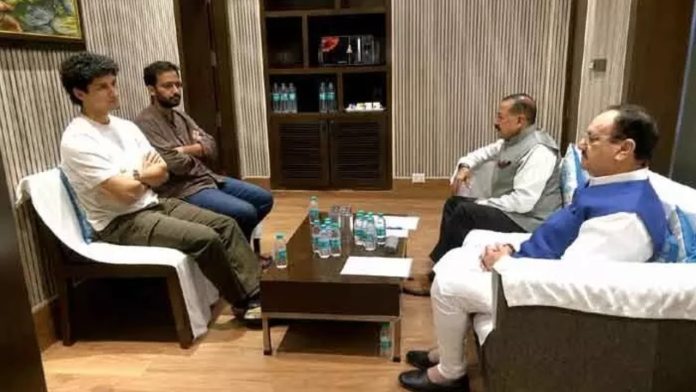
The NEET paper leak controversy, which has caused widespread concern among lakhs of students and parents across the country, along with demands for a complete overhaul of the education system, has intensified the political atmosphere in the national capital, Delhi. A crucial meeting held between Central Government representatives and the delegation from the Cockroach Janata Party (CJP), which is leading the protests, at the Constitution Club in Delhi has generated significant anticipation nationwide.
Representing the Central Government at these high-level talks were BJP National President and Union Health Minister J.P. Nadda, along with PMO Minister of State Dr. Jitendra Singh. The government undertook this dialogue directly in an effort to address the intense dissatisfaction within the education system and respond to the mounting pressure from students.
On the other side, the CJP delegation attending the meeting included senior representatives Saurabh Das, Ashutosh Ranka, and Abhijeet Deepke. The CJP placed the grievances of affected students and the shortcomings within the education system clearly before the Union ministers, making it clear from the outset that they would not accept any half-measures or temporary assurances from the government.
The most significant demand raised by the CJP during these extended discussions was the resignation of Union Education Minister Dharmendra Pradhan. CJP leaders firmly insisted that Dharmendra Pradhan must step down immediately, taking moral responsibility for the NEET paper leak and the repeated failures of the National Testing Agency (NTA), stating that his removal would be the only genuinely decisive action.
During the meeting, which lasted over an hour and a half, the CJP delegation submitted a comprehensive written memorandum to the Central Government, outlining three primary demands:
The immediate resignation of the Education Minister.
Compensation of ₹1 crore each to the families of affected students who died by suicide due to the mental distress caused by NEET irregularities and leaks.
That no FIR be registered against any student protesting for their future.
Responding to the CJP’s proposals, the Centre reacted positively, assuring that it would withdraw cases already registered against protesting students, keeping their futures in mind, and would ensure that no new FIRs are filed against them. The ministers clarified that it was not the government’s intention to bring students within the ambit of criminal proceedings.
While these discussions were underway, information emerged that the Union Cabinet had taken a key decision aimed at curbing paper leaks. The Cabinet approved an amendment bill prescribing imprisonment of up to ten years and heavy fines for those found guilty of leaking examination papers. However, the CJP made clear that mere announcements of fast-track courts or new laws would not suffice.
The CJP asserted that it is the government’s responsibility to support the families of students who lost their lives due to the severe stress caused by the leak controversy. They demanded compensation of ₹1 crore for each affected family, along with support for one eligible family member, and called on the government to recognize the hardships faced by underprivileged and middle-class families.
Responding to the demand for Dharmendra Pradhan’s resignation, Union Minister J.P. Nadda stated that the matter would be taken up with Prime Minister Narendra Modi and brought before the senior Cabinet on behalf of the government. He attempted to reassure the CJP representatives by stating that the government was committed to improving transparency in the education system.
However, unsatisfied with the temporary assurances given by the Centre, CJP representatives made clear that their protests and struggle would continue until an official announcement regarding Dharmendra Pradhan’s resignation is made. The protesters demanded that mere discussions should not be used to stall for time, and called for Prime Minister Modi to intervene immediately and take a decision.
Although both sides exited the Constitution Club after the meeting concluded, no joint or official statement has been issued so far. However, intense anticipation now surrounds the steps the government will take next regarding developments in the education sector following this meeting.
Overall, the NEET paper leak controversy has not only exposed serious flaws within the country’s education system but has also become a major political challenge for the Central Government. Lakhs of students and parents across the country are watching closely and eagerly awaiting the final decision the Central Government will take on this sensitive issue, one so closely tied to the futures of students.