





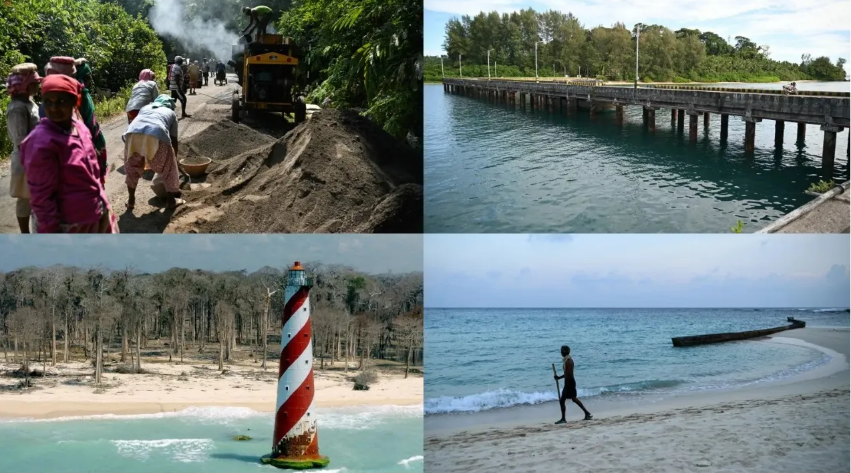
The Centre’s ambitious $11-billion Great Nicobar Island development project has emerged as one of India’s most strategically significant yet controversial infrastructure initiatives. Located near the maritime boundaries of Thailand, Malaysia and Indonesia, the remote island is being positioned as a major trade, logistics and defence hub through plans for an international transshipment port, a dual-use military-civilian airport, a power plant and a large township capable of housing around 350,000 people. While initially promoted as an economic development project, the government has increasingly highlighted its strategic importance amid growing concerns over regional security and China’s expanding presence in the Indo-Pacific.
The island’s proximity to the Strait of Malacca, one of the world’s busiest maritime chokepoints, has elevated its geopolitical significance. A substantial share of global trade, including a major portion of China’s energy imports and commercial shipping, passes through the strait. Defence analysts believe the project could significantly enhance India’s maritime surveillance capabilities and strengthen its ability to monitor naval movements across the Indian Ocean Region.
However, the project has triggered widespread criticism from environmentalists, tribal rights activists and researchers. Concerns have been raised over its potential impact on the indigenous Shompen tribe, which has lived in relative isolation on the island for centuries. Critics argue that a significant portion of the project area overlaps with tribal reserve land, posing a serious threat to the community’s traditional way of life. International experts have also warned that the development could endanger the tribe’s long-term survival, while members of the local Nicobarese community fear displacement and loss of livelihoods.
Environmental concerns have further intensified the debate. According to official estimates, nearly 964,000 trees may need to be cleared to facilitate the project. Experts warn that large-scale construction in the ecologically sensitive region could cause irreversible damage to biodiversity and coastal ecosystems. The island’s location in Seismic Zone V, one of India’s highest earthquake-risk zones, has also raised questions about the feasibility of major infrastructure projects in the area. The region was severely affected by the 2004 Indian Ocean tsunami, which caused significant land subsidence in parts of the island.
The project has also become a political flashpoint, with opposition leaders accusing the government of prioritising large-scale development at the cost of indigenous communities and environmental protection. Critics contend that the initiative is being increasingly framed as a national security project to counter growing opposition, while supporters argue that it is essential for strengthening India’s strategic presence in the Indo-Pacific.
Despite differing views over its long-term implications, analysts agree that Great Nicobar’s location offers India a valuable strategic advantage in monitoring key maritime routes. The debate, however, continues over whether the project’s anticipated economic and security benefits outweigh its environmental, social and ecological costs.