





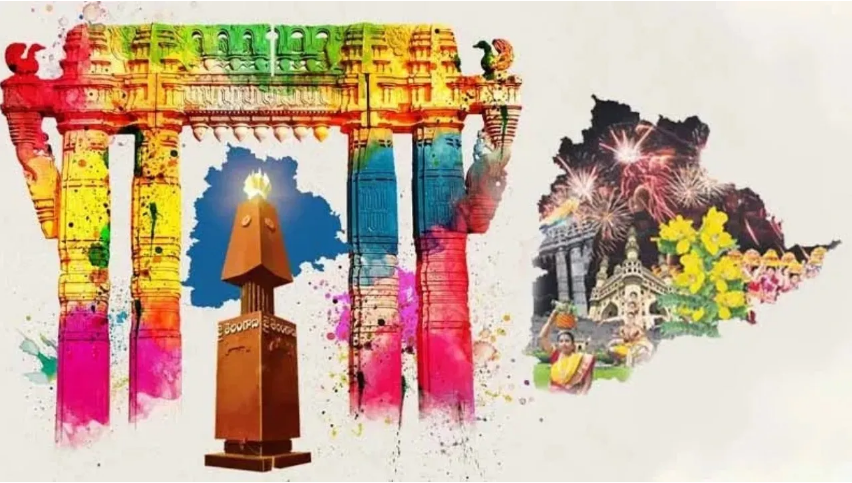
June 2 marks a historic and emotional occasion for the people of Telangana, commemorating the formation of the state on June 2, 2014. The creation of Telangana was the culmination of decades of struggle, public movements, student sacrifices, and political efforts aimed at achieving self-governance for the region’s people. As Telangana completes twelve years as a separate state, its journey from integration into India to attaining statehood remains one of the most significant chapters in modern Indian political history.
Although India gained independence in 1947, the Telangana region continued under the rule of the Nizam of Hyderabad. Following sustained public movements and the Government of India’s military action, popularly known as Operation Polo, the Hyderabad State was integrated into the Indian Union on September 17, 1948. Thereafter, Hyderabad functioned as a separate state until 1956 under the leadership of Chief Minister Burgula Ramakrishna Rao.
In 1956, during the linguistic reorganization of states, the Telangana region was merged with the Andhra region to form the united state of Andhra Pradesh. To safeguard Telangana’s interests in employment, resource allocation, and administration, leaders from both regions signed the historic Gentlemen’s Agreement. Based on these assurances, Andhra Pradesh was officially formed on November 1, 1956.
However, dissatisfaction began to grow as many in Telangana felt that the promises made under the Gentlemen’s Agreement were not being implemented. Concerns over inequitable distribution of funds, water resources, and government jobs led to the first major Telangana statehood movement in 1969. The agitation, spearheaded by students, intellectuals, and government employees, found its epicenter at Osmania University. The movement witnessed widespread protests and police action, resulting in the deaths of more than 300 students. During this period, Marri Chenna Reddy founded the Telangana Praja Samithi, giving the movement a significant political dimension.
In an effort to address regional grievances and restore stability, then Prime Minister Indira Gandhi introduced the Six-Point Formula in 1973. The proposal was accepted by leaders from both regions, leading to a temporary decline in the agitation. Although the movement subsided publicly, feelings of discrimination and regional imbalance continued to persist within Telangana society for the next several decades.
The demand for separate statehood regained momentum in 2001 when Kalvakuntla Chandrashekar Rao (KCR) resigned from the Telugu Desam Party and founded the Telangana Rashtra Samithi (TRS). With intellectual support from Telangana ideologue Professor K. Jayashankar and strong political mobilization by KCR, the statehood demand once again became a major political issue, gaining prominence from village-level discussions to national debates.
A defining moment in the movement came in 2009 when KCR launched an indefinite hunger strike demanding separate statehood. The agitation triggered massive public participation across Telangana, with students, civil society organizations, and ordinary citizens joining the protests. The self-immolation of Osmania University student Kasoju Srikanth Chary further intensified the movement. Facing mounting pressure, the Union Government announced on December 9, 2009, that the process for Telangana’s formation would be initiated. However, opposition from leaders in the Andhra region led the Centre to reconsider its decision and establish the Justice Srikrishna Committee to examine the issue.
As the committee’s recommendations failed to satisfy all stakeholders, the Telangana Political Joint Action Committee (TJAC), led by Professor M. Kodandaram, emerged as a key force in the movement. Mass mobilizations such as the Million March, Sagara Haaram, Chalo Assembly, and the historic 42-day Sakala Janula Samme (general strike) in 2011 and 2012 brought normal life across Telangana to a standstill. The sustained public pressure ultimately compelled the Congress Working Committee (CWC) to approve the formation of a separate Telangana state comprising ten districts in July 2013.
In February 2014, despite opposition from the then Andhra Pradesh government led by N. Kiran Kumar Reddy, the Union Government introduced the Andhra Pradesh Reorganisation Bill, 2014, in Parliament. Following intense debates, the bill was passed by both the Lok Sabha and Rajya Sabha and received presidential assent on March 1, 2014.
Finally, on June 2, 2014, Telangana officially became the 29th state of India. K. Chandrashekar Rao, the principal architect of the movement, was sworn in as the state’s first Chief Minister, fulfilling the long-standing aspiration of millions of people. To symbolize Telangana’s unique identity, the state adopted the Indian Roller (Palapitta), Spotted Deer, Jammi Tree, and Tangedu Flower as its official state symbols.
Twelve years after its formation, Telangana continues to commemorate the sacrifices of countless individuals whose efforts and aspirations paved the way for the realization of a separate state and a distinct regional identity.