





-Ravi Prakash

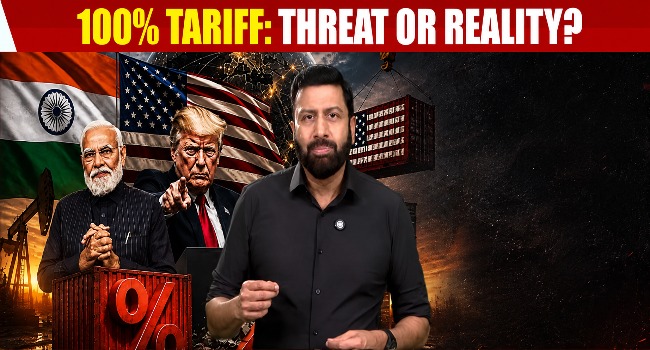
Is another difficult phase approaching in the Narendra Modi–Donald Trump relationship? Is the United States preparing to increase pressure on India once again? Is there truly a possibility of tariffs of up to 100 percent being imposed on India? Is Donald Trump quietly setting in motion a much bigger game behind the scenes? These are pressing questions that demand answers today, because developments in the United States over the past few hours could have a serious impact on India.
The US Senate has passed a major sanctions bill targeting Russia and Iran, clearing it with an overwhelming vote of 86 to 11. Buried within this legislation is a provision that India will need to watch very carefully. Should the bill also clear the House of Representatives and be signed into law, the American president would gain the authority to impose tariffs of up to 100 percent on countries that purchase large quantities of oil or gas from Russia. India is among the principal countries that could be affected by this provision.
It must be stated clearly that the United States has not yet made any formal announcement against India. Only the Senate has passed the bill; the House of Representatives still has to take it up, and only if it clears there too would it become law. Even so, the scale of the Senate’s majority is not something to dismiss lightly — it amounts to a significant warning shot for India. What was once simply an energy decision, India’s continued purchase of Russian oil, has evolved into a major geopolitical and trade issue, one with the potential to strain the broader India-US relationship.
The questions worth examining are why India finds itself in America’s crosshairs, what a 100 percent tariff would actually mean in practice, which Indian industries stand to be hit hardest, whether India can realistically halt its Russian oil purchases, and what such a move would mean for the country’s energy security. At the heart of it all lies the biggest question: is the Modi-Trump relationship heading toward friction, and what exactly is unfolding behind the scenes?
Understanding why the United States has suddenly turned its attention to India requires focusing on a single factor — Russian oil. Following Russia’s invasion of Ukraine, the United States and its allies imposed sanctions on Moscow, working to cut off the revenue Russia earns through energy exports. India, however, never stopped purchasing crude oil from Russia, for a straightforward reason: with Russian crude available at significantly lower prices, India has been able to meet its vast energy needs without difficulty. From India’s perspective, this was never an act of defiance against the United States — it was a matter of energy security, pricing, supply, and national interest.
Washington views the issue through an entirely different lens. Its argument is that as long as countries continue purchasing large volumes of oil and gas from Russia, energy revenue will keep flowing into Moscow. Increasing economic pressure on Russia, by this logic, cannot be achieved by targeting Moscow alone — it requires targeting Russia’s biggest energy customers as well. This is precisely why the new US legislation carries such weight: if the bill passed by the Senate becomes an Act, the American president would be empowered to impose tariffs of up to 100 percent on countries that are major consumers of Russian energy. India is specifically named among the countries likely to be affected, alongside China, Japan, and several European nations. Technically, then, this is not a bill designed to punish India — it is a broader sanctions strategy aimed at containing Russia. But for one reason alone, India risks being caught in its crossfire: Russian oil.
The bill introduced by the US Senate is genuinely emerging as a serious headache for India, placing New Delhi in a difficult position. On one hand, Washington is warning India to scale back its oil imports from Russia. On the other, India is left grappling with a basic question: where else can it source the crude oil it needs, and at what price? A large share of the country’s crude requirements must be met through imports, and with Russian oil available at a discount, New Delhi sees little reason to walk away from that arrangement. This has been India’s consistent position — that its energy needs and national interests take precedence. Washington’s warning, however, is unambiguous: India’s standing in the American market will be shaped by how much Russian oil it continues to buy. This is where the real trouble begins, because the dispute is unlikely to remain confined to oil alone. India exports goods worth billions of dollars to the American market every year, giving every Indian exporter reason to take this development seriously.
The trade mechanics can be understood simply. If an Indian company exports a product worth 100 dollars to the United States and a 100 percent tariff is applied, the American importer may be required to pay an additional 100 dollars. This does not necessarily mean Indian exporters will immediately absorb losses of that magnitude — the real economic impact depends on the product involved, any applicable exemptions, contract terms, pricing structures, and ultimately who ends up bearing the tariff burden. What is clear, though, is that a 100 percent tariff constitutes a formidable trade barrier, one that could make Indian products considerably more expensive in the American market. Faced with that scenario, American buyers would have several options: absorbing the additional cost themselves, passing part of it on to consumers, renegotiating prices with Indian suppliers, or simply turning to another country offering the same product. This leads to the next essential question — which Indian industries stand most exposed to such a shift.
For the millions of Indians whose livelihoods are tied to trade, the central question is which sectors would be hit first if the United States were to impose tariffs of up to 100 percent. The United States ranks among India’s most important export markets, and India’s exports there are far from limited to one or two categories — they span pharmaceuticals, electronics, machinery, textiles, garments, gems and jewellery, engineering goods, and chemicals. Consider an Indian manufacturer whose business depends heavily on American buyers: if that manufacturer’s product suddenly becomes markedly more expensive in the US market, buyers may simply turn to alternative suppliers elsewhere. That would force the Indian exporter to cut prices, eroding profit margins, shrinking order volumes, and ultimately requiring cuts to production. The final and most consequential effect would be felt in employment. In this sense, a tariff war is never merely a dispute between governments — its effects eventually reach factory floors, exporters, workers, and, ultimately, poor and middle-class households.
Pharmaceuticals, electronics, machinery, gems and jewellery, textiles, chemicals, and engineering goods form the backbone of India’s exports to the United States, and the American market plays an outsized role in sustaining many of these sectors. Steep tariffs would inevitably erode the competitiveness of Indian goods. Yet there is another dimension to this story: sanctions do not burden only the country being targeted — importers within the United States are also required to pay the tax. This raises an important question of who ultimately bears that cost: the Indian exporter, the American importer, the end consumer in the United States, or some combination of all three. The answer would likely vary from product to product, but one point remains constant — a fully implemented 100 percent tariff would make trade between the United States and India considerably more complicated, bringing into focus the central dilemma at the heart of this dispute.
Even as the United States presses India to scale back its oil imports from Russia, a basic question in New Delhi remains unresolved: where else will India source the crude it needs? India is among the world’s largest consumers of crude oil, and a substantial share of that requirement must be imported. Since the Ukraine war, discounted Russian crude has proven highly advantageous to Indian refiners, allowing them to manage supply effectively and enabling India to keep its energy costs under control. From New Delhi’s standpoint, the relationship with Moscow is not merely political goodwill — it is also a significant economic calculation. With a population exceeding a billion people relying on affordable, refined crude, India sees little incentive to give up that supply voluntarily. Washington’s position, however, is equally clear: continued purchases of Russian oil, in its view, amount to funding Russia’s war effort, and the United States is determined to impose a financial cost on countries that buy Russian energy. This has left India in a genuinely difficult position.
India’s available options can be laid out plainly. The first is to reduce Russian oil purchases, which would avoid the risk of confrontation with Washington. The second is to continue buying Russian oil, accepting the burden of steep American tariffs as a consequence. The third is to significantly increase crude imports from alternative sources such as the Middle East, the United States, and Africa — though this option is far from simple. Switching a major oil supplier is not comparable to changing brands at a fuel station; refineries must be equipped to process different crude grades, and shipping costs, insurance, contractual arrangements, and logistics must all be factored in. Cost remains the decisive consideration: if India is forced to replace cheaper Russian crude with costlier alternatives, that additional expense must be borne by someone — whether the government, oil companies, or ordinary consumers. This is why the question of Russian oil extends well beyond foreign policy; it touches directly on the country’s energy security and the livelihoods of ordinary citizens. Even so, the core question persists — can India realistically walk away from Russian oil altogether?
On the surface, the American demand appears simple: stop buying Russian oil. Why, then, can India not simply comply? The reality is that doing so is far from straightforward. Any pivot away from Russian crude would require India to focus on alternative supply sources, different crude grades, shipping capacity, insurance arrangements, contracts, refinery compatibility, and, crucially, competitive pricing. India can certainly diversify its oil sources, and it is already doing so — but a complete and immediate replacement of Russian crude would come at an additional cost under present conditions. That extra cost would have to be absorbed somewhere, whether by the government, by oil companies, or directly by consumers. The real question, then, is not whether India can stop buying Russian oil — technically, it can — but how steep a price it would have to pay for doing so.
Should India significantly cut its Russian oil purchases and increase imports from the Middle East, the United States, and Africa instead, and should those alternative supplies prove costlier, India’s import bill would rise sharply. It is worth noting that India’s crude oil import bill already comes under considerable pressure whenever global oil prices rise. New Delhi is thus caught between two significant risks: on one side, the trade friction with the United States that stems from continuing to buy Russian oil; on the other, the economic burden of forgoing cheaper oil altogether. India has consistently maintained that its energy purchases are guided strictly by national interest — and this is precisely where the underlying tension originates.
The United States has a clear strategic objective: weakening Russia economically. India, too, has its own strategic priorities — safeguarding its energy security, sustaining its economic growth trajectory, and preserving the freedom to make foreign policy decisions in line with its national interest. It is at this intersection that the goals of Washington and New Delhi come into direct conflict, giving rise to the most compelling question in this unfolding story.
If India does not curtail its Russian oil purchases, it risks facing steep American tariffs that would hurt its exports and erode its competitive edge. If it abandons Russian oil in favour of costlier alternatives, its energy expenses would rise substantially. In other words, there is no option here free of consequence — India must weigh which loss is more manageable and which risk it can absorb more easily. This, then, is not simply a matter of “India versus America” — it is a far more complex calculation. The real twist in this story lies elsewhere: India is not alone in buying Russian oil at scale. China does the same, a fact that fundamentally changes the dynamics of the situation.
China ranks among the largest purchasers of Russian crude, raising an important question: can the United States realistically impose such steep tariffs on both India and China simultaneously? China is not a minor trading partner for the United States — it is one of America’s most significant economic relationships. A trade war with Beijing would carry consequences for American companies, American consumers, and global supply chains alike, and could well push inflation higher within the United States itself. Should Washington deploy this power too aggressively, the fallout would not remain confined to Moscow, New Delhi, and Beijing — it would be felt directly within the American economy. In short, a 100 percent tariff remains, for now, a threat rather than an automatic outcome. The Senate has passed the bill, but the House of Representatives still has to approve it, and even if it becomes law, it would fall to the president to decide how and against whom this power is actually exercised. This is where the real political dimension of the story comes into play.
Modi and Trump have repeatedly described India and the United States as strategic partners, citing cooperation across defence, technology, trade, energy, and artificial intelligence. Yet Russian oil has now emerged as the single biggest point of friction in that relationship. For the first time in this particular phase of ties, the prospect of a 100 percent tariff is being seriously discussed. Whether this represents merely another round of trade negotiations, or signals a larger contest playing out behind the scenes between Modi and Trump, remains to be seen. Should the United States attempt to force India to choose a side, the question is whether New Delhi will yield to that pressure — or respond firmly, in its own manner. That, ultimately, is the real contest underlying this 100 percent tariff warning.
Before concluding, one important fact deserves attention: India is not the only country that could be affected by a 100 percent tariff. Under this revised legislation, the top five countries purchasing Russian crude in significant volumes are China, India, Slovakia, Hungary, and Azerbaijan. Technically, then, this bill was not drafted with India alone in mind — it reflects broader American economic pressure on countries buying Russian energy. However, given the scale of India’s Russian oil purchases, the implications are especially significant from New Delhi’s perspective.
The next major question is whether Donald Trump will actually deploy this 100 percent tariff option. The answer appears to be conditional: should the bill become law and circumstances warrant it, Trump could certainly choose to use it — but there is no requirement that he must. The legislation grants the president discretionary powers to make exceptions in the national interest. At present, this 100 percent tariff remains a threat and a potential instrument of pressure, not a tariff that has actually been imposed.
The story ultimately circles back to Modi and Trump. Is this simply another round of trade negotiations, or is Washington effectively pressing India to choose between Russian oil and access to the American market? India, for its part, must now balance three competing priorities: energy security, economic interest, and strategic autonomy. Going forward, the questions worth watching closely include whether Trump will actually deploy the 100 percent tariff option, whether India can afford to give up Russian oil, who ultimately bears the cost of a tariff war, whether Modi and Trump will arrive at a compromise, and finally, whether this marks the beginning of a broader India-US trade dispute. One thing, however, is certain: the Senate vote is not the final word on this story — it is only the beginning.