





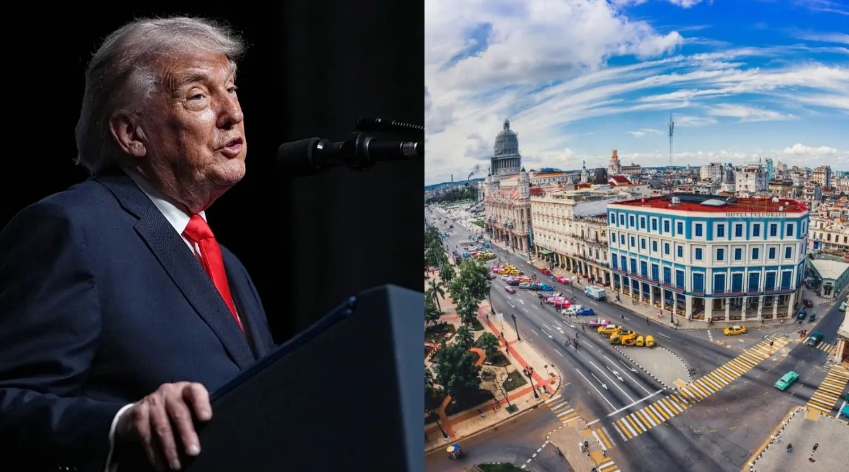
U.S. President Donald Trump has once again stirred international debate with strong remarks on Cuba, stating that the United States would “take control of Cuba” after the conclusion of the ongoing Iran conflict. Speaking at a public event in Florida, Trump reportedly said that Cuba would be taken over immediately once current military priorities are completed, describing the island nation as being in a “difficult situation” that requires urgent U.S. intervention.
Military Posturing and Naval Strategy Claims
In his remarks, Trump indicated a potential military strategy involving the U.S. Navy. He suggested that the aircraft carrier USS Abraham Lincoln would be positioned extremely close to the Cuban coastline, reportedly just 100 yards away, after returning from operations linked to Iran. According to his statement, such a move would be aimed at forcing a quick surrender from Cuba without prolonged conflict, signaling a highly aggressive posture.
White House Position and Security Concerns
The White House has repeatedly maintained that Cuba remains a national security concern for the United States. American officials have accused the Cuban communist regime of supporting extremist activities and contributing to regional instability in Latin America. The Trump administration has also emphasized that countering communist influence in the Western Hemisphere continues to be a key strategic objective.
Decades-Old U.S.–Cuba Hostility
Relations between the United States and Cuba have remained strained for more than 60 years, dating back to the 1959 revolution led by Fidel Castro. Following the communist takeover, Cuba nationalized American-owned assets, which led to a sharp deterioration in bilateral ties. In response, the United States imposed a comprehensive trade embargo in the 1960s, severely restricting diplomatic, economic, and commercial relations.
Economic Impact of Long-Term Sanctions
The prolonged sanctions have had a deep and lasting impact on Cuba’s economy. Restricted access to global markets, fuel supplies, financial systems, and medical imports has significantly weakened the country’s economic stability. Cuba continues to face shortages in essential goods such as food, medicine, and energy, while its infrastructure remains largely underdeveloped, contributing to ongoing domestic challenges.
Geopolitical Dimensions and Strategic Outlook
Trump’s remarks also come amid growing U.S. concerns over alleged Russian and Chinese influence in Cuba. Reports suggest increasing geopolitical competition in the region, with Washington closely monitoring developments. While the statements have intensified political debate, official confirmation of any operational plan has not been provided, and the situation remains highly sensitive as international observers await further clarity.