





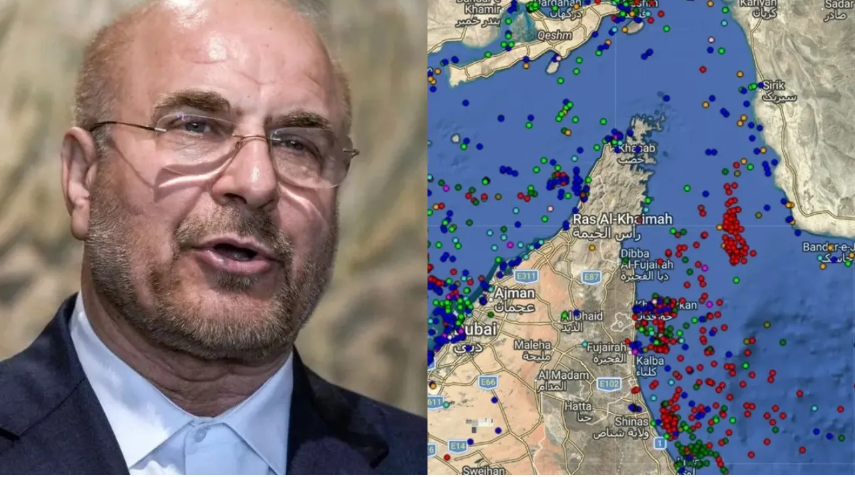
Peace talks between the United States and Iran have reportedly collapsed, escalating geopolitical tensions in the West Asian region. Following the breakdown of negotiations, US President Donald Trump warned of possible measures targeting the strategic Strait of Hormuz, a vital global oil transit route. The developments have heightened concerns over energy security and global crude oil stability.
In response, Iranian Parliament Speaker Mohammad Baqer Ghalibaf reacted sarcastically, posting a photograph of fuel prices near the White House on social media. He suggested that Americans may soon nostalgically remember current fuel prices if tensions continue to escalate. Ghalibaf also shared a symbolic equation, “ΔO_BSOH > 0 ⇒ f(f(O)) > f(O),” which has triggered widespread debate among analysts and social media users.
Enjoy the current pump figures. With the so-called 'blockade', Soon you'll be nostalgic for $4–$5 gas.
ΔO_BSOH>0 ⇒ f(f(O))>f(O) pic.twitter.com/rVxlC6vFWG
— محمدباقر قالیباف | MB Ghalibaf (@mb_ghalibaf) April 12, 2026
According to experts, the equation refers to the economic impact of potential disruptions in the Strait of Hormuz. Here, ΔO_BSOH represents changes linked to a blockade or rising tensions in the strait, while O denotes current crude oil prices. The function f(O) describes the initial increase in oil prices due to reduced supply and disrupted transportation routes.
Analysts further explain that the term f(f(O)) represents a secondary or cascading effect on prices. Once initial price hikes occur, additional factors such as market panic, higher shipping insurance costs, and geopolitical uncertainty amplify the increase. This feedback mechanism results in a sharper and more sustained rise in global oil prices.
Meanwhile, reports suggest that US military officials have indicated possible restrictions on maritime movement through the Strait of Hormuz following failed talks held in Islamabad. With global crude prices already under pressure, Iran has warned that any blockade could significantly disrupt international energy supplies. Analysts caution that such a scenario could trigger a major surge in oil prices and broader instability in the global economy.