





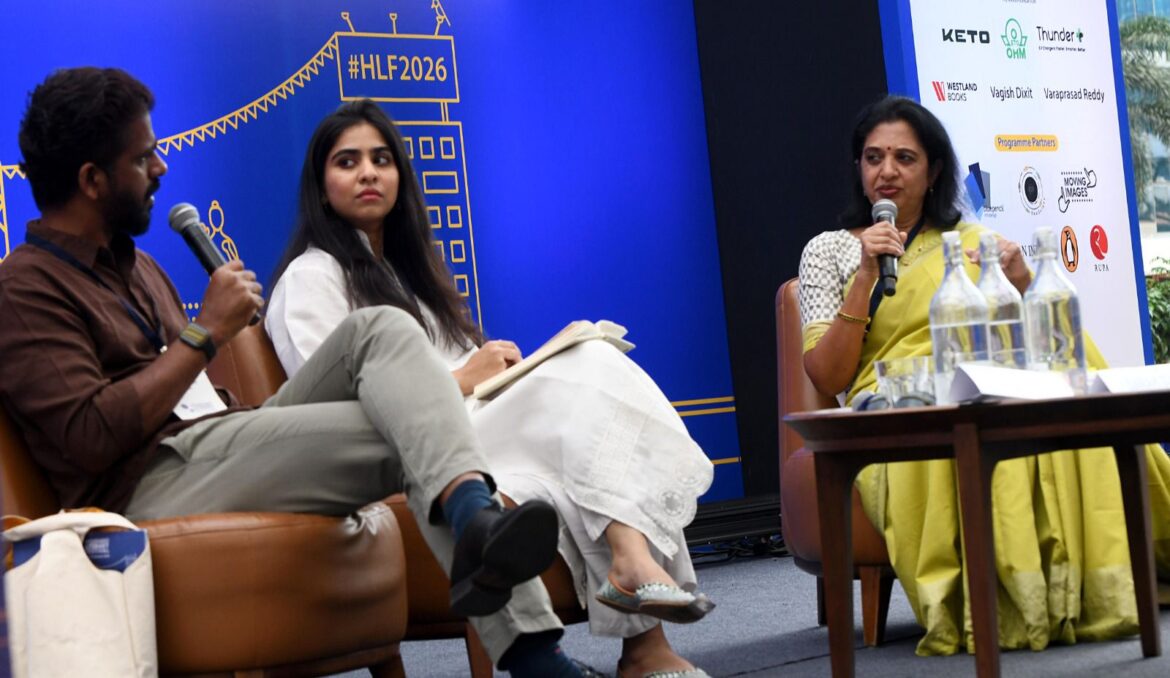
Hyderabad: Prominent writer and journalist Stanley Johny on Saturday questioned the absence of international sanctions on Israel despite what he described as the killing of nearly 70,000 people in Gaza, including around 20,000 children. Speaking at the Hyderabad Literary Festival (HLF), Johny drew a sharp contrast with the global response to the Russia–Ukraine war, where the death of about 10,000 civilians led to sweeping sanctions against Russia.
“Why is Israel treated differently?” Johny asked, arguing that Israel’s close alliance with the United States has insulated it from global accountability. He expressed pessimism over the prospects of an independent Palestinian state, calling it “virtually impossible” under current geopolitical realities.
The remarks came during a panel discussion on Palestine, held as part of HLF, which focused on the books Letters from Gaza and Israel–Palestine: Revenge in Old West Asia – Original Sin. The session was moderated by Dr Y.S. Sunita Reddy.
Author Sarah Jiya, who edited Letters from Gaza, described the everyday reality of Palestinians living under constant fear. “People in Palestine wake up each morning unsure whether they will survive the day,” she said, reading excerpts from letters written by young Gazan writers. The letters, she noted, vividly capture a life marked by bombardment, displacement and the looming threat of death.
Johny and Jiya traced the historical roots of the conflict, particularly the period following the Second World War. Johny pointed out that Jews constituted about five per cent of Palestine’s population at that time, a figure that has now risen to around 55 per cent. He alleged that nearly 77 per cent of Palestinian land has been occupied and said that Gaza and the West Bank are effectively under Israeli control.
Both speakers argued that international agreements, including United Nations resolutions and the Oslo Accords, have failed to secure full sovereignty for Palestine. Addressing Israel’s frequent attribution of violence to Hamas, they noted that Hamas did not exist before 1987 and that earlier resistance was led by the Palestine Liberation Organisation (PLO). Johny recalled that in 1993, PLO leader Yasser Arafat had proposed accepting just 23 per cent of historic Palestinian territory in return for statehood, a proposal that, he said, was never implemented.
Johny also criticised West Asian countries for what he termed a lack of responsibility in supporting the emergence of an independent Palestinian state. He pointed to a shift in India’s official position as well, noting that until 2015 New Delhi consistently supported a two-state solution based on the 1967 borders with Jerusalem as the Palestinian capital. “Today, India speaks only of a two-state solution, without reference to borders,” he said, adding that India’s growing defence and intelligence partnership with Israel has influenced this stance.
Throughout the session, moderator Sunita Reddy raised questions on international law, media narratives and political accountability, prompting detailed responses from the panelists.
The discussion underscored the continuing global divide over Palestine and raised pointed questions about selective morality and the unequal application of international norms—questions that, the speakers suggested, remain as urgent as ever.