





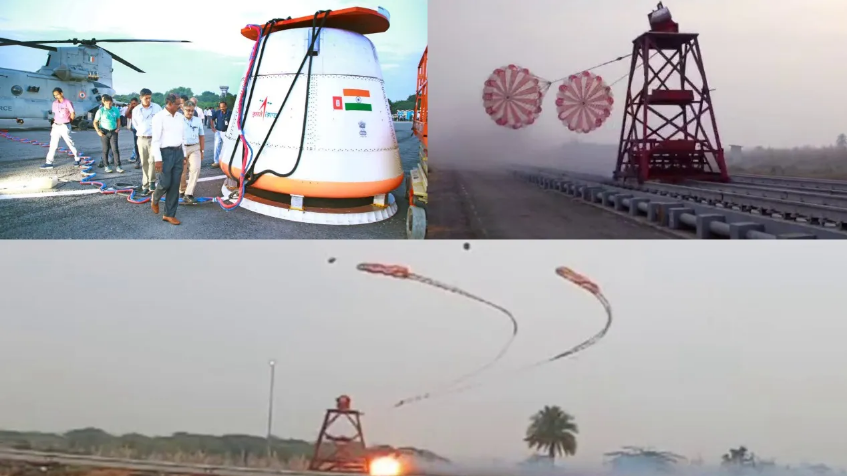
The Indian Space Research Organisation (ISRO) has achieved a significant milestone in its Gaganyaan mission by successfully completing qualification tests for the drogue parachutes designed to decelerate the crew module and ensure a safe landing during re-entry. The tests were conducted on December 18 and 19 at the Terminal Ballistics Research Laboratory (TBRL) of DRDO in Chandigarh, where scientists evaluated the parachutes’ performance using the rail track rocket sled facility. The Gaganyaan mission involves a total of 10 parachutes of four different types, and the recent tests validated the efficiency of the drogue parachutes under varied conditions.
Heartening to note that India has moved one more step closer to its first Human Space mission #Gaganyaan.
ISRO successfully completed the Drogue Parachute Deployment Qualification Tests for the Gaganyaan Crew Module at the RTRS facility of TBRL, Chandigarh, during 18–19 December… pic.twitter.com/ci47TQDaoA
— Dr Jitendra Singh (@DrJitendraSingh) December 20, 2025
During re-entry, the crew module travels at extremely high speeds, and the parachute system is designed to reduce this velocity in stages. Initially, two parachutes deploy to remove the module’s protective cover, followed by the deployment of two drogue parachutes to slow the module further. Finally, three main parachutes open to ensure a safe splashdown in the sea. The tests confirmed the parachutes’ performance under different weather conditions and velocities.
ISRO stated that the drogue parachutes performed optimally even under challenging conditions, achieving all specified objectives. The successful experiment was carried out through joint efforts of the Vikram Sarabhai Space Centre and DRDO laboratories.
As India moves closer to its first human spaceflight, this achievement marks a key milestone in ensuring astronaut safety and brings the nation a step closer to the highly anticipated Gaganyaan mission, scheduled for 2026.