





– Ravi Prakash
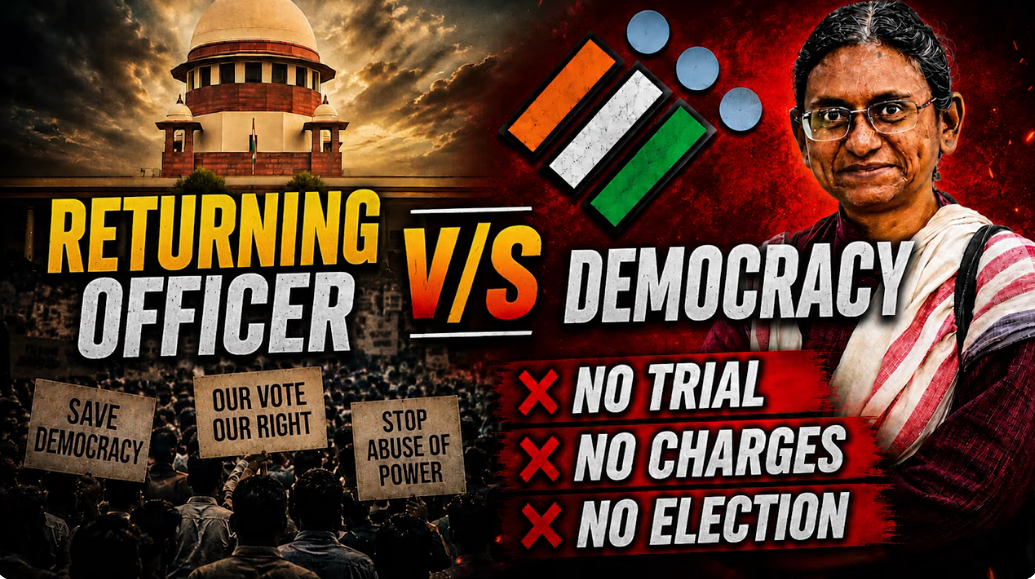
I am writing this today for one reason. Not because of one politician. Not because of one election. Not because I support Congress or BJP or any party in between. I am writing this because something happened recently that I cannot stop thinking about. Something that goes far beyond politics. Something that cuts to the very heart of what we call democracy in this country. The rejection of Meenakshi Natarajan’s Rajya Sabha nomination has raised concerns that every Indian — regardless of which party they support — should be deeply uncomfortable with. It is a question about the power of a single returning officer, the fairness of our electoral process, and whether we have built enough safeguards to protect a candidate’s most fundamental democratic right: the right to contest.
The question comes from the Meenakshi Natarajan case. Her Rajya Sabha nomination was rejected over an alleged non-disclosure linked to a private complaint. She went to the Supreme Court — as any of us would if we believed an injustice had been done to us. And the Supreme Court told her something that has stayed with me ever since. Once the election process has begun, the Court said, it cannot intervene. The remedy, it said, lies in an election petition — filed after the election is over. I sat with that for a while. I kept reading it, trying to make sense of it. A candidate is removed from the race before a single vote is cast. And the only legal remedy available to her is one that comes after the election has already concluded. After the results are declared. After the moment has passed and cannot be brought back. I keep asking myself — what does that remedy actually give her?
Here is what troubles me most. The Supreme Court’s inability to intervene during the election process is not a flaw in the judiciary. It is a limitation built into the system itself. And that limitation exposes every candidate in India to a risk that we have not talked about honestly enough — the risk of wrongful disqualification with no meaningful recourse in time. If a Returning Officer makes a wrong call, if the rejection itself is the injustice, there is no mechanism to catch that error before it is too late. No rapid review. No emergency hearing. No body that steps in and says, wait, let us look at this before the election moves forward. The candidate is out. The election continues. And whatever wrong was done stays done.
I am not saying that is what happened in Meenakshi Natarajan’s case. I genuinely do not know. My point is — what if it had been wrong? What if the Returning Officer had made a mistake? Who corrects it? When? And how? Because right now, the answer seems to be — nobody corrects it in time. Not before the election. Not when it actually matters. And a system that allows a single official to determine a candidate’s eligibility, without any meaningful check on that decision before voting begins, is a system that has left a dangerous gap in the integrity of its own process.
When I first heard about this case, I noticed something in myself. For a brief moment, I thought — this is a Congress politician, this is a political fight, maybe I don’t need to get worked up about this. And then I caught myself. Because that thinking — that “it’s their problem, not mine” thinking — is exactly how democratic protections erode. We stay quiet when it happens to the side we don’t like. And then one day it happens to the side we do like. And by then the precedent is already set, the gap in the system is already baked in, and nobody wants to hear our outrage because we were silent when it mattered.
So let me say this clearly. Today it is Meenakshi Natarajan. Tomorrow it could be a BJP candidate whose nomination is rejected on contested grounds. The day after, it could be an independent — someone with no party backing, no resources, no powerful supporters — who gets thrown out of the race and has nowhere to turn. This issue is not about any one political party. It never was. It is about accountability and oversight in a system that affects every candidate, every voter, and every election in this country. The candidate changes. The power stays exactly the same. And unchecked power does not stay in one place — it moves, it expands, and eventually it reaches all of us.
Every system built on accountability has one fundamental requirement — the people who hold power must themselves be held accountable. We understand this for judges. We understand it for police. We understand it for politicians. But somehow, when it comes to Returning Officers and nomination rejections, we have built a system where the check comes too late to matter. And so I keep coming back to the same question. Who guards the gatekeeper? If a Returning Officer has the power to remove a candidate from an election and that decision cannot be reviewed in time, then that officer holds an enormous, unchecked power over our democratic process — over who we get to vote for, over who gets to participate in the first place. That is not a small thing. That is the foundation of what a free and fair election is supposed to mean.
I do not pretend to have all the answers. But I know what the questions are. Should there be a fast-track review process for nomination rejections? Should there be a window — even a short one — where a rejected candidate can get an emergency hearing before the election proceeds? Should Returning Officers be required to document their reasoning in a way that is transparent and open to scrutiny? These are not radical ideas. They are basic accountability mechanisms. The kind that exist in most systems where consequential decisions are made. We have built one of the most impressive electoral systems in the world — the scale, the logistics, the participation are genuinely remarkable. But a system that cannot protect a candidate’s right to contest before it is too late has a gap that no democracy can afford to ignore.
I wrote this because I care about elections. I care about democracy. Not as abstract ideas, but as real things that shape real lives. I wrote this because I believe that if we are only outraged when it happens to our side, we are not actually defenders of democracy — we are just defenders of our team. The Meenakshi Natarajan case has surfaced a real structural question about the fairness and integrity of how we run elections in India. It deserves a real structural answer. Because if the gatekeeper gets it wrong and no one can intervene before the damage is done, it is not just one candidate who loses. It is all of us. And that is something I am not willing to stay quiet about.