





-Ravi Prakash
Namaste…
Where are those 17 students who were supposed to appear for the NEET re-exam?
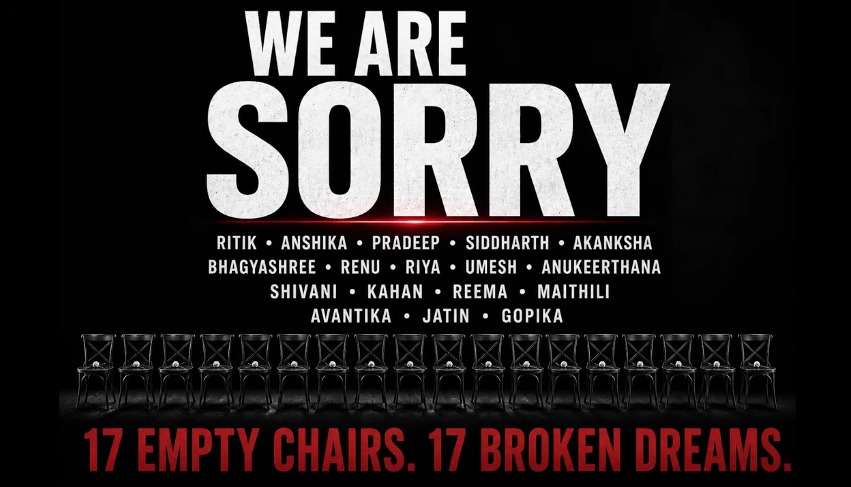
Ritik Mishra, Anshika Pandey, Pradeep Meghwal, Siddharth Hegde, Akanksha Chaturvedi, Bhagyashri, Renu Meena, Riya Kumari Thapa, Umesh Mali, Anukeertana, Shivani Yadav, Kahan Patel, Reema Begum, Maithili, Avantika, Jatin and Gopika.
These are the 17 students who did not appear for today’s NEET exam.
This morning, millions of students woke up across the country. They flipped through their notes one last time. They checked whether their admit cards were in order. Their parents bowed before God and wished their children all the best, hoping they’d write the exam well. Every student left home to write the most crucial exam of their lives. But these 17 children did not go. Because they are no longer among us.
Today, the entire country is talking about question papers, cutoff marks, ranks, and admissions. But those seventeen families are sitting in silence — remembering their children who should have been sitting in an exam hall — and weeping. That is why we cannot begin this story with politics. We cannot talk about NTA’s failures. We cannot question the government. We cannot even discuss the exam itself. This story must begin with their names. Because before they were NEET candidates, they were someone’s sons and daughters. They had dreams. They had fears. They had so many plans for the future. Today, all those dreams have dissolved into nothing.
So what exactly happened? For the past several weeks, the NEET exam has been surrounded by controversy. Allegations of paper leaks surfaced. Questions arose about the integrity of the examination system. Confusion gripped students. Faith in the future began to crumble. The trust that crores of families had placed in an institution — that trust collapsed completely.
Students spend years preparing for this one exam. Ten to fourteen hours of study every single day. Countless families pour their life savings into coaching centres. Children give up their friends, their joy, their youth. And they all believe in one thing — that if they work hard and stay honest, the exam will be conducted with equal fairness. That is the unspoken contract between students and the system. The student studies with sincerity. The system conducts the exam with integrity. The result comes with complete transparency. But what happens when that trust shatters? What happens when students begin to doubt the very system they were depending on? This is the mental anguish that millions of young people across this country are living with right now.
And there is another deeply disturbing truth in all of this. Perhaps for the first time in India’s history, today’s exam was conducted under extraordinary security — biometric verification, AI-powered surveillance cameras, multi-layered identity checks, and unprecedented safety measures. It didn’t feel like an exam. It felt like a national security operation. And that itself raises a devastating question. If all of this was possible today, why were students subjected to weeks of anxiety and uncertainty beforehand? Why were they left drowning in confusion? Why did crores of children have to spend sleepless nights before the system even acknowledged its own failures?
Before we point fingers at the government, at the NTA, at the examination bodies — we must turn that question toward ourselves. This problem did not begin with a paper leak. The leak only exposed what was already rotting from within. Why are our children carrying unbearable pressure? Why have we given one exam this much power over a young mind? Why have we created a situation where a single mark decides an entire future? The noise of coaching centres, the weight of parental expectations, the relentless comparisons with neighbours and relatives, our collective obsession with chasing a handful of professions — together, all of this is turning children into machines that are not allowed to fail. And that pressure is destroying them from the inside. When the system fails, children lose hope in the future. When the pressure becomes too great, they lose the will to live.
Today, as lakhs of students sat inside exam halls across this country, one bitter truth haunted the entire nation. Seventeen names. Seventeen empty chairs. Seventeen families whose children never got the chance to sit for this exam. Before we celebrate toppers, before we debate cutoff marks, before we fight over seats — we must ask ourselves one enormous question. Before they were NEET candidates, had we forgotten that they were just children?
Today, NEET was not just an exam. It was an operation. Perhaps for the first time in our country’s history, a medical entrance test was conducted under military-level security. Air Force aircraft were used to transport question papers and ensure they reached exam centres on time. In several locations, papers were sent via special flights to prevent leaks. CRPF and CISF forces were deployed in double-layered security arrangements. In many cities, central paramilitary forces stood guard alongside local police at exam centres. Question papers travelled under armed escort. Every exam centre was placed under total surveillance. Students underwent biometric and facial recognition checks before being allowed inside. High-quality CCTV cameras watched every corner. Artificial intelligence cameras were deployed to prevent irregularities. Not one layer of checking, not two — many. Multiple rounds of identity verification. Monitoring at every single step. A seven-tier security perimeter — for one exam.
And now this raises one question in the minds of every parent in the country — a question they have every right to ask. Why did it come to this? Why did a medical entrance exam require Air Force planes, paramilitary forces, biometric screening, and AI surveillance? Because none of this came out of nowhere. All of this became necessary because trust in the system had completely collapsed. That is the real story.
Yes, the government deserves credit for ensuring today’s exam was conducted under such tight security. No one would fault these strict measures. Parents who want a fair future for their children will not oppose them. Students who want to write an honest exam will not object. But the central question remains unanswered — how did we arrive here in the first place? Deploying massive forces to prevent wrongdoing is not victory. Real success is when students trust the system so deeply that no security is even needed.
Today, lakhs of students completed their biometric checks and walked through those doors. But what they carried in their hands wasn’t just a hall ticket. They carried weeks of mental anguish, confusion about what tomorrow holds, endless controversies and disputes, and the haunting doubt of whether their hard work would even be rewarded fairly. That tension cannot be seen by CCTV cameras. Facial recognition systems cannot record it. Even artificial intelligence cannot detect it. It lives only inside the minds of those children — children who have been studying day and night for two, three years for one exam, children from middle-class families whose parents spent every last rupee on fees, children who sacrificed festivals, friendships, and ultimately their own childhood for a dream. That is why this story is not about a paper leak. The fact that Air Force planes, CRPF, biometrics, and AI surveillance all had to be deployed for one exam means we are admitting a bitter truth — that the people’s faith in the system is gone. Today, rebuilding that lost trust is a far greater task than conducting a clean exam.
This is the heaviest and most difficult part of this conversation. Because after questioning the government, the NTA, the examination process, and the failures of officials — now it is time to look at ourselves in the mirror. The government can stop paper leaks. It can deploy the Air Force. It can station CISF, CRPF, and police forces. It can install CCTV cameras. It can use artificial intelligence. It can build a seven-layered security shield. But there is one thing no government can do. No government can walk into the mind of a 17-year-old child and take away the fear living inside him. That responsibility belongs to all of us — parents, teachers, schools, coaching centres, relatives, and society as a whole.
Because the real crisis that NEET has exposed is not one of administrative management. It is a crisis of mental health, of emotions, of the human heart. Consider what we have done to our children. At an age when they should be discovering who they are, at an age when they should be making friends, playing, learning hobbies, and building resilience through wins and losses — they are being buried alive under tests, ranks, mock exams, and endless comparisons. Thousands of families have allowed their entire existence to revolve around a single exam. Every conversation is about marks. Every discussion is about ranks. Every dream is about one college. Every fear is about one result. Without realising it, we have been sending our children a deeply dangerous message — that winning is the only path, and that losing means life itself is over.
But life does not work that way. No exam can measure courage. No exam can assess compassion. No exam can evaluate character. No exam can test the will to fight. And no exam can ever determine the worth of a human life. And yet, somehow, children have started to believe exactly that — that one bad result will define their future, that one step backward means everything is ruined, that one exam is the only thing that can earn them dignity in this world. There is no greater lie than this. Because every successful parent knows one truth: the most extraordinary moments in life never come according to plan. Careers change. Dreams change. Jobs change. Lives transform entirely. But a child only gets one life.
The events of the past several weeks are a reminder that this country needs a much larger conversation — not just about exam reforms, not just about NTA changes, not just about security arrangements, but about children’s mental health, about the emotional support they deserve, about the pressure we load onto those young shoulders, about the language we use at home, and about the expectations we place on them. Because if a child believes that failing an exam is a greater punishment than not living to see the next sunrise, then something is catastrophically wrong in the society we have built. And none of us — no government, no institution, no parent, no school, no media, no one — can deny it or look away.
Let us come back to where we began. Those seventeen names. Ritik. Anshika. Pradeep. Siddharth. Akanksha. Bhagyashri. Renu. Riya. Umesh. Anukeertana. Shivani. Kahan. Reema. Maithili. Avantika. Jatin. Gopika.
Tonight, the rest of the country is deep in calculations — cutoffs, answer keys, which college, which seat. But the world of those seventeen families is different. They live in a silent, solitary place where none of that exists. There are no results there. No counselling. No college admission. No white coat ceremony. Only memories remain. Perhaps, as a society, we owe them something — not excuses, not political slogans, not the blame game. Only honesty. The honesty to admit that the system broke somewhere. The honesty to acknowledge that trust has been lost. The honesty to accept that our children are carrying a weight no child should ever have to carry.
Before this ends, there is only one thing left to say — on behalf of all of us. To every student whose life was lost, we bow our heads and ask for forgiveness. Forgive us for failing to build a system worthy of your trust. Forgive us — the institutions that could not give you the assurance you deserved. Forgive this society for making you feel that an exam mattered more than your life. Forgive us for not seeing the invisible war those young minds were fighting alone, while everyone else argued about papers and ranks and politics.
Let us make a promise to ourselves — that no exam, no controversy, no career ambition will ever be placed above the life of a child. Because NEET is only an entrance exam for medical college. It must never become an exit point from life.