





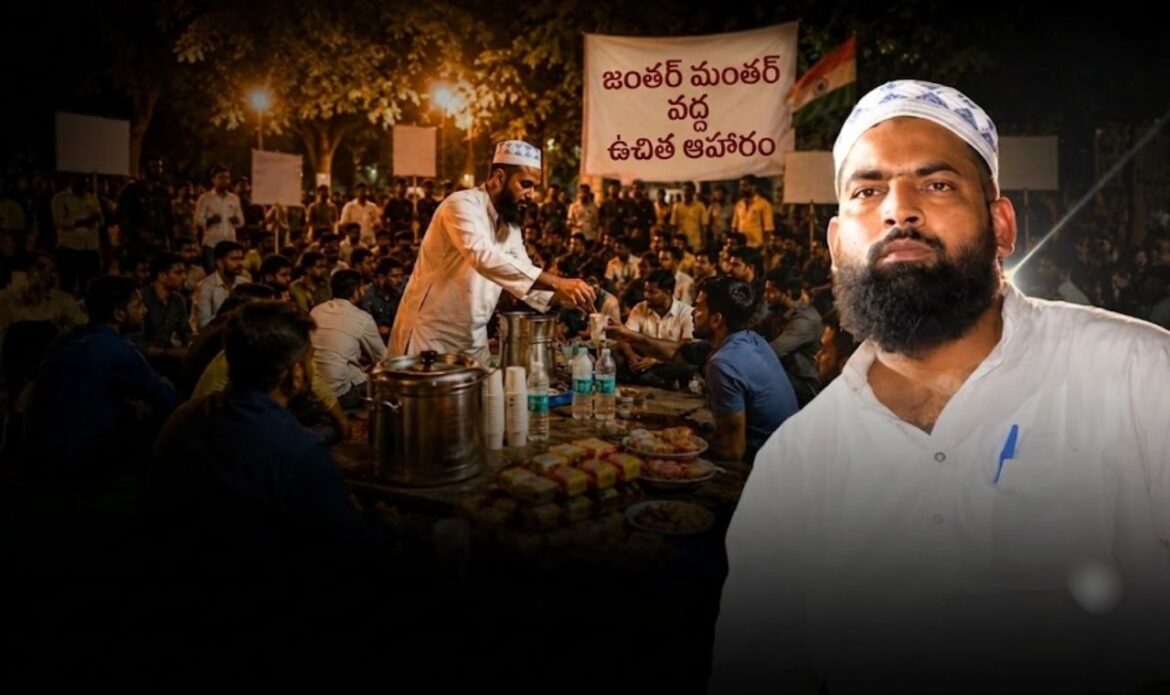
A movement that began as a small social media post has now reached a level that forced the Central Government to its knees — something no one could have imagined even in their wildest dreams. This struggle, carried out jointly by students and unemployed youth, has achieved an unprecedented victory in the country’s history. Under the leadership of the Cockroach Janata Party, this massive protest, which continued for nearly 36 days, left the Central Government with no option but to relent. At the same time, an act by a young man named Mohammed Junaid at Jantar Mantar surprised the entire nation. Amid the site of protests and controversy, he proved that religion is not a barrier between human beings by providing food to hungry, unemployed youth and students. Videos showcasing his generosity went viral on social media. Here now are the complete details of this movement — who exactly is Mohammed Junaid, the man who fed the hungry, and where does he come from? Let’s find out in full.
Mohammed Junaid, the Man Who Provided Food and Water
Mohammed Junaid hails from Nahal village in Ghaziabad district, Uttar Pradesh. His father’s name is Mustafa, and theirs is an ordinary middle-class family. He demonstrated his humanity by serving this movement. During the protests, as students and CJP supporters struggled in the scorching heat, he stepped forward to help. He began by distributing drinking water bottles at his own expense to the protesters gathered at Jantar Mantar, and later went on to voluntarily provide free food and snacks to thousands of people, showcasing his generous spirit. Junaid’s remarkable act of service went widely viral on social media.
Trouble for Mohammed Junaid After Serving Food
Allegations emerged that police took Junaid into custody on July 24 while he was distributing free food to protesters at Jantar Mantar. Reports suggest that he was kept blindfolded through the night, and that a police official questioned him the following morning. He was reportedly asked where the funds for the food distribution were coming from and how he was arranging such large quantities of food, before being released after questioning. Junaid subsequently alleged that UP Police raided his home in Ghaziabad as a consequence of his participation in the protests. He also stated that his father was taken to the police station for questioning, and claimed that police even confiscated the family’s Aadhaar cards and bank passbooks in order to summon him to the station. CJP’s leadership has extended its support to Junaid over this issue.
The Origins of CJP
On May 15, 2026, remarks made by Chief Justice of India Surya Kant during a court hearing, referring to unemployed youth, became highly controversial. Referring to them as being “like cockroaches” sparked outrage among young people. In protest against those remarks, a young man named Abhijeet Deepke reacted on social media, sarcastically responding, “What would it look like if all the country’s cockroaches (youth) united?” This drew a strong response, leading to the creation of a website and Instagram page under the name Cockroach Janata Party on May 16, 2026. Subsequently, youth frustrated by the NEET paper leak, irregularities in other examinations, and severe unemployment turned this into a rallying cry for a movement, which began gaining lakhs of followers within a very short time.
Protests Begin at Jantar Mantar
The protests officially began when Abhijeet Deepke arrived in Delhi from the United States on June 6, 2026, and went to Jantar Mantar. Although the movement started small, it grew dramatically with each passing day. Unemployed youth mobilized, questioning the injustice being done to students. After five days, on June 11, students released a manifesto listing five demands, further intensifying the struggle.
Prominent Figures Who Supported the Movement
This struggle received support not just from students, but also from prominent figures across various fields, public organizations, voluntary groups, social media influencers, and opposition parties. Notably, the person who played the most crucial role in this movement was Sonam Wangchuk, an environmentalist and social activist, who undertook a fast unto death lasting nearly 20 days in support of the students’ protest. Along with him, CJP representatives Ashutosh Ranka and Saurav Das, together with several lakh people on social media, rallied behind the CJP movement, building pressure on the Central Government.
The Intensified “Chalo Sansad” March
On July 20, CJP called for a “Chalo Sansad” rally, which proved to be the turning point of the movement. Thousands of students marched toward Parliament, but Delhi Police blocked them and carried out a baton charge. Not stopping there, they also deployed tear gas. This left several people injured, and the protest escalated sharply. This marked the first time since 2001 that the gates of Parliament had to be locked.
The Centre Relents
Faced with the baton charge on students, Sonam Wangchuk’s deteriorating health, and growing support for the protest, the Central Government finally relented. BJP National President J.P. Nadda and Union Minister Jitendra Singh held talks with CJP’s leadership. Among CJP’s key demands during these discussions, the most significant was the resignation of Education Minister Dharmendra Pradhan. Finally, after this prolonged struggle, Union Education Minister Dharmendra Pradhan announced his resignation on July 25, marking this as a historic victory in the news.