





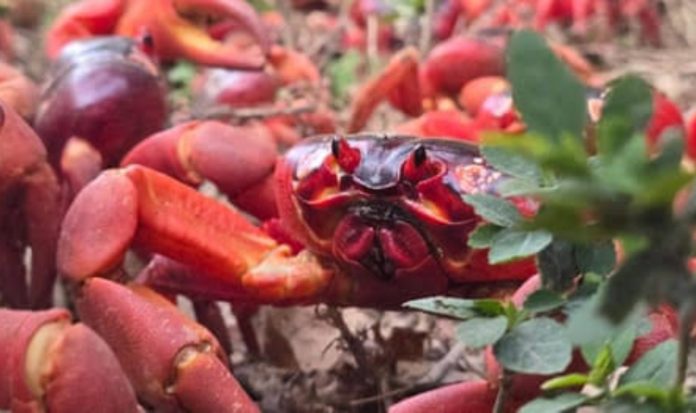
A natural wonder has unfolded on Christmas Island, an Australian territory, where millions of red crabs have begun their annual mass migration from the forests towards the sea coast to breed. Roads, streets and fields across the island are covered with crabs, resembling a red carpet. The spectacle takes place every year in October or November on the island, which lies in the Indian Ocean about 200 miles from Indonesia’s Java island, as soon as the first showers of the rainy season fall.
Fresh videos released by Parks Australia, the country’s national parks agency, have captivated nature lovers. They show millions of crabs marching in swarms across the roads. To prevent the crabs from being killed under vehicles, authorities have temporarily closed several roads on the island. The crabs are also moving ahead by climbing specially built “crab bridges” that help them cross roads safely. The sound of their legs as they walk is heard like falling rain.
The migration follows a remarkable natural calendar that depends mainly on three factors: rainfall, the phase of the moon and the cycle of the ocean tides. Female crabs generally go into the sea to lay eggs in the early hours, during the last quarter of the moon and when the tide is receding. If rain falls close to the egg-laying time, the crabs rush towards the coast at great speed to make it in time.
Scientists say climate change has a serious impact on the migration. According to a 2013 study by Princeton University, the migration is delayed or cancelled altogether if the rains do not arrive properly. In 1997, for instance, when a severe drought occurred under the influence of El Nino, the crabs did not migrate at all. This year, although “Super El Nino” conditions exist, enough rain has fallen for the migration, and the crabs have begun their journey.
After reaching the shore, male and female crabs mate, and the females then enter the seawater and release their eggs, which hatch almost immediately on touching the water. Escaping other creatures in the sea, young crabs return to the shore in large numbers only once or twice a decade. The journey of the red crabs, which has amazed naturalists and tourists around the world for decades, is delighting onlookers once again this year.