





- Ravi Prakash

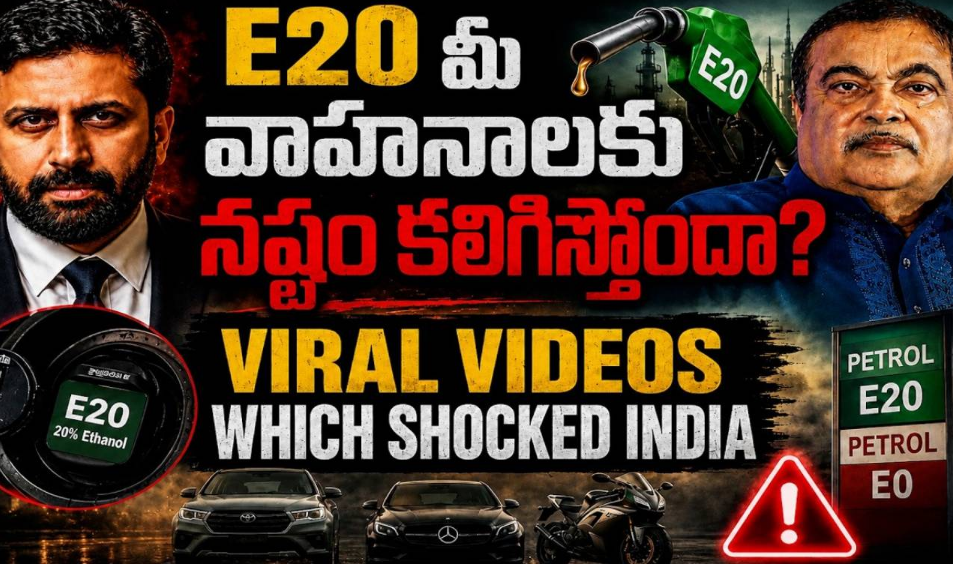
Did you know that the petrol you’re pouring into your vehicle today is not the same petrol you used two years ago? Would you believe that crores of Indians across the country — whether they know it or not — are already using E20 petrol? For the past few weeks, videos going viral on social media have shown cars, SUVs, expensive luxury vehicles, and even motorcycles reportedly facing problems because of this fuel. This dispute has now reached the highest court in the land and has also stirred up a major political storm. Opposition parties are calling it a scam, while the Central government insists it is the nation’s energy future. So who is telling the truth? The issue has the most significant impact on lakhs of vehicle owners across the country.
In a viral video posted on his account, prominent Bihar-based YouTuber and social media influencer Manish Kashyap alleges that his Toyota Innova Hycross, worth nearly Rs 40 lakh — despite being marketed as E20-compatible — has developed serious problems after running just 12,000 kilometres. He further claims that the ethanol policy is damaging vehicles across India. Manish Kashyap is not alone in making such allegations. X user Pushparaj Sharma also shared a 69-second video alleging that a Mercedes car’s engine was damaged because of E20 fuel. In his X post, he criticised Union Minister Nitin Gadkari and also raised questions about the government’s ethanol policy. These are allegations made solely by Pushparaj Sharma in his social media post.
This controversy has not been confined to expensive cars alone. Another person, Shiva Thakur, shared a separate viral video posted on Instagram under the handle laila_three60, alleging that a brand-new bike, specifically designed for E20 fuel, stalled shortly after being filled with petrol. He also questioned whether such problems are occurring specifically in vehicles designed for E20. However, these are merely allegations made in social media posts. The chain of such videos did not stop there. Another X user, Abhinay, posted two separate videos filmed at a petrol pump, alleging that many vehicle owners have been complaining of engine problems after using E20 petrol. Abhinay also questioned whether ordinary Indians are unknowingly becoming part of an experiment. These, too, are merely allegations made by Abhinay in his X posts.
Similar allegations have been surfacing one after another on social media from various parts of the country. Some say mileage has dropped significantly. Others say they have faced engine problems. Still others allege disputes over warranty claims. Everyone is asking the same question — is E20 petrol genuinely damaging vehicles in India, or is this just another piece of misinformation going viral on social media? To find the answer to that question, we first need to understand a basic point. What exactly is E20 petrol? Why is the government pushing it so aggressively? Why has it suddenly triggered such a huge uproar across the country? Let’s understand this in detail.
What Exactly Is E20? Why Is the Government Promoting It?
Are the viral videos genuine, or are they being exaggerated beyond what’s warranted? Before arriving at a conclusion on this, we first need the answer to one general question. Unless we understand what E20 actually is, the entire controversy will not make sense either. It is a fuel containing 20% ethanol and 80% petrol. Ethanol is an alcohol-based fuel. In India, it is primarily produced from sugarcane, molasses, and food grains. Until now, petrol sold in India contained a lower percentage of blended ethanol. But now, the Central government has set a target of moving the country toward petrol blended with up to 20% ethanol. This is referred to as the E20 policy. The government cites four key reasons for introducing E20 fuel.
First: India imports a massive quantity of crude oil from abroad every year, spending thousands of crores of rupees in foreign exchange as a result. Blending more ethanol into petrol reduces the need for crude oil imports.
Second: The government says ethanol reduces carbon emissions and helps the country move closer to its environmental goals.
Third: The government argues that this creates a huge market for Indian farmers. Sugarcane mills, distilleries, and grain producers stand to benefit from the rising demand for ethanol.
Fourth: The government believes that by reducing dependence on crude oil, India will further strengthen its long-term energy security.
In the government’s view, this is a policy that benefits everyone — which is why it is being promoted.
Everything appears positive on the surface. So where did the controversy begin? Critics say the problem does not lie with ethanol itself, but with how E20 has been implemented. According to their version, the lakhs of vehicles currently running on Indian roads were built either to run entirely on petrol or on fuel with a much lower percentage of ethanol. They argue that such older cars and bikes were not built to continuously run on E20 fuel.
Automobile experts too have raised concerns on certain points. They argue that E20 usage could reduce engine efficiency, damage fuel system components, and increase maintenance issues in vehicles. However, those supporting E20 say that many of these fears are exaggerated, and that the remaining issues can be addressed through manufacturer guidelines and newer technology.
Mileage Concerns
The most common complaint among vehicle owners is reduced mileage. Why does this happen? Because one litre of ethanol contains less energy compared to one litre of petrol. This means that, theoretically, a vehicle may need to consume slightly more fuel to travel the same distance. Many vehicle owners posting videos on social media say they are facing exactly this situation — claiming reduced mileage, the need to refuel more frequently, and rising maintenance costs. However, whether these experiences are directly caused by E20 itself, or influenced by the specific vehicle model, its compatibility, maintenance, driving conditions, and other factors, is something that needs to be checked on a case-by-case basis for each vehicle.
Many vehicle owners also say that these days, it has become difficult to find petrol without ethanol blending. In other words, whether your vehicle is old or new, and whether you want E20 or not, in most cases you have no alternative available. This is why petitions on the matter have now reached the highest court. Some petitioners are demanding clear labelling on fuel, along with the availability of low-ethanol or ethanol-free petrol, so that consumers have the freedom to choose.
Another question repeatedly raised in this debate concerns warranty and insurance. If an older vehicle develops an engine or fuel-system problem, who is responsible for it? Will the manufacturer honour the warranty? Will the insurance company accept the claim? All these questions are adding to the anxiety of owners of vehicles manufactured before the E20 rollout.
However, supporters of the policy completely reject the allegations that E20 is damaging vehicles across the country. Union Minister Nitin Gadkari is among the most prominent of them. He says E20 causes no damage to vehicles whatsoever, and that certain vested-interest groups are running a false campaign against ethanol. He has further alleged that there exists a powerful lobby that stands to lose if ethanol succeeds. On one side are thousands of social media posts alleging engine problems, reduced mileage, and vehicle damage; on the other side is the government insisting that E20 is completely safe and that these claims amount to misinformation. So where does the truth actually lie? This controversy has not remained confined to vehicle owners alone — it has now escalated into a full-blown political battle. Opposition parties allege that the government implemented this policy in haste, are raising questions over transparency, and are alleging a conflict of interest. This debate is now playing out both in the Supreme Court and on political platforms. Let’s take a look at all of it.
What began as a controversy over complaints from a section of vehicle owners has now turned into a full-scale political debate. The opposition accuses the government of implementing this policy on crores of Indians without adequately addressing public concerns. The government, for its part, completely denies all these allegations. As a result, the issue is no longer confined to social media — it continues to play out at the same intensity on political platforms as well.
Congress president Mallikarjun Kharge questioned the remarks made by Union Minister Nitin Gadkari. Referring to the recent hearing in the Supreme Court, he alleged that the government is arguing one way outside the court and another way inside it. Following this, Karnataka minister Priyank Kharge put out a post on X, alleging that nearly 3 crore 60 lakh Indians have unknowingly become part of a nationwide experiment. Citing complaints from vehicle owners about reduced mileage and engine problems, he questioned the decision to make E20 mandatory, and also demanded that the decision be withdrawn until complete clarity is provided on the matter. These are purely political allegations made by Congress leaders, and the government does not accept these criticisms.
The controversy has not stopped with the Congress alone. The Jharkhand Mukti Morcha has also clearly stated its position on X. Political analyst Tehseen Poonawalla, seen as sympathetic to the Congress, has also launched a campaign against the ethanol blending policy. In his X post, he termed it an “ethanol scam” and announced that he would hold a protest at Jantar Mantar. He demanded that vehicle owners be given the freedom to decide for themselves whether or not they want ethanol-blended petrol.
So, who should ordinary citizens believe — the government, the opposition, or the videos going viral on social media? Perhaps the answer to this question lies not in politics, but in the personal experience of every vehicle owner. Because politics is one thing, and your vehicle is another. Whether you own a motorcycle, a hatchback, a sedan, an SUV, or a luxury car, the questions remain the same for everyone.
Is your vehicle E20-compatible? If not, which fuel should you use? If your vehicle’s mileage has dropped, is ethanol really the cause, or are there other factors at play? And if an engine problem does arise, who determines whether E20 is to blame — the manufacturer, the service centre, the insurance company, or the mechanic? These are the very questions crores of Indian vehicle owners are seeking answers to today.
One thing, however, can be said with clarity. The government describes the ethanol blending policy as one of the biggest changes in India’s fuel policy in decades. It strongly argues that this will reduce oil imports, benefit farmers, strengthen the country’s energy security, and reduce pollution. Critics, however, say that consumers need greater transparency, along with clearer assurances on vehicle compatibility and long-term effects. This debate shows no sign of ending anytime soon. The legal battle will continue, the political arguments will continue, and so too will this debate among the crores of vehicle owners across the country.