





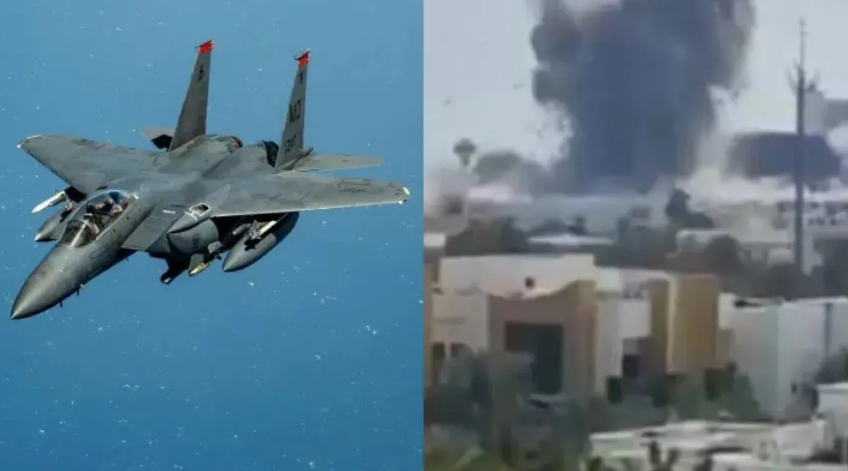
Amid ongoing tensions in the Middle East, U.S. President Donald Trump has claimed that recent American military strikes have significantly degraded Iran’s missile capabilities, leaving the country with only a small portion of its pre-conflict arsenal. However, reports citing classified U.S. intelligence assessments have presented a contrasting picture, fueling debate within Washington’s political and security establishment.
Speaking in an interview with Meet the Press, Trump said U.S. military operations had reduced Iran’s missile stockpile to approximately 21-22 percent of its original capacity. He also asserted that his administration had successfully managed the security situation around the Strait of Hormuz, one of the world’s most critical energy transit routes, and had ensured the safe passage of multiple commercial oil tankers.
The remarks come as the administration faces growing domestic pressure over fuel prices ahead of upcoming U.S. midterm elections, with the White House highlighting its Middle East strategy as a key achievement.
However, a report published by The New York Times, citing a classified intelligence briefing presented to members of Congress, suggested that Iran has retained a substantial portion of its military capabilities. According to the assessment, Tehran has re-established control over 30 of its 33 strategic missile sites near the Strait of Hormuz and continues to possess nearly 70 percent of its pre-conflict missile inventory despite the U.S. strikes.
The intelligence findings have raised questions about the extent of the damage inflicted on Iran’s military infrastructure and the accuracy of official claims regarding the success of the campaign.
Meanwhile, Lebanese President Joseph Aoun has sharply criticized Iran and the Iran-backed Hezbollah movement, accusing Tehran of interfering in Lebanon’s internal affairs and using the country as leverage in its negotiations with the United States.
Aoun also criticized Hezbollah leader Naim Qassem, stating that the Lebanese people have grown exhausted by years of conflict and instability. He called for a diplomatic approach to resolving tensions with Israel rather than continued military confrontation.
At the same time, diplomatic efforts are underway in Washington to establish a new ceasefire arrangement between Israel and Lebanon. The proposed framework reportedly includes provisions aimed at halting Hezbollah attacks and reducing cross-border hostilities.
Despite these efforts, concerns remain over the durability of any agreement, particularly after both sides were accused of violating a ceasefire reached earlier this year. Aoun cautioned that military force alone cannot deliver lasting peace, pointing to the Gaza conflict as evidence that military victories do not necessarily eliminate armed groups or underlying tensions.
Since the end of Lebanon’s civil war in 1990, Hezbollah has remained the country’s most heavily armed non-state actor, maintaining that its weapons are necessary to deter potential Israeli aggression.
The contrasting claims from the Trump administration and U.S. intelligence agencies have added further uncertainty to an already volatile regional situation. As diplomatic negotiations continue alongside military and political confrontations, the future direction of the Middle East crisis remains closely watched by governments and security analysts worldwide.