





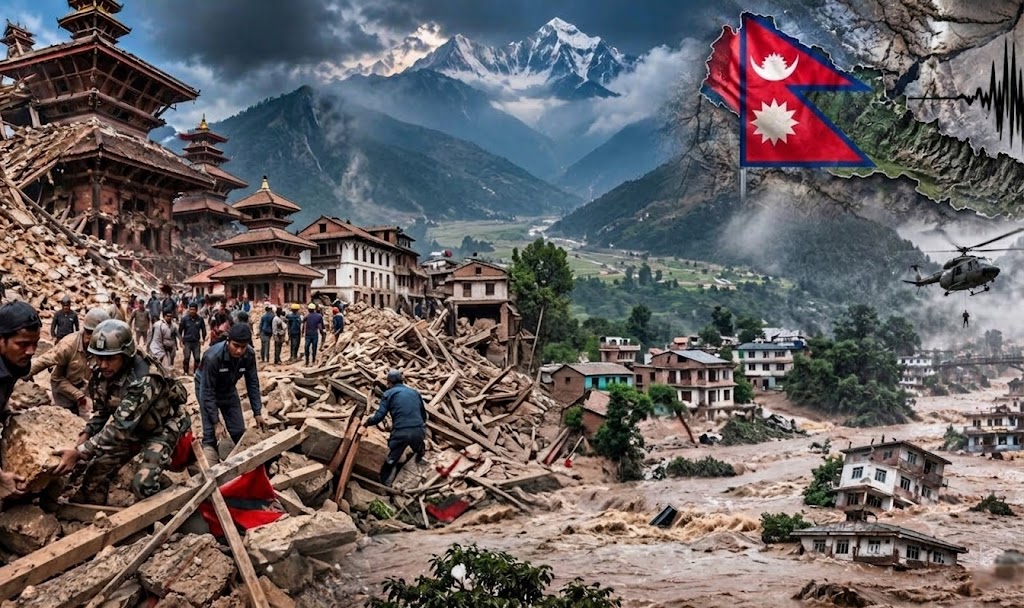
Nature has once again shown its fury on Nepal. Already reeling from heavy rains, landslides, and devastating floods, the country has now been shaken by an earthquake. Coming before people could even recover from the flood tragedy, this earthquake has left them even more anxious. Why exactly did a 5.3 magnitude earthquake occur in Nepal? If the quake originated at a depth of 143 kilometers, how did its tremors become noticeable on the surface? With floods on one side, landslides on the other, and now natural blockages forming across a river — could this situation lead to another major disaster? Can Nepal, already in the grip of severe crisis, withstand yet another natural calamity? Let’s find out clearly in this story.
The earthquake was recorded near the Lomanthang area in Nepal’s Mustang district, registering a magnitude of 5.3 on the Richter scale. The tremors, which struck at 9:53 pm on Tuesday, were centered at a depth of approximately 143 kilometers below the earth’s surface. Tremors were also felt in Manang, Dolpa, and Myagdi districts. However, since the earthquake’s epicenter was located at such a great depth, its impact on the surface remained limited. Officials stated that no loss of life or significant property damage occurred.
But this is where the real concern in Nepal begins. That’s because, even before this earthquake, the country has been battling a massive natural disaster. Last month, sudden flash floods on the Bhote Koshi river devastated Nepal. The surging floodwaters submerged several areas, severely damaging homes, roads, and bridges. According to police, 1,366 people have lost their lives in this disaster so far, with thousands of families still awaiting news of missing loved ones. Reuters reported that these floods caused approximately $2.56 billion in direct losses. In other words, even before fully recovering from the flood damage, Nepal is now confronting yet another natural disaster.
At the same time, another danger has emerged in Parbat district in Gandaki Province. Massive landslides have blocked the flow of the Kimrung river, a tributary of the Modi river. With the landslide debris obstructing the river’s flow, water has begun accumulating there. If these natural blockages weaken and suddenly give way, the pent-up water risks surging downstream as a massive flood, carrying mud, rocks, and trees along with it. This would significantly heighten the risk of sudden flash floods in downstream areas. Accordingly, authorities have alerted residents in downstream areas along the Kimrung river, including Nayapul and Birethanti, warning them to move to safe locations immediately if necessary. Officials are continuously monitoring the water level in the river and the state of the blockage. Given the possibility of a sudden, massive flood downstream should the water pressure build up and breach the blockage, priority is being placed on preemptive measures.
However, there is no evidence so far to suggest that the recent earthquake caused the landslides blocking the Kimrung river. It appears that these blockages formed as landslides occurred in hill areas already weakened by heavy rains and floods. In other words, before the impact of one disaster in Nepal has even subsided, another danger is emerging. For areas already damaged by floods and landslides, the earthquake tremors have now become an additional source of concern.
Nepal’s geographical conditions are also a major factor behind these blockages forming on the Kimrung river. This Himalayan nation is characterized by high mountains, steep slopes, and deep river valleys. When heavy rains fall, the soil and rocks on these hillsides weaken. When landslides occur, they not only block roads but also obstruct the flow of rivers. Water accumulates there, and if the blockage breaks, it risks surging suddenly toward downstream areas. This is why the impact of landslides in Nepal is not confined to the hills alone, but extends to river basin areas as well.
These geographical conditions are also posing a major challenge to relief operations. With roads damaged in hill areas, floodwaters submerging routes in some places, and landslides blocking roads in others, it has become difficult for rescue teams to reach affected areas. On one hand, damaged routes need to be restored; on the other, people in danger need to be moved to safe areas. As a result, both rescue operations and infrastructure restoration have become critical priorities. Amid this situation, India too is standing by Nepal to speed up relief efforts. Notably, Indian teams are working alongside Nepali teams on relief operations in the Chilime tunnel area. High-density polyethylene pipes are being used to continue work inside the tunnel while clearing the mud and debris that accumulated due to the floods and landslides. Controlled blasting is also being carried out wherever necessary to establish a temporary access road from Syabrubesi to the tunnel entrance. As part of this, relief efforts are also focused on restoring damaged roads, tunnels, and transport routes.
Meanwhile, authorities have grown even more vigilant following the earthquake. Although this earthquake did not cause major damage, given that its epicenter was located deep underground, they are continuously monitoring conditions in areas already weakened by rains, floods, and landslides. In particular, they are tracking water levels in rivers, landslide movements, natural blockages, and changes in slopes. Issuing early warnings in high-risk areas and relocating people wherever necessary have now become the primary focus for officials.
In Nepal, natural disasters are now compounding one another. Heavy rains are triggering landslides, which in turn are blocking river flows. When rivers are obstructed, water accumulates, and if that blockage breaks, the same water risks turning into a sudden flash flood. If such a situation were to recur in areas already damaged, everything from evacuating people to carrying out relief operations would become significantly more difficult.
Authorities are currently closely monitoring the situation in the Kimrung river basin area, taking measures to keep the river’s flow under control while making arrangements to move people in downstream areas to safety before the danger escalates. Meanwhile, restoration work on damaged infrastructure, including the Chilime tunnel, continues. For Nepal, severely battered by a series of disasters, every preemptive measure and every relief effort has now become critical.
Thousands of families have already suffered severe losses due to these disasters — some have lost loved ones, while many others have lost their homes and livelihoods. Amid this situation, the blockage on the Kimrung river has now become an extremely critical concern. Officials must closely monitor the water flow and landslide movements there, and move people in downstream areas to safety before the danger increases. To prevent even the slightest negligence from causing another disaster in areas already affected, officials have placed their focus firmly on preemptive action.
Overall, Nepal is currently in the grip of a severe crisis caused by a series of natural disasters. The earthquake that struck amid the ongoing floods and landslides has heightened concern once again, while the blockage on the Kimrung river has introduced a fresh danger. Although the earthquake did not cause major damage, officials must remain vigilant regarding the river’s flow. For now, focus remains firmly fixed on the situation at the Kimrung river.