





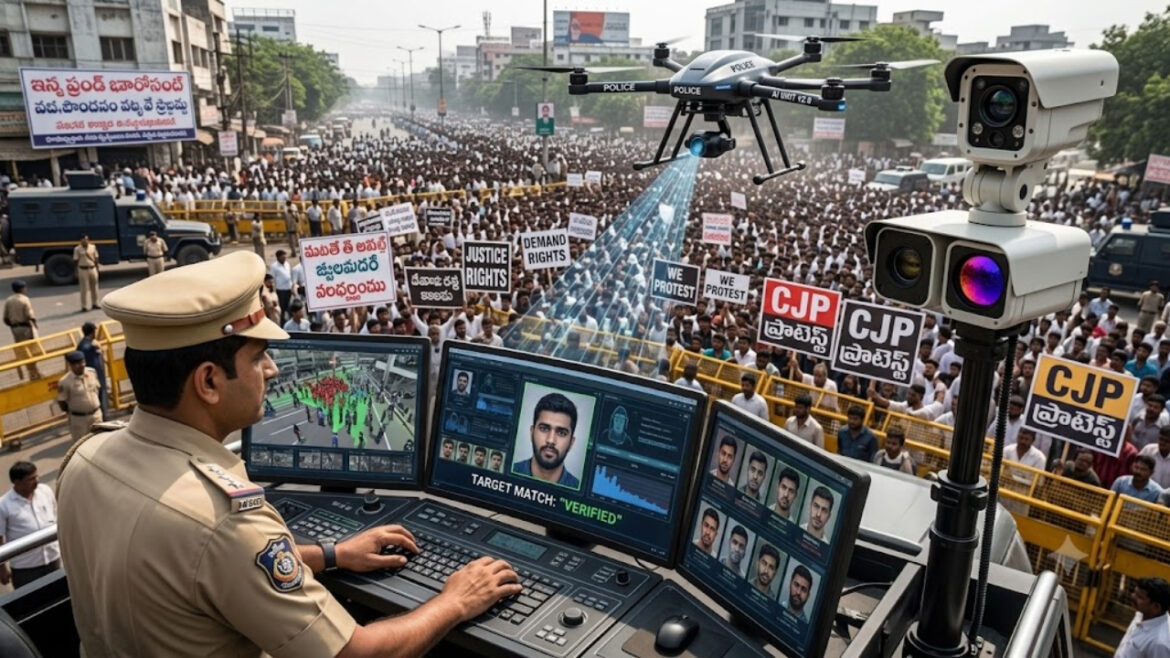
Police arrested nearly 2,500 people involved in rioting during the protests at Jantar Mantar in Delhi in just three days. However, this raised questions among many about how police managed to identify so many offenders within such a large crowd of thousands, and how exactly their criminal history was accessed. The answer lies in the fact that police used Facial Recognition Systems (FRS), artificial intelligence (AI), and algorithms to identify the accused in a short span of time.
FRS stands for Facial Recognition System. It is essentially an upgraded version of the “face lock” technology commonly used on smartphones. Just as fingerprints differ from person to person, the bone structure and measurements of every individual’s face are also highly unique. This FRS technology identifies key points on the face and generates a unique digital data profile. As a result, even if a person grows a beard, wears a mask, or puts on glasses, the system can still easily recognize their original face.
Delhi: Security has been heightened at the Jantar Mantar protest site as the Cockroach Janta Party's protest continues. Delhi Police have deployed AI-powered mobile surveillance vans equipped with Facial Recognition System (FRS) technology at the site pic.twitter.com/By9RRwVg96
— IANS (@ians_india) July 25, 2026
This technology recognizes faces through four distinct stages. In the first stage, CCTV cameras, drones, or special FRS vans installed in crowded areas and at protest sites capture clear images of people as they move. In the second stage, the camera performs a 3D mapping of the face, noting dozens of key data points such as the distance between the eyes, the length and width of the nose, the shape of the chin, the width of the forehead, and the distance between the cheekbones.
In the third stage, the computer combines all these measurements into a unique mathematical code, referred to in technical terms as a “face print” or “facial map.” In the fourth stage, this newly generated face print is compared by the computer against the police’s existing digital database of offenders, which includes photographs of previous criminals, individuals with court warrants, or those named in FIRs. If a match is found, an alert message is immediately sent to officials stationed in the control room.
This FRS system has become a powerful tool for security forces and investigative agencies. No matter how large or chaotic a crowd may be, offenders can be easily identified within seconds. Beyond this, the technology is also useful for locating lost children or elderly individuals at fairs and large public events. Notably, it also serves as evidence in courts to establish that an accused person was present at the scene of a crime.