





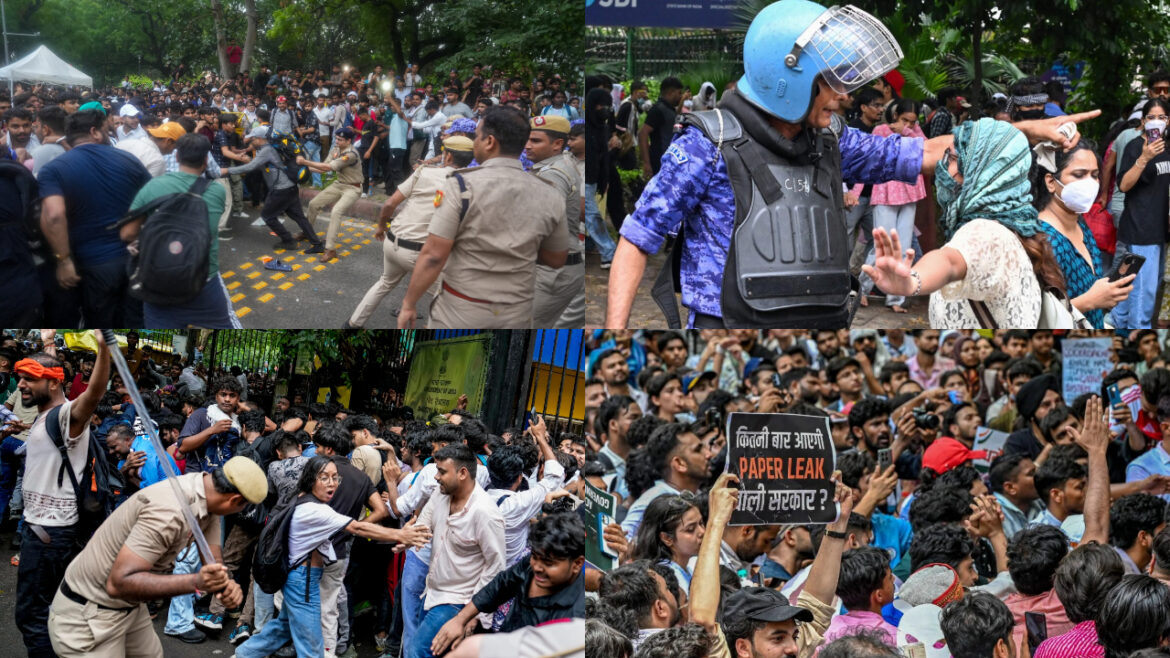
Protests organized by the ‘Cockroach Janata Party’ (CJP) against irregularities in the Union Education Ministry and the NEET paper leak issue led to severe tensions in the national capital, Delhi. A large number of students and CJP leaders took to agitation at Jantar Mantar, demanding the immediate resignation of Union Education Minister Dharmendra Pradhan. During this, when protesters attempted to march towards Parliament, security forces stopped them.
The clashes between protesters and police during the Parliament march eventually turned violent. Police resorted to a baton charge to bring the situation under control, while protesters threw stones, further heating up the atmosphere. In these riots, two Assistant Commissioners of Police (ACPs), six police personnel, and several protesters were seriously injured. These incidents made maintaining law and order in the capital a challenge.
Taking these violent incidents seriously, Delhi Police have moved to take extremely strict action against those involved in the rioting. Police made clear that, besides registering criminal cases against those who disrupted law and order and resorted to violence during the protests, they would also expedite the process of cancelling their passports. This decision is expected to have a serious impact on their future employment and foreign travel.
Police have accelerated the comprehensive collection of evidence for these actions. Those involved in the attacks and stone-throwing are being identified through CCTV footage obtained from the incident sites, media videos, social media, drone visuals, and other digital evidence. Security forces warned that while peaceful protest is permitted, those who take the law into their own hands and incite violence will not be spared under any circumstances.
Meanwhile, as a precautionary measure in view of the unrest, authorities issued an advisory that all shops, offices, and restaurants in Connaught Place (CP), Delhi’s major commercial hub, must close by 6:30 PM. This decision was taken by the New Delhi Traders Association (NDTA) on the instructions of New Delhi Municipal Council (NDMC) officials. It was stated that this emergency closure was meant to prevent property damage to businesses and to protect ordinary citizens. Due to the intensity of the public unrest, the metro transport system in the capital was severely affected for a second consecutive day. Citing security reasons, the Delhi Metro Rail Corporation (DMRC) announced the closure of 17 major, high-traffic metro stations until further orders. These include key stations such as Rajiv Chowk, Patel Chowk, Central Secretariat, Supreme Court, Mandi House, ITO, Delhi Gate, Khan Market, and Shivaji Stadium.
The sudden halt of metro services caused severe hardship for daily commuters and employees. Hundreds of passengers had to resort to alternative routes to reach their destinations. With a sudden surge in road traffic, buses, autos, and cabs got stuck in traffic jams for hours. This led to a significant increase in both travel time and financial burden for ordinary people.
To bring the situation under control, the Lieutenant Governor of Delhi granted additional powers to the police system. Orders were issued extending the preventive detention powers available to Delhi Police under the National Security Act (NSA) until October 18. According to a notification issued by the Delhi government’s Home Department on July 15, these special preventive powers were granted to the Police Commissioner under NSA Section 3(2).
Responding to the extension of these powers, a government official clarified that this was merely a routine renewal of powers that occurs every three months as per rules, and not an order issued specifically targeting the ongoing CJP protests. However, given the current law-and-order situation, this NSA provision is set to become an additional tool for police in controlling unruly mobs.
Even though the central government has assured that it is investigating the paper leak issue and will ensure entrance exams are conducted with utmost transparency in the future, CJP leaders and student organizations remain unsatisfied. They allege that the government’s statements and assurances are merely delaying tactics and do not offer a permanent solution to the problem. They have made it clear that their struggle will not stop until strict action is taken against those responsible.