





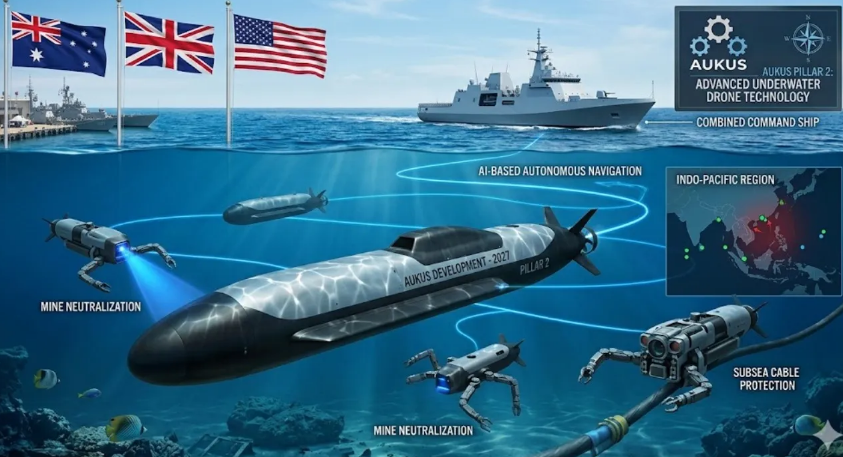
The AUKUS alliance comprising the United States, the United Kingdom and Australia has unveiled a major new defence initiative aimed at strengthening undersea security capabilities in the Indo-Pacific region amid growing concerns over China’s expanding military presence.
As part of the initiative, the three nations will jointly develop advanced unmanned underwater drone technology capable of detecting, tracking and responding to threats beneath the ocean surface. The partners have set a target of delivering the first operational capabilities of the project by 2027.
The announcement was made during the Shangri-La Dialogue security summit in Singapore by U.S. Defense Secretary Pete Hegseth, UK Defence Secretary John Healey and Australian Deputy Prime Minister Richard Marles.
The project is the first major programme to be launched under Pillar II of the AUKUS agreement, which was established in 2021 to accelerate cooperation in advanced defence technologies among the three countries.
According to officials, the unmanned underwater systems will perform a broad range of missions beyond conventional surveillance. The drones are expected to assist in detecting hostile submarines, neutralising underwater mines, conducting electronic warfare operations and supporting maritime security missions. The systems are also being designed with the capability to strike designated targets when required.
A key objective of the initiative is the protection of critical undersea infrastructure that underpins the global economy. Nearly 95 percent of the world’s internet traffic is transmitted through fibre-optic cables located on the seabed, while numerous international oil and gas pipelines also operate beneath the oceans.
Recent incidents involving damage to undersea communication cables in regions such as the Baltic Sea and the Taiwan Strait have heightened concerns among governments about the vulnerability of critical underwater infrastructure. AUKUS members believe enhanced undersea surveillance and response capabilities are essential to safeguarding these assets from potential threats.
To support the programme, the three countries are jointly developing advanced navigation and networking technologies that will enable the drones to operate independently in deep-sea environments where GPS signals are unavailable. The systems will incorporate artificial intelligence, advanced sensors and secure communication networks to enhance autonomous decision-making and mission effectiveness.
The AUKUS partnership operates through two principal pillars. Pillar I focuses on providing Australia with nuclear-powered submarine technology, while Pillar II is dedicated to the development of next-generation military capabilities, including artificial intelligence, hypersonic weapons, quantum computing, cyber technologies and autonomous systems.
Defence analysts view the latest initiative as part of a broader strategy to counter China’s growing naval influence in the Indo-Pacific region. Beijing’s expanding military activities in the South China Sea and around Taiwan have prompted the United States and its allies to strengthen maritime security cooperation and enhance deterrence capabilities across key sea routes.
China has repeatedly criticised the AUKUS partnership, arguing that the alliance risks undermining regional stability and could contribute to an arms race in the Indo-Pacific. Chinese officials maintain that such defence arrangements increase geopolitical tensions and threaten long-term regional peace.
The underwater drone programme represents a significant step in the evolution of undersea warfare and maritime security, highlighting the increasing importance of advanced autonomous technologies in shaping the future strategic balance in the Indo-Pacific region.