





- Ravi Prakash

Why do we buy bottled water? Because we believe it is safe water. Whether at an airport, a railway station, a restaurant, or a small roadside shop, when we feel thirsty we buy a bottle and drink it. We trust the brand. We trust the label on the bottle.
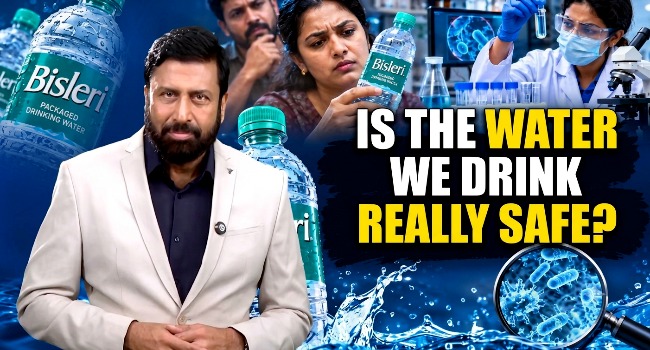
We never ask where the water in it came from or how it was purified. But what if the very water we drink believing it to be safe contains harmful chemicals? Exactly such questions are now being raised about Bisleri, one of the most recognised bottled water brands in the country.
The FSSAI, the government body that monitors the quality of food products in the country, has taken action over one sample from Bisleri’s Goa plant. Two types of chemicals, bromate and PAHs, have come into the controversy. But this is not just Bisleri’s story. For two decades, controversies have been erupting over the quality of bottled water in India.
What happened
The controversy began over one particular batch manufactured at Bisleri’s Goa plant. The batch number is JO270, with a manufacturing date of 27 September 2025. According to the FSSAI, a sample from this batch was first tested in a laboratory, where the bromate level was recorded at 0.012 mg per litre. The maximum permitted limit is only 0.01 mg, so the level was higher than the prescribed limit.
Bisleri challenged the result, and the sample was sent to a referral laboratory. This time, bromate was found to be within the limit, but another type of chemical, PAHs, was detected. Their level was recorded at 0.14 mg, that is, 144 micrograms per litre. Under the rules, when a company appeals, the referral laboratory’s result is treated as final. The FSSAI therefore banned the sale of that batch and granted permission for prosecution against the company.
What are bromate and PAHs?
In some cases, ozone gas is used to purify water. Ozone is useful for killing harmful microorganisms, but when it reacts with bromide that is naturally present in water, bromate can form. The process must be carried out very carefully, because bromate in high quantities is harmful to health and has been classified as a substance that may cause cancer.
PAHs, or polycyclic aromatic hydrocarbons, are produced when materials such as coal, oil, wood and tobacco do not burn completely. Some of them have been identified as causing cancer. That is why finding them in a drinking water sample is a matter of concern.
Bisleri’s stand
Bisleri does not accept the FSSAI’s allegations. It argues that the entire controversy relates to just one batch manufactured at the Goa plant. It says the FSSAI collected six samples and that there were differences between the results. In the later round of tests, PAHs were recorded in only one of the six samples, while another sample from the same batch passed all tests. The company says it got more tests done on PAHs and has objections to the differences in results.
On November 25, Bisleri presented its stand once again. It said the batch in dispute is not in the market at all, and that operations at its 143 plants across the country are continuing. Samples of batches manufactured later at the Goa plant also conform to quality standards, the company says.
The FSSAI, on the other hand, has clarified that its action is limited to one batch and one sample. It has directed the company to conduct a root cause analysis to identify how the problem arose. So one thing is clear: this does not mean that all Bisleri bottles are dangerous, nor that there are quality problems in all 143 plants.
Should we panic?
If you have consumed Bisleri even once, it does not mean you will get cancer. Monitoring is required. Over a period of a year, how much concentration of the compound you take in and how much dosage you consume will decide whether you actually get cancer. But this issue is a very important concern.
The FSSAI has done very good work, but I would request it to investigate other packaged drinking water brands available in the market as well. Are they actually safe or not? In India, the number of cancer patients is increasing so much. Could adulteration be a cause behind it? Only independent testing will tell us now.
The disputed September 2025 batch was consumed long ago, so there is nothing to panic about. Whatever damage has been done is done already. The issue now is between the FSSAI and Bisleri, which is the criminal prosecution. It is a deterrent so that the company does not do it again, and also a signal to other companies and brands that the same could happen in their plants. It alerts people too: before we consume, we should be careful about the brand, the packaging, and whether it is compliant or not.
Not the first time
Is this the first time such a controversy has arisen? No. In February 2003, the Centre for Science and Environment (CSE) conducted a study on whether bottled water contained pesticide residues. It tested 17 brands sold in Delhi and its surrounding areas and 13 brands sold in the Mumbai region. The results created a sensation across the country: pesticide residues were found in all brands tested except one.
In Delhi, the average level of pesticide residues was 36.4 times higher than the European standards used for comparison. In Mumbai, it was 7.2 times higher. Bisleri, Kinley, Aquafina and Bailey were among the brands tested. The report led to a major debate across the country, and the government ordered an inquiry into whether the standards in place were adequate and how they were being enforced.
In July 2003, the government announced stricter standards for pesticide residues in bottled water. But the story did not end there. In January 2004, BIS stop-marking orders were issued to more than 200 bottled water manufacturing units across the country. According to reports at the time, the number was 213. The reason was that they failed to submit test reports in line with the new pesticide standards, or failed to meet quality standards. The list included units of well-known brands. According to news reports, at least eight Bisleri units and three Kinley units also faced this action.
What we need to note is that the problem with bottled water quality was not confined to a single company. Questions were raised then about how the manufacturing process stood across the entire industry, how quality was being tested, and how far the rules were being followed.
The latest figures
In February 2025, in reply to a question in the Rajya Sabha, the Central Government disclosed details of tests conducted on bottled water. In 2022-23, officials tested 1,776 samples, of which 650 were found not to conform to the prescribed quality standards. In 2023-24, 1,300 samples were tested and 333 failed to meet quality standards. That means about 37 percent of samples in the first year and about 26 percent in the second did not conform. This number is very important.
However, one thing needs to be said clearly. If a sample is found to be non-conforming, it does not necessarily mean that it is poisonous. It only means that it failed to meet the prescribed standards. How serious the violation is may vary from case to case.
Even so, these figures place some questions before us. If so many samples are failing quality standards, are we conducting enough tests? Are factories being inspected regularly? Are we taking immediate action against companies that violate the rules?
Changes in regulation
There is another important point. Earlier, BIS certification was mandatory for manufacturing packaged drinking water and mineral water. In October 2024, the government amended the Food Safety Regulations and removed the mandatory BIS certification requirement. This should not be understood to mean that there is now no regulation on bottled water.
After that, through the FSSAI, the government classified packaged drinking water and mineral water as a high-risk food category. It brought in rules requiring mandatory inspections before granting licences to manufacturers and regular inspection of manufacturing units. In December 2025, the government also announced a special testing scheme for bottled water, which came into effect on 1 January 2026. Under it, manufacturers must get the prescribed tests done and maintain records.
So there have been changes in the regulatory system, but the real question lies in implementation. Are factories being inspected regularly? Are samples being collected independently? Are there laboratories capable of detecting chemicals? How quickly is action being taken against companies that violate standards? These are very important questions, because they relate directly to public health.
So let us come back to the bottle in our hands. You may buy Bisleri, Kinley, Aquafina or any other brand. The purpose of this story is not to create fear among people, nor to say that the water of all brands is dangerous. The real question is about consumer trust.
In 2003, the controversy over pesticide residues in bottled water erupted. In 2004, action was taken against more than 200 manufacturing units. Government figures themselves say that in 2022-23 and 2023-24, hundreds of samples failed to meet quality standards. Now, in 2026, action has been taken against one particular batch from Bisleri’s Goa plant.
Looking at all this, there is only one question we need to ask: how robust is the system that ensures the water we drink is safe? Companies should not expect consumer trust on the strength of their brand name alone. The government must conduct tests independently and make the results known to the public. Strict action must be taken if quality standards are violated. Companies, too, must state clearly what went wrong and what they are doing to ensure such a problem does not recur.
Because for millions upon millions of Indians, bottled water is not a luxury item; it is a daily necessity. We spend money to buy a bottle believing it to be safe. But when it comes to drinking water, trust alone is not enough. Every bottle and every batch must be proven safe through testing.